





An FGN bond coupon vs auction yield Nigeria comparison starts with the labels, not the larger percentage. A coupon applies to face value. A dated auction marginal rate describes that auction’s clearing result. A household’s cash outlay also depends on price, accrual and separately charged costs.
The DMO’s 16 November 2026 auction result provides a useful closed example. The March 2028 line retained its 21% coupon while its marginal rate was 16.8900%. Settlement was 18 November. These figures are historical auction evidence, not a current offer or return available to a reader.
FGN bond coupon vs auction yield Nigeria: read the four instrument rows
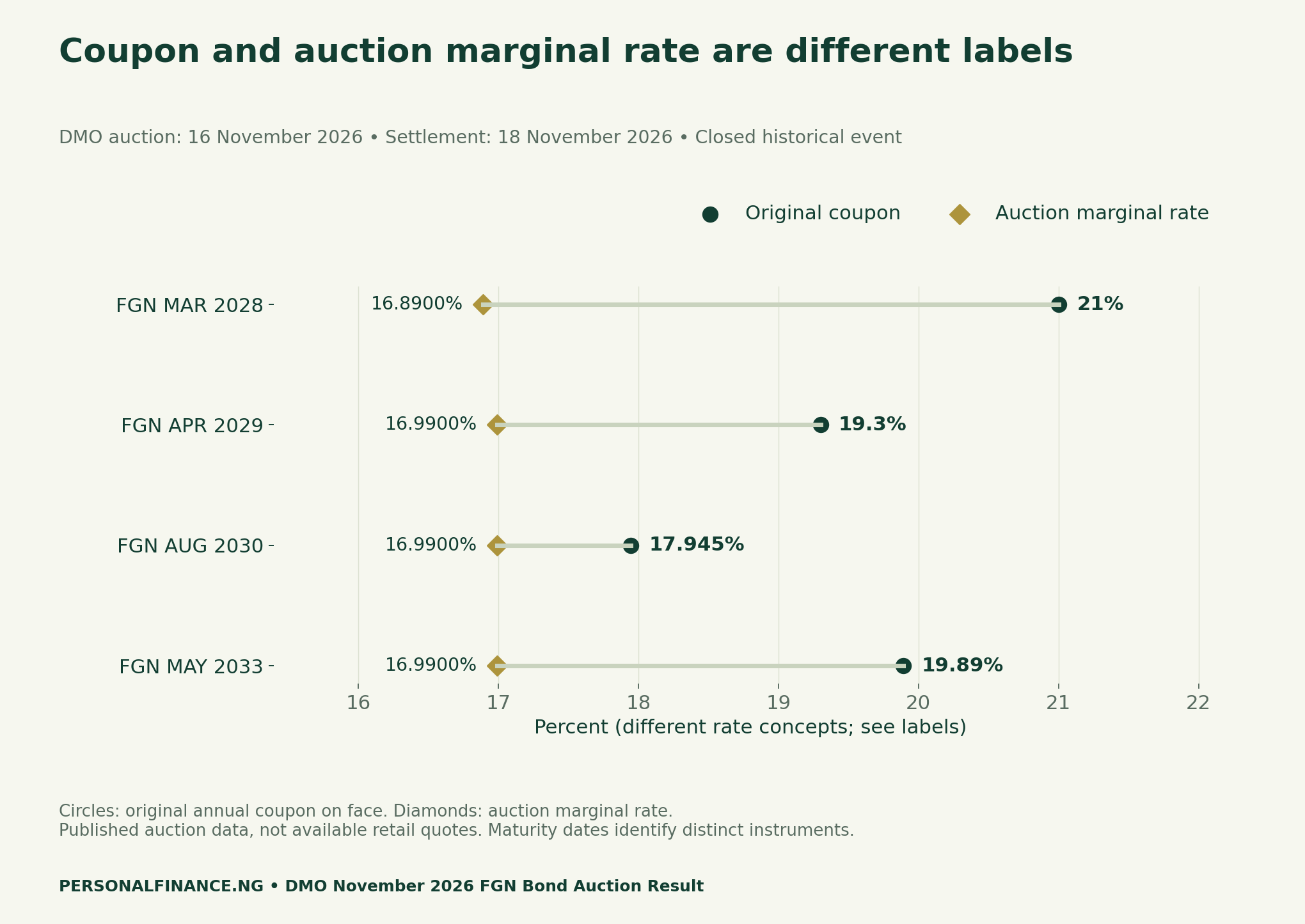
| Instrument | Original coupon | Auction marginal rate |
|---|---|---|
| 21.00% FGN MAR 2028 | 21% | 16.8900% |
| 19.30% FGN APR 2029 | 19.3% | 16.9900% |
| 17.945% FGN AUG 2030 | 17.945% | 16.9900% |
| 19.89% FGN MAY 2033 | 19.89% | 16.9900% |
Read each rate beside its instrument and date. Do not take the largest coupon, compare it with a savings account’s quoted rate and conclude that the bond delivers the larger return on your purchase cash. The denominator and remaining payment schedule differ.
Also distinguish original issue tenor from time left until maturity. A reopened bond can retain the name of a multi-year issue while much less time remains. Use the actual maturity date and settlement date in a quote decoder, rather than assuming a fresh full term starts when you buy.
A reopening keeps the coupon, while the price can differ
The November offer circular says reopening buyers pay a price corresponding to the clearing yield, plus accrued interest. It specifies a ₦50,001,000 minimum for that primary auction and ₦1,000 increments thereafter. Those auction terms do not automatically establish a broker’s secondary-market retail minimum.
This report concerns those reopened FGN bond lines. It does not substitute their auction access terms for FGN Savings Bond terms. When you ask a provider for a quote, identify the exact instrument and route first; similar names do not make the products interchangeable.
Before comparing two quotes, ask whether the price is per ₦100 or per ₦1,000 face, what face amount it buys and which settlement date applies. A price without its basis can create a tenfold reading error. Keep the quoted source and time so a later price does not silently replace an earlier one.
Turn a fictional quote into the cash needed now
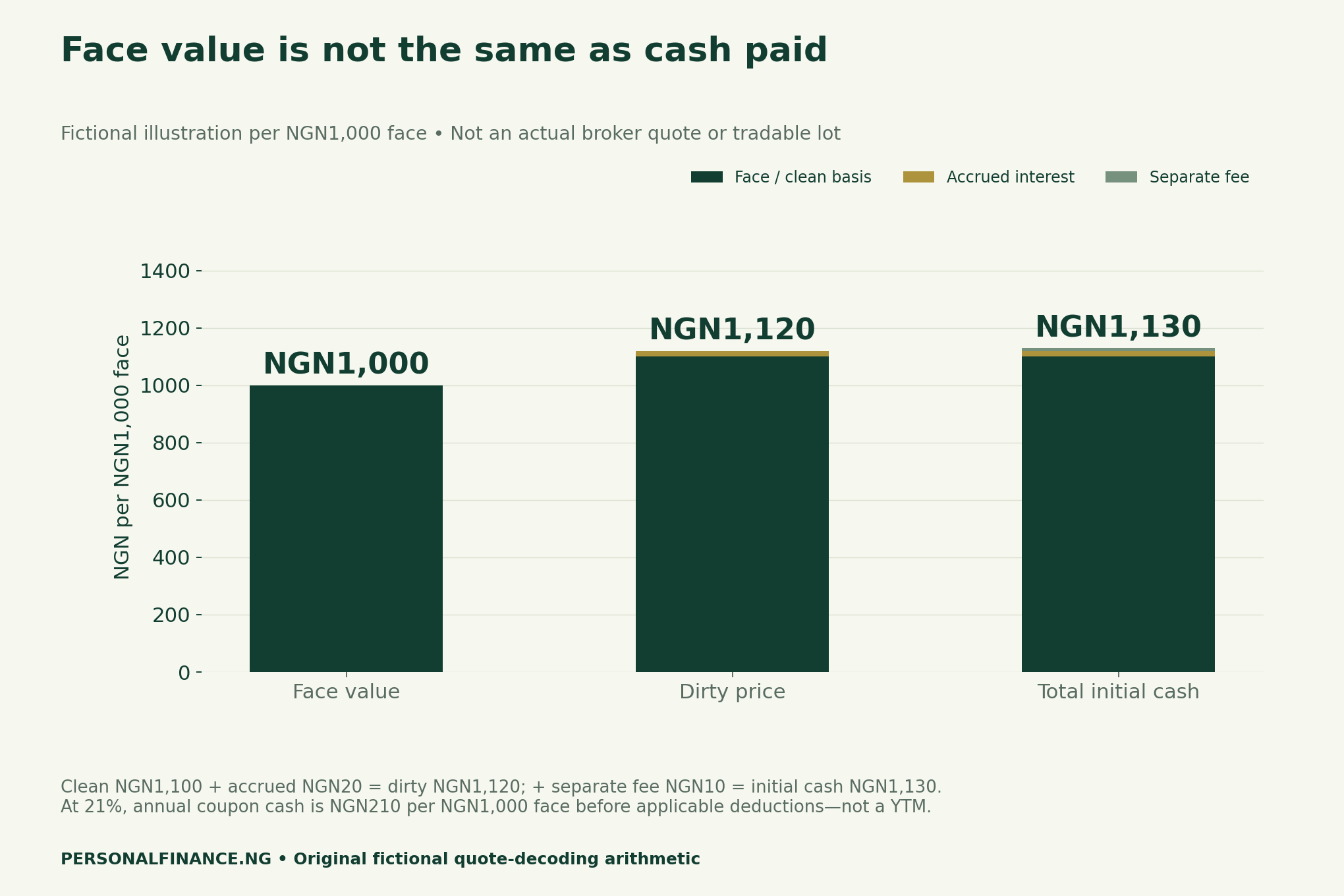
The DMO’s bond explanation distinguishes clean price, which excludes accrued interest, from dirty price, which includes it. Our invented example sets clean price at ₦1,100 per ₦1,000 face and accrual at ₦20. Dirty price is therefore ₦1,120. A separate fictional ₦10 fee makes initial cash ₦1,130.
The face amount stays ₦1,000 in that illustration. Applying a 21% annual coupon to it gives ₦210 of annual coupon cash before applicable deductions. Paying ₦1,130 does not change the face amount into ₦1,130 or make the coupon rate apply to that larger outlay.
The fee is an invented input, not a statement about a dealer’s actual charges. Likewise, the accrual is an arithmetic example without an assumed live settlement calendar. Ask for the real components and check whether a quoted total already includes a charge before adding it again.
Why coupon divided by price is not yield to maturity
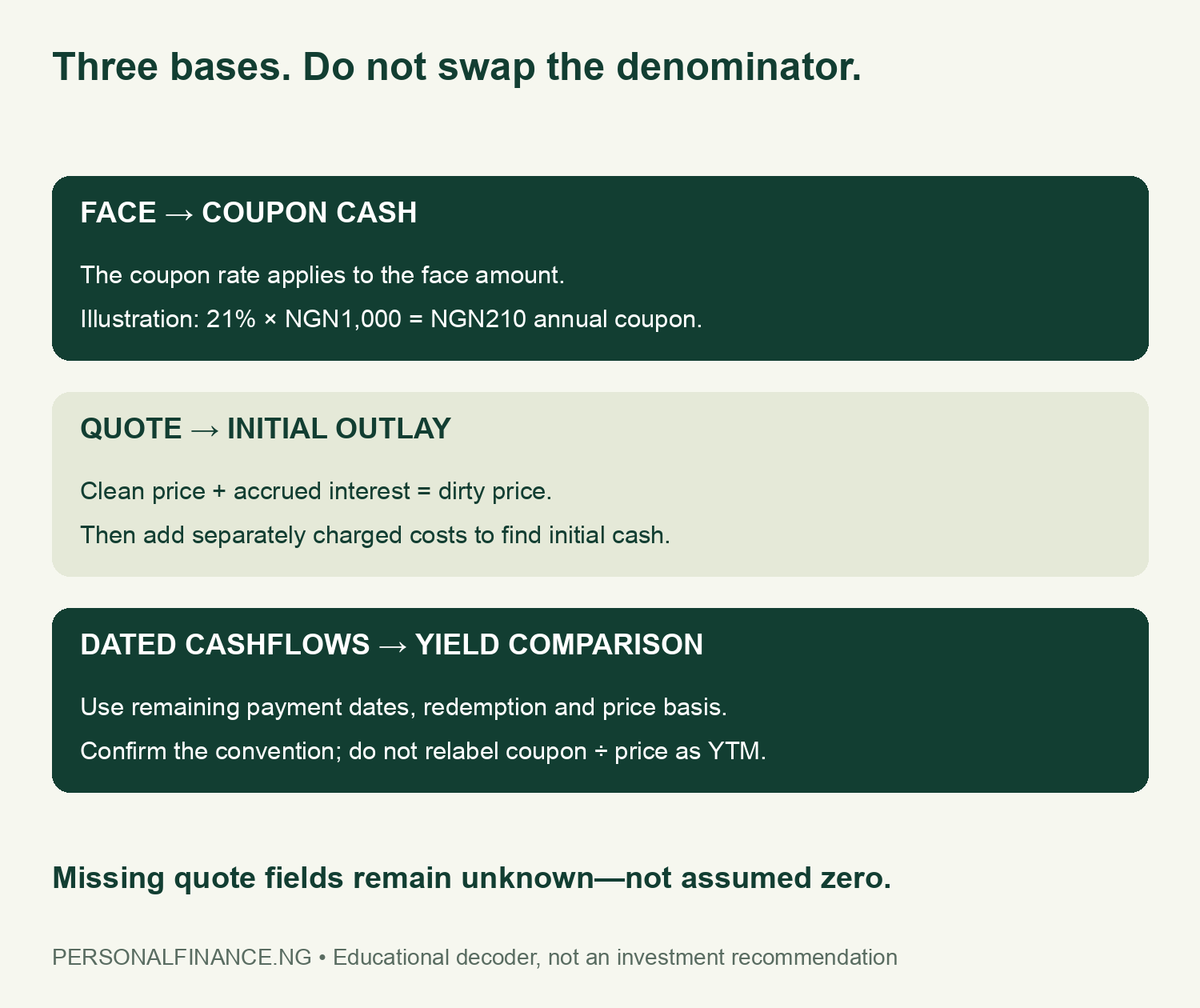
A yield-to-maturity calculation needs the remaining dated cashflows, the redemption amount, settlement and the stated yield convention. Dividing annual coupon by a clean price does not capture all of that. In particular, it does not account for the difference between purchase price and eventual redemption in the same way.
We therefore provide no numerical YTM for the fictional quote. There is no complete dated cashflow schedule or verified convention to support one. Ask the quote provider what its yield label means and which costs it includes before using it in a comparison.
Keep household timing separate too. If you may need cash before maturity, ask about the current exit bid, dealing costs and how a sale would work. Do not assume you can recover your original purchase cash at any chosen date, or treat an auction result as a guaranteed early-sale value.
Use a blank decoder before choosing what to compare
The worksheet records instrument identity, face amount, price basis, clean price, accrual, dirty price, separate fees and total initial cash. It then asks for settlement, dated coupons, redemption, yield label, relevant deductions, early-sale terms and your earliest possible cash need.
Put unknown fields in the missing-information column. A blank fee or accrual is not zero, and a published coupon is not a complete offer. Request a clear explanation through the provider’s official channel. This report does not recommend a trade, select an investment or establish a personal tax outcome.
Your Personalized Financial Plan
Get expert financial advice tailored exclusively to your goals. Receive a custom roadmap in just 1-3 business days.
Get StartedMethod, limits and downloadable quote tools
We transcribed the DMO table’s four instrument coupons, marginal rates and dates, then checked its offer terms and price definitions on 22 November 2026. The paired-dot chart is historical source analysis. The price-component chart and arithmetic are fictional educational examples, with no actual dealer quote or completed investment.
The CSVs retain the published rates separately from the invented quote components. For a different household comparison that also requires consistent cost bases, see our full-checkout price guide. A shared comparison principle does not make shopping and bond returns the same financial calculation.
- DMO November coupon, marginal-rate and date table (CSV)
- Fictional face, coupon and initial-cash components (CSV)
- Blank bond-quote decoder (CSV)
- Coupon, price and yield measure dictionary (CSV)
Sources: DMO November 2026 auction result, offer circular and bond price explanation. Suggested citation: Nigerian Personal Finance, “FGN Bond Coupon vs Auction Yield: Read the Quote Before Comparing Returns”, 22 November 2026. No current offer, personal advice or numerical YTM is asserted.


