





CNG bus fare savings Nigeria commute budget headlines can sound like money you can immediately spend elsewhere. A useful budget asks a narrower question: can the service carry you on the route, dates and hours you actually need, at a verified full journey cost?
The State House announcement of 19 November describes an approximately 40% fare-reduction target on participating routes. It envisages an initial 300-bus supply, with the first 100 expected in Lagos by end-December 2026. Arrival is not the same as a passenger timetable, a route allocation or a ticket you can buy.
CNG bus fare savings Nigeria commute budget: target versus usable service
Treat the announcement as a reason to gather information, not as a confirmed saving for every household. Your commute has particular endpoints, a start time and a return journey. A vehicle arriving in the country does not establish that it will serve any of those requirements.
First, find the official operator and route information. Then check the actual ticket price and operating start date. Finally, confirm hours in both directions and the days you travel. Keep the date of each check because an initial schedule can change as a service develops.
Do not use a social-media claim without tracing it to the operator. A photo of a bus does not establish passenger access, and a general statement about lower fuel costs does not tell you the fare. Leave missing information visibly unknown in the worksheet.
Compare a full journey, not only its main fare
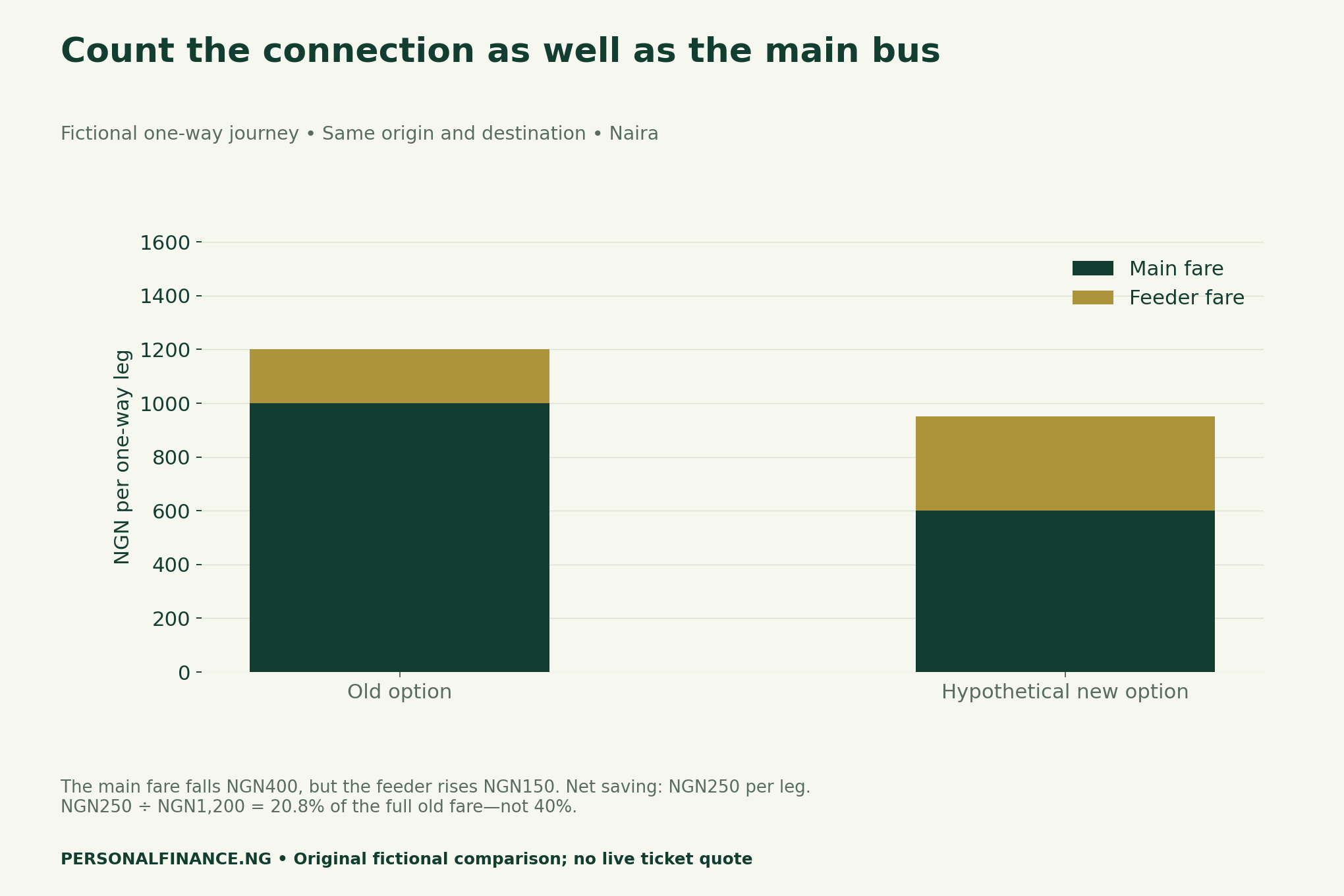
Consider an invented commute. The old main fare is ₦1,000 each way and the feeder costs ₦200, giving ₦1,200 per one-way leg. A hypothetical new main fare of ₦600 is 40% lower, but a ₦350 connection raises the new full-leg total to ₦950.
The net saving is therefore ₦250 per leg: ₦1,200 minus ₦950. Divide ₦250 by the old full total of ₦1,200 to get about 20.8%. Do not use the main-fare percentage as the household’s door-to-door reduction when the connecting cost changes.
For your own comparison, keep the origin and destination the same. Record each unavoidable fare rather than mixing a station-to-station price with a door-to-door price. If the new stop requires another paid connection, include it. Keep any unpriced item unresolved rather than silently treating it as free.
Three monthly budgets show why availability matters
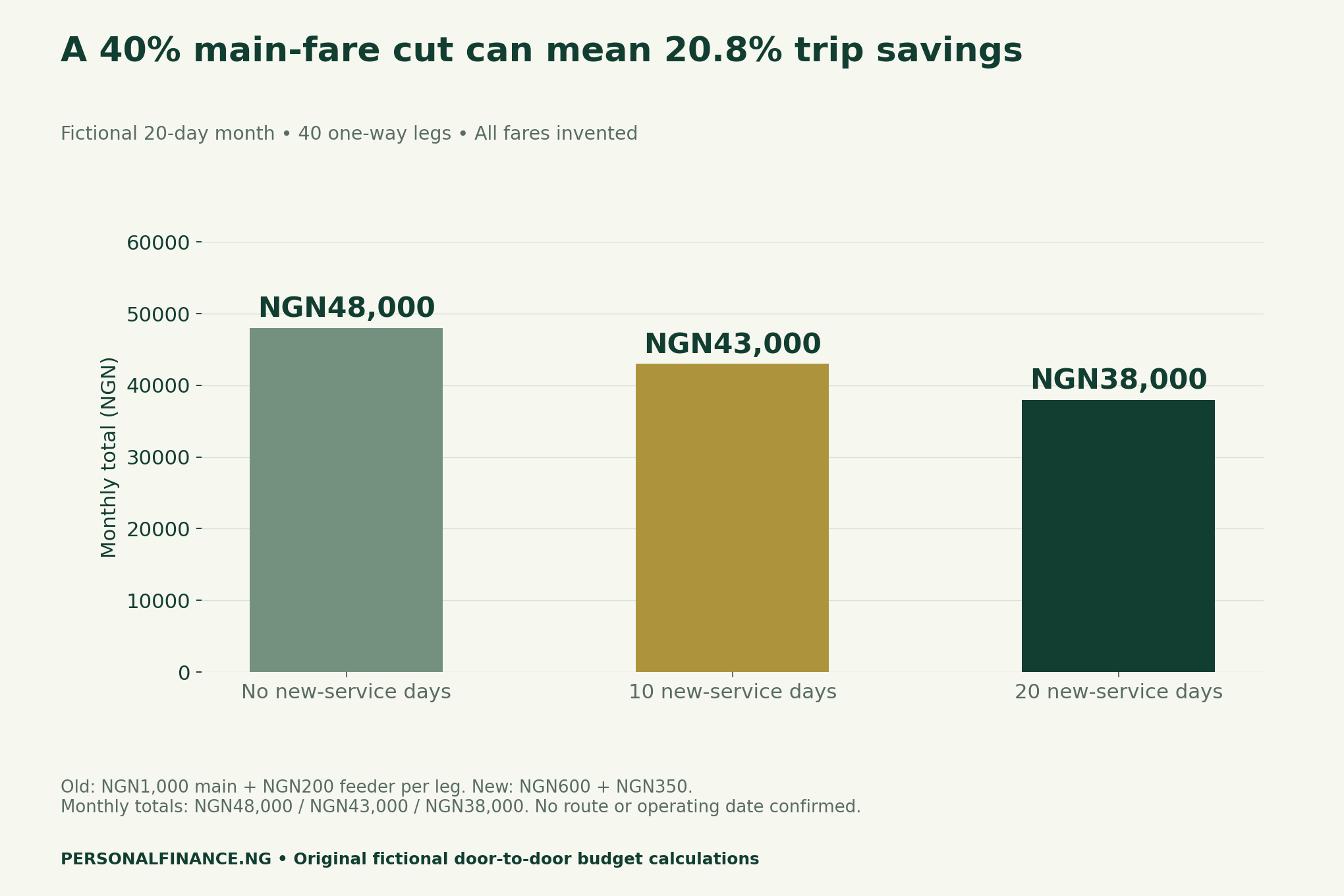
Assume twenty commuting days with two one-way legs each day. The old option costs 40 × ₦1,200 = ₦48,000. If the new option genuinely serves all twenty days, the total becomes 40 × ₦950 = ₦38,000. The fictional full-month saving is ₦10,000.
However, if the new option works for only ten days, twenty legs use the new fare and twenty use the old fare. The total is ₦19,000 plus ₦24,000, or ₦43,000. That saves ₦5,000 against the old month, not the ₦10,000 full-availability result.
This is arithmetic, not a forecast of disruption. We chose the three availability cases to show how a budget responds. The model assumes both daily legs fit the new option on a service day. If only one direction works, calculate each leg separately instead of counting the whole day as covered.
Use an evidence hierarchy before releasing fallback cash
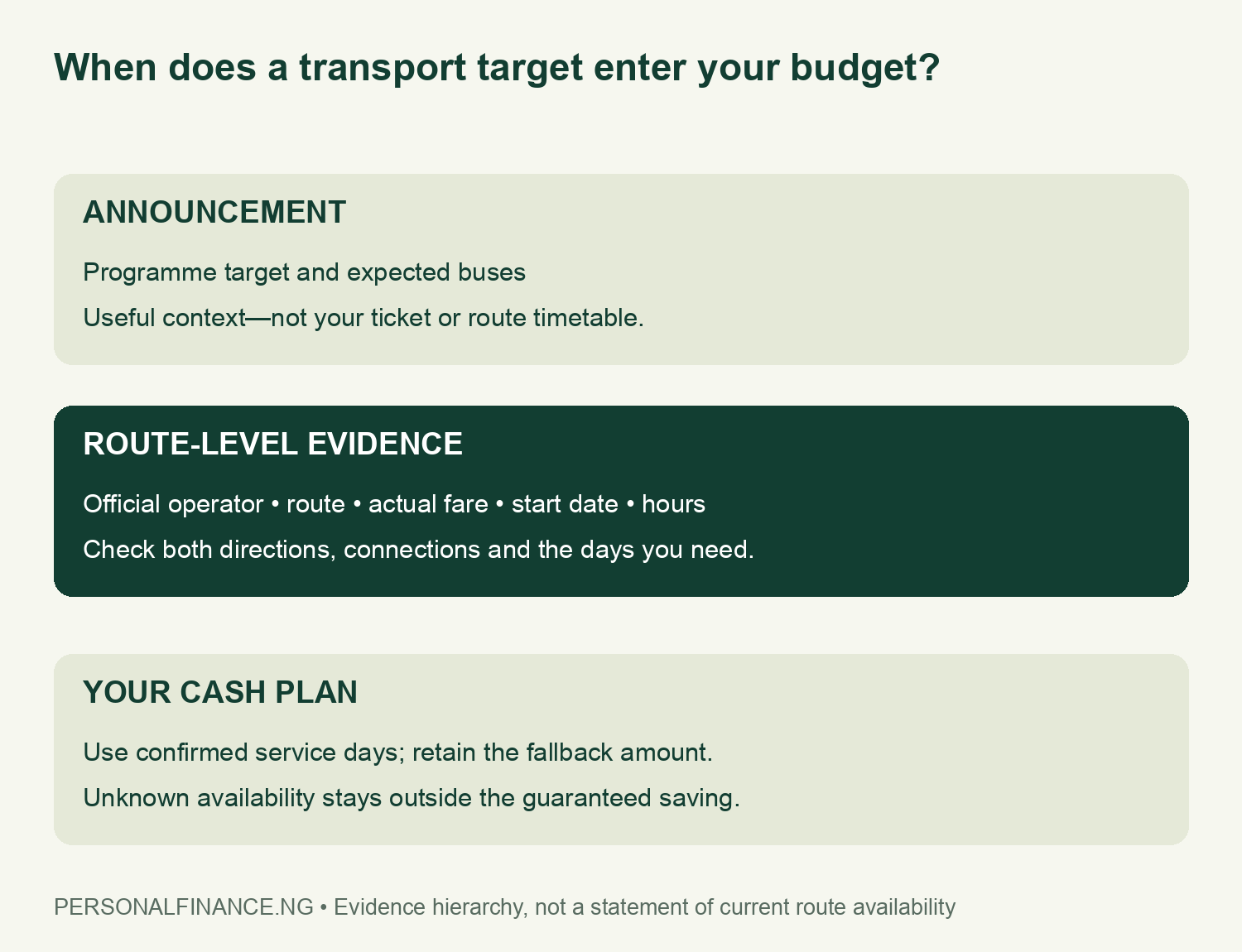
Keep a baseline budget for the journeys you still need. Add a second plan using only the new-service legs that you can support with route-level evidence. The difference is a conditional saving. Do not move that amount into another fixed commitment merely because a national target exists.
Also record a fallback that you can actually afford and use. A cheaper main ticket may have no value for a shift that starts before the first bus, or for a return trip after the last departure. Time and access remain practical constraints even when this worksheet measures cash fares only.
Review the first real tickets and journeys against your plan. If the fare or hours differ, update the record and recalculate remaining travel days. Keep actual spending separate from a forecast so you can explain why the month changed without presenting an invented service-performance statistic.
Method, limitations and free commute tools
We checked the dated State House release on 22 November 2026. The original model uses fixed invented fares and a twenty-day month. It includes main and feeder fares but does not estimate waiting time, missed work, discounts, route coverage or actual service reliability. No reader-specific operator or fare is confirmed.
Your Personalized Financial Plan
Get expert financial advice tailored exclusively to your goals. Receive a custom roadmap in just 1-3 business days.
Get StartedThe source register preserves announced quantities and their status. The calculation CSV shows every scenario input, while the blank worksheet lets you record your own dated evidence. For a separate household payment problem, our transfer-tracing guide explains why a debit and confirmed credit need different records.
- CNG announcement and status boundaries (CSV)
- Fictional 20-day commute calculations (CSV)
- Blank route and fare confirmation worksheet (CSV)
- Commute measure dictionary (CSV)
Source: State House, 19 November 2026, checked 22 November. Suggested citation: Nigerian Personal Finance, “CNG Bus Fare Savings: When Can You Change Your Commute Budget?”, 22 November 2026. All household amounts and scenarios are invented educational calculations, not ticket quotes or financial advice.


