





Comparing a salary increase with inflation in Nigeria needs matching dates and a clear pay basis. October’s lower annual inflation rate does not mean that prices returned to their old level. A pay rise can increase your naira income while still reducing what that income buys.
The National Bureau of Statistics release dated 16 November 2026 reports October headline inflation of 14.06% year-on-year, compared with 14.63% in September. Monthly inflation was 0.43%, up from 0.06%. We downloaded the official report and spreadsheet on 18 November and checked the calculations before building the tools below.
Salary increase versus inflation in Nigeria: the useful calculation
Use this exact formula: real pay change = (1 + nominal pay rise) ÷ (1 + inflation over the matching period) − 1. Enter both rates as decimals. Subtracting inflation from a pay rise is a rough shortcut; the ratio gives the exact change under the chosen benchmark.
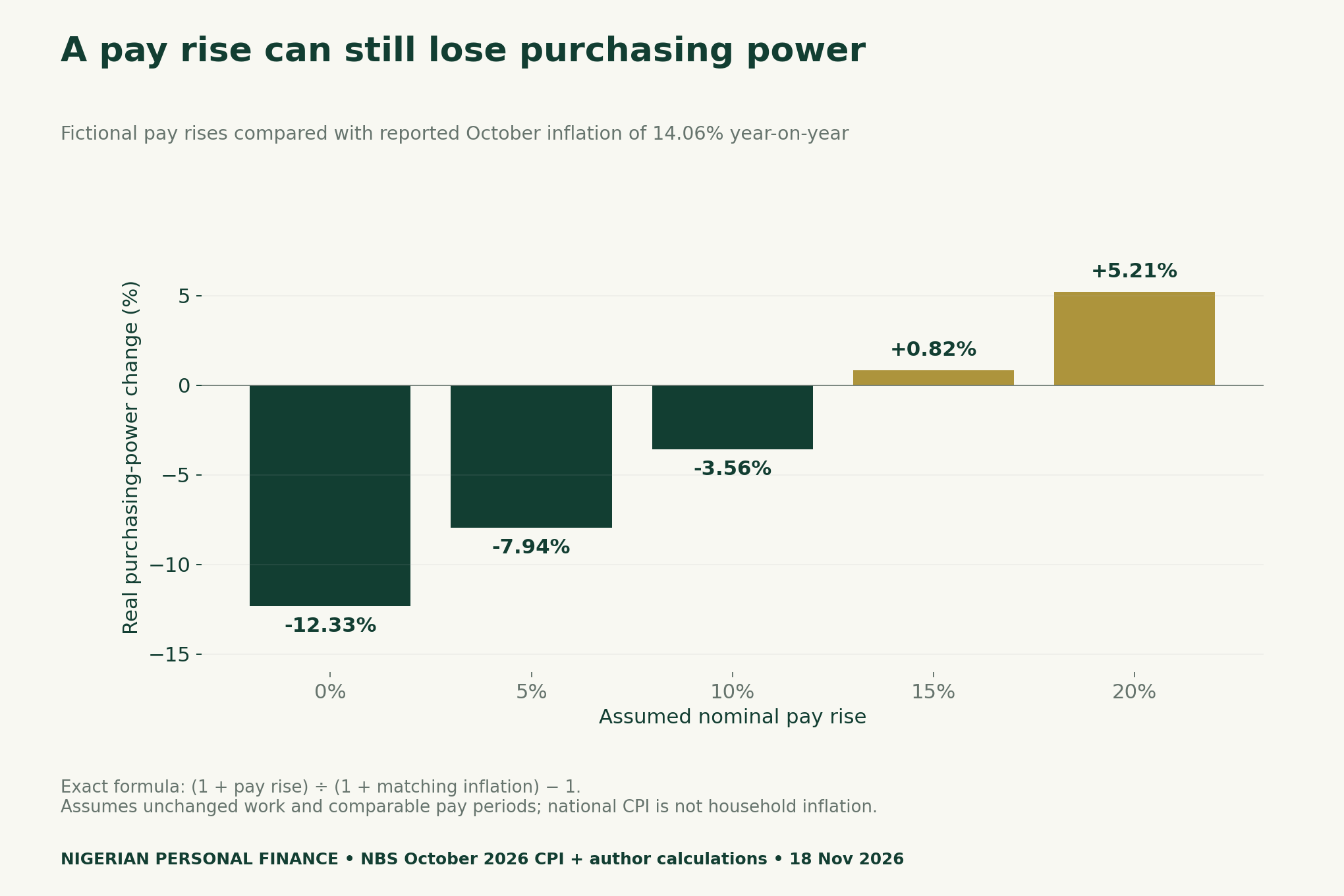
| Assumed rise | Real change at 14.06% inflation | Meaning under this benchmark |
|---|---|---|
| 0% | -12.33% | Purchasing power falls |
| 5% | -7.94% | Purchasing power falls |
| 10% | -3.56% | Purchasing power falls |
| 15% | +0.82% | Purchasing power rises |
| 20% | +5.21% | Purchasing power rises |
For example, a 10% rise produces 1.10 ÷ 1.1406 − 1, or about −3.56%. It does not produce an exact −4.06% change. The simple subtraction overstates the loss in this example. Neither result proves what happened to a particular household, whose spending mix may differ from the national basket.
What a fictional NGN 200,000 salary would need
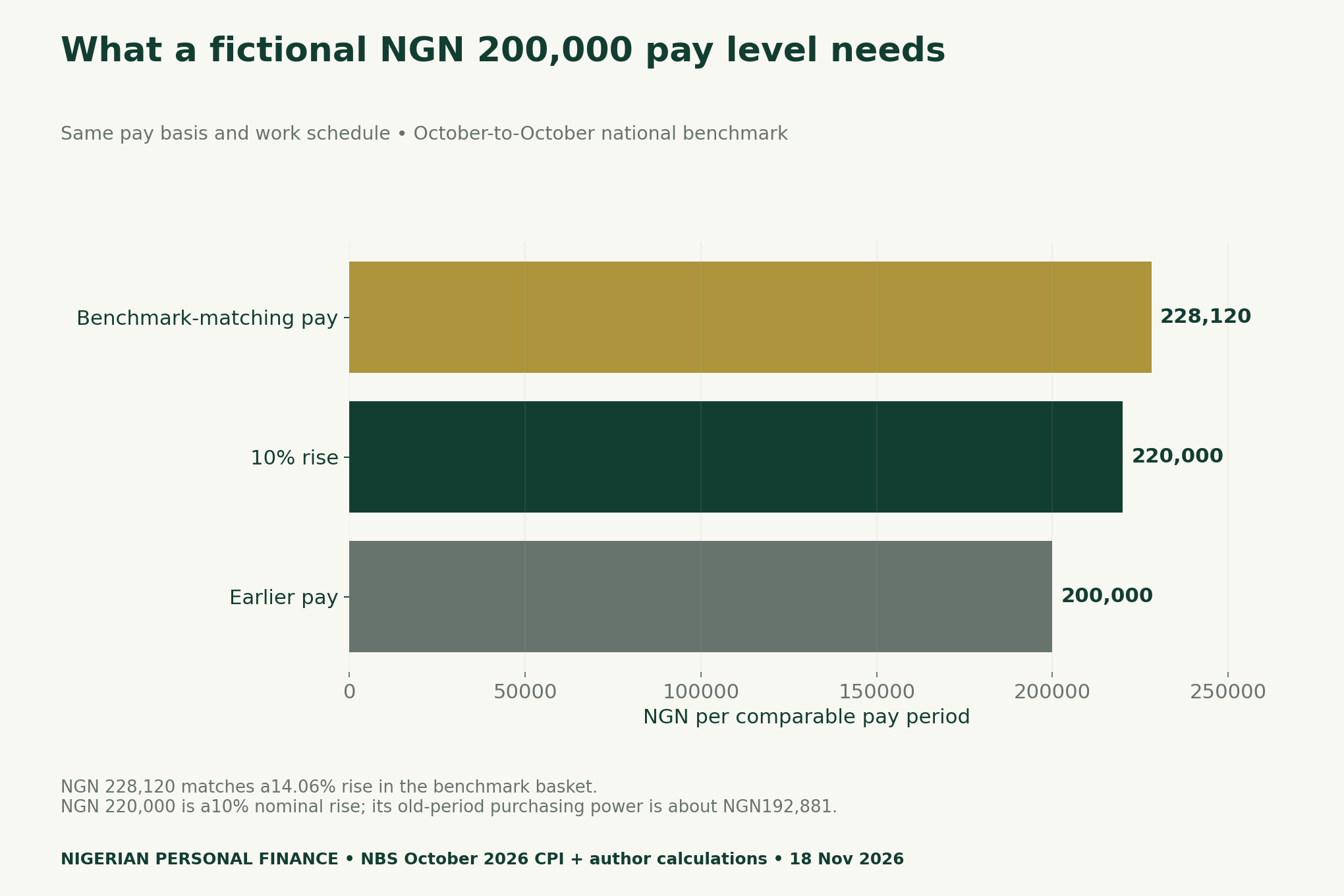
A fictional earlier monthly salary of NGN 200,000 would need to become NGN 228,120 to match a 14.06% increase in the benchmark basket. A 10% increase instead takes it to NGN 220,000. Dividing that new amount by 1.1406 gives roughly NGN 192,881 in the earlier period’s purchasing power.
This is a comparison tool, not a recommended salary demand or a claim that employers awarded a typical increase. It also does not calculate deductions, pension contributions or benefits. If your earlier figure is gross salary, use gross salary again; if it is take-home pay, compare like with like and explain any deduction changes.
Do not confuse easing inflation with cheaper living
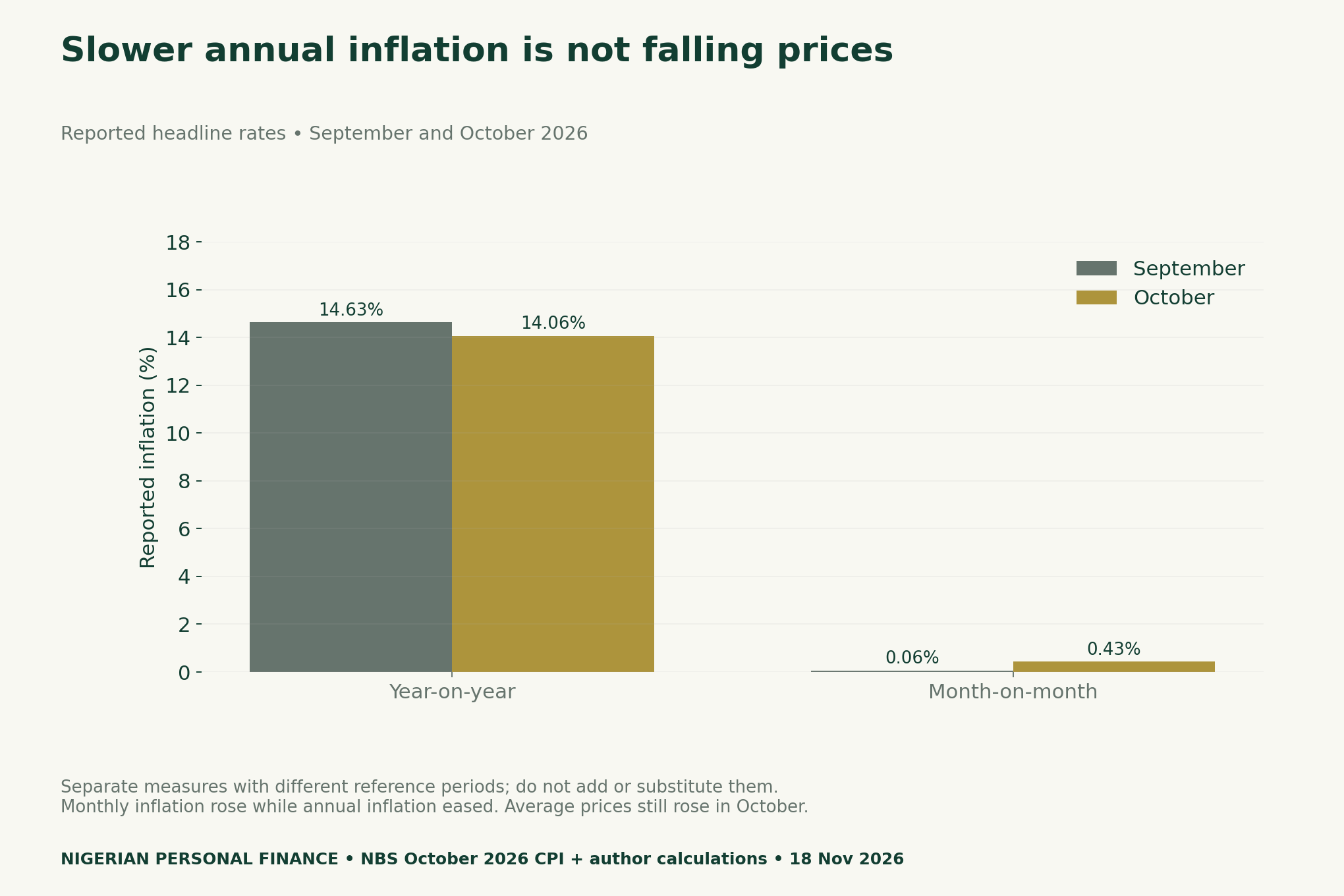
Annual inflation measures change from a year earlier. Monthly inflation measures change from the preceding month. October’s positive monthly rate means that the national average price level rose during October, even though the annual growth rate eased. Slower price growth is not the same thing as the general price level falling.
Also keep the twelve-month average measure separate. The release reports 15.40% for the average CPI of the latest twelve months relative to the previous twelve-month average. That is not interchangeable with October-to-October inflation. Choose the price period that matches the pay comparison you are actually making.
Match pay periods before using the headline rate
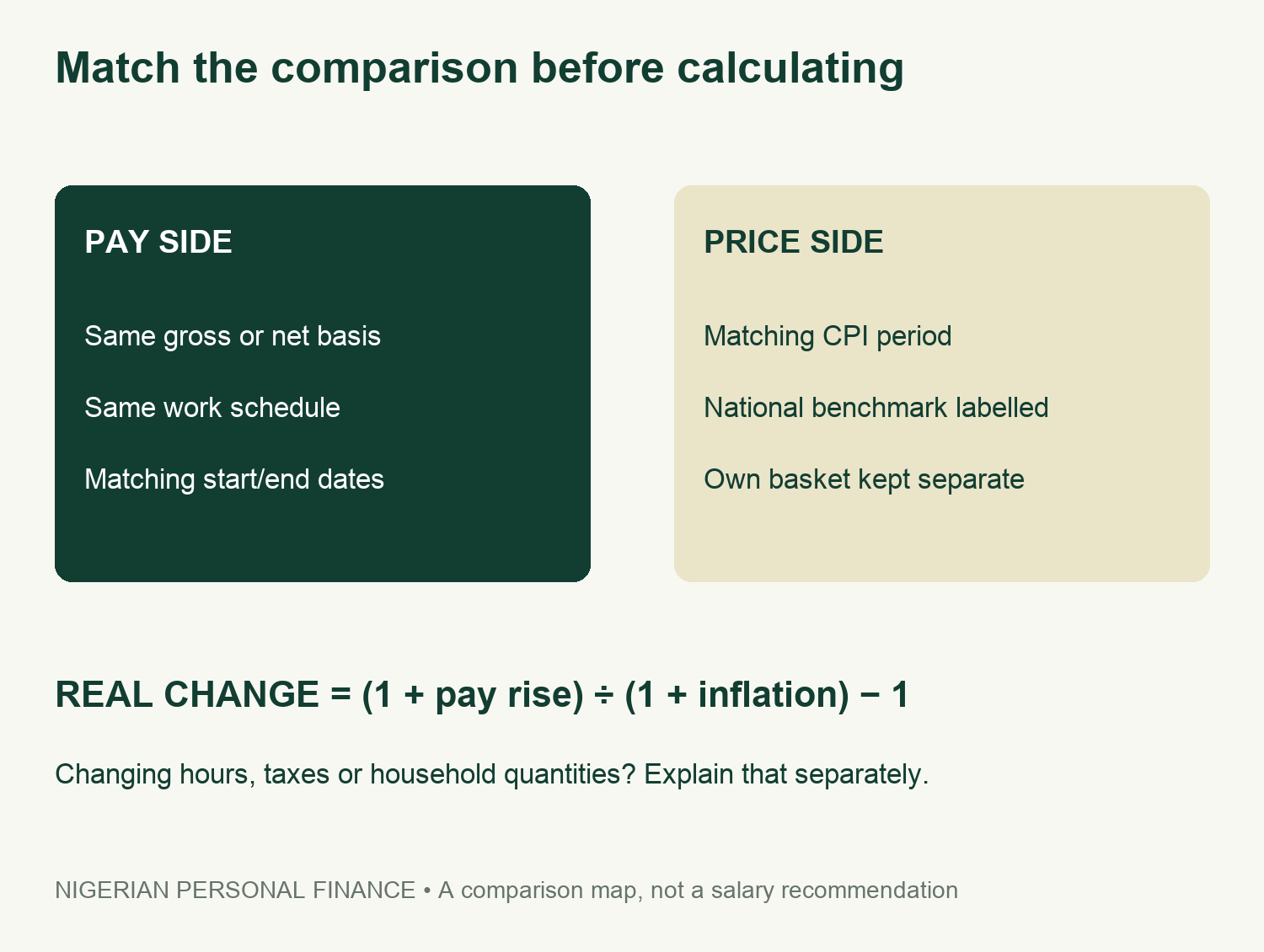
An October 2025-to-October 2026 pay comparison can use the corresponding annual CPI benchmark. A rise that started in March cannot automatically be measured against October’s annual number. For a different interval, use the relevant CPI index ratio and retain the source dates. Do not multiply one month’s rate by twelve and describe it as observed annual inflation.
Changing hours complicates the interpretation. More monthly pay after longer hours is not necessarily a higher rate of compensation. Likewise, a one-off bonus may improve this month’s cash flow without changing recurring salary. Record those changes separately rather than forcing every difference into an inflation-adjusted salary percentage.
For a private spending check, compare the same quantities and quality across dates. A larger grocery bill can reflect higher prices, more people, more goods or substitution. Keep receipts and note quantity changes. The blank household worksheet deliberately does not label its total as an official inflation rate.
Our guide to lifestyle inflation and savings considers spending choices after income changes. Use it alongside this price comparison: a change in lifestyle and a change in market prices are separate explanations for pressure on a budget.
Source audit: retain the levels, recalculate the changes
The official ZIP contains the 21-page report and its spreadsheet. In Table 1, the unrounded headline indices are 146.382021 for September and 147.015205 for October 2026. Their ratio reproduces 0.43255585% monthly inflation. The October 2025 index of 128.89 gives 14.06253782% annual inflation. Both round to the headline rates used here.
However, the report’s page 6 says the monthly rate increased by 0.38%. The displayed 0.43% and 0.06% rates differ by 0.37 percentage points. The spreadsheet’s unrounded rates differ by approximately 0.37649 percentage points, which rounds to 0.38. We therefore identify the rounding basis rather than treating the two calculations as interchangeable.
Similarly,18.97% minus 14.06% is 4.91 percentage points. This describes a change in inflation rates, not a 4.91% fall in the price level. Our source audit retains both the displayed figures and the calculation basis so another reader can reproduce the comparison.
Your Personalized Financial Plan
Get expert financial advice tailored exclusively to your goals. Receive a custom roadmap in just 1-3 business days.
Get StartedMethod, limitations and four downloadable tools
We use the national all-items CPI, with price reference year 2024 and expenditure-weight reference year 2023. The salary scenarios are fictional, use the rounded 14.06% reported rate, assume constant work and exclude tax effects. We do not rank states, estimate a household’s cost of living or predict future inflation. Source versions were checked on 18 November 2026.
- Fictional salary and real-change calculations (CSV)
- NBS source and rounding audit (CSV)
- Blank matching-pay-period ledger (CSV)
- Blank same-basket household worksheet (CSV)
Suggested citation: Nigerian Personal Finance, “Nigeria Inflation: Did Your Pay Rise Keep Up?”,18 November 2026. Primary source: NBS October 2026 CPI catalogue, report page 6 and spreadsheet Table 1. Original calculations, charts and private worksheets by this publication. Retain the matching reference period when reusing a figure.