






A petrol price comparison in Nigeria needs the travel cost as well as the posted price. A farther station may save money on each litre while costing more fuel to reach. The useful calculation subtracts the genuinely extra journey cost from the saving on the purchase you already planned.
This guide uses a dated regulator statement for context and original fictional scenarios for the arithmetic. Two charts, a decision infographic and four CSV tools make the assumptions reproducible. They are not live station quotes, a price forecast or a reason to buy more petrol.
What FCCPC reported—and when
The FCCPC statement dated 10 November 2026 reported petrol price ranges of ₦1,405–₦1,420 per litre in Abuja and ₦1,325–₦1,370 in Lagos while describing its monitoring work. Those are dated reported ranges, not prices checked at particular stations today, a national average or a legal price cap.
Keep the observation date beside any quoted price. A comparison can become outdated when a price changes, a station has no fuel or a queue alters the journey. Do not treat a monitoring statement as a guaranteed future price reduction or evidence that a particular retailer has broken the law.
Petrol price comparison Nigeria: start with gross saving
Subtract the alternative station’s price from the usual station’s price. Multiply that gap by the normal safe purchase volume you already intended. The result is the gross pump saving before any extra trip cost. If the gap is not positive, there is no pump-price saving in that direction.
For a fictional usual price of ₦1,400 and alternative price of ₦1,350, the gap is ₦50 per litre. Buying a planned 20 litres produces a gross saving of ₦1,000. These inputs are chosen to explain the method; they are not verified quotations or a claim that either station exists.
Count the extra distance, not the whole journey
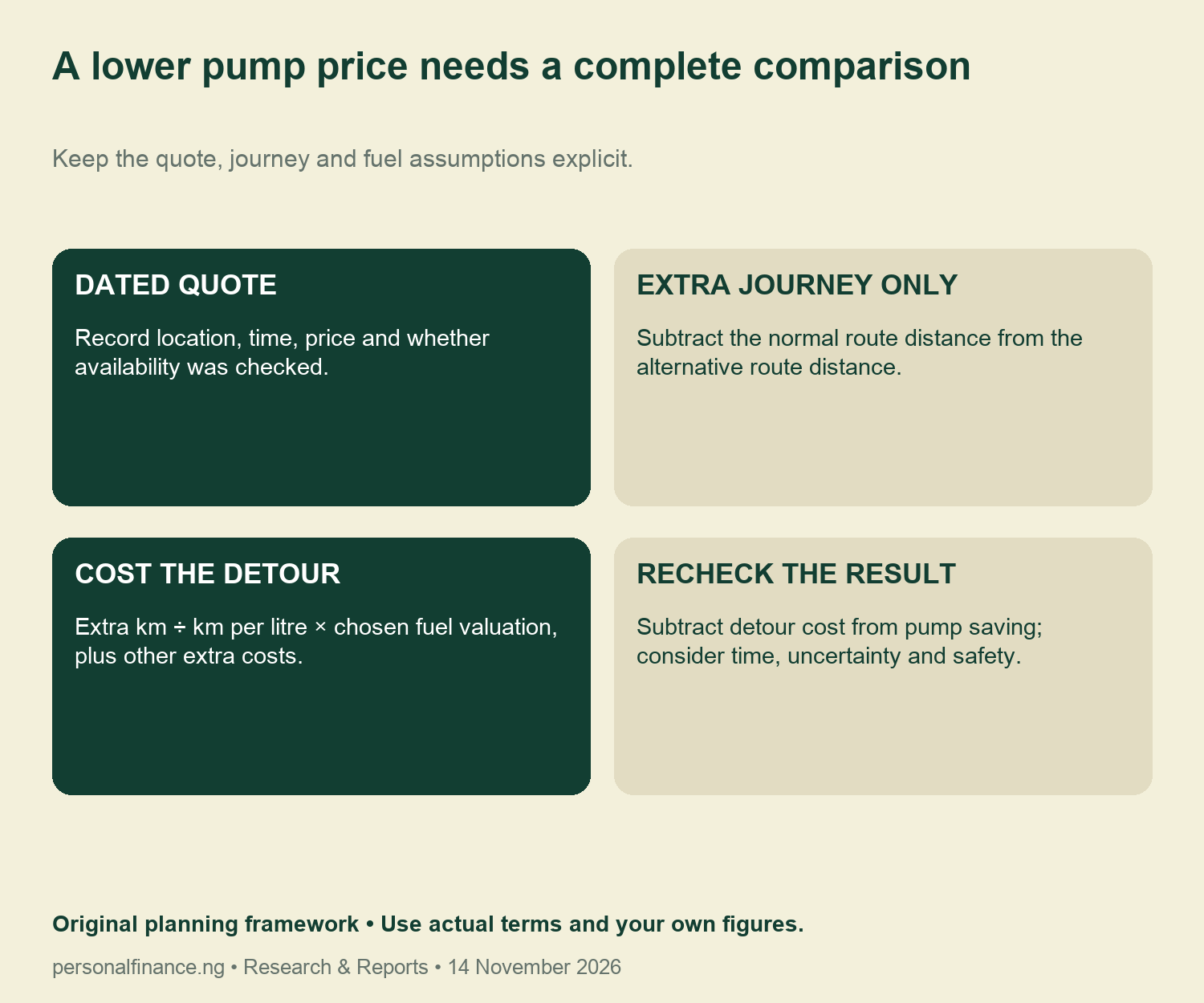
Compare the route you would normally take with the route needed for the alternative. If the usual trip is 6 kilometres and the alternative trip is 14 kilometres, the extra distance is 8 kilometres. Costing all 14 kilometres as an added expense would include travel that was going to happen anyway.
If the station is genuinely on an already planned route, the extra distance may be small. It is still worth considering extra queuing, idling or other costs. Conversely, an entirely separate journey may add far more distance than the straight-line gap between the stations.
Work through the fictional 20-litre example
Assume the extra 8 kilometres uses fuel at 10 kilometres per litre. That adds 0.8 litre of consumption. Valuing it at the fictional ₦1,350 per litre gives ₦1,080 of travel-fuel cost. The ₦1,000 gross saving minus ₦1,080 leaves a loss of ₦80 before time, tolls or other incremental costs.
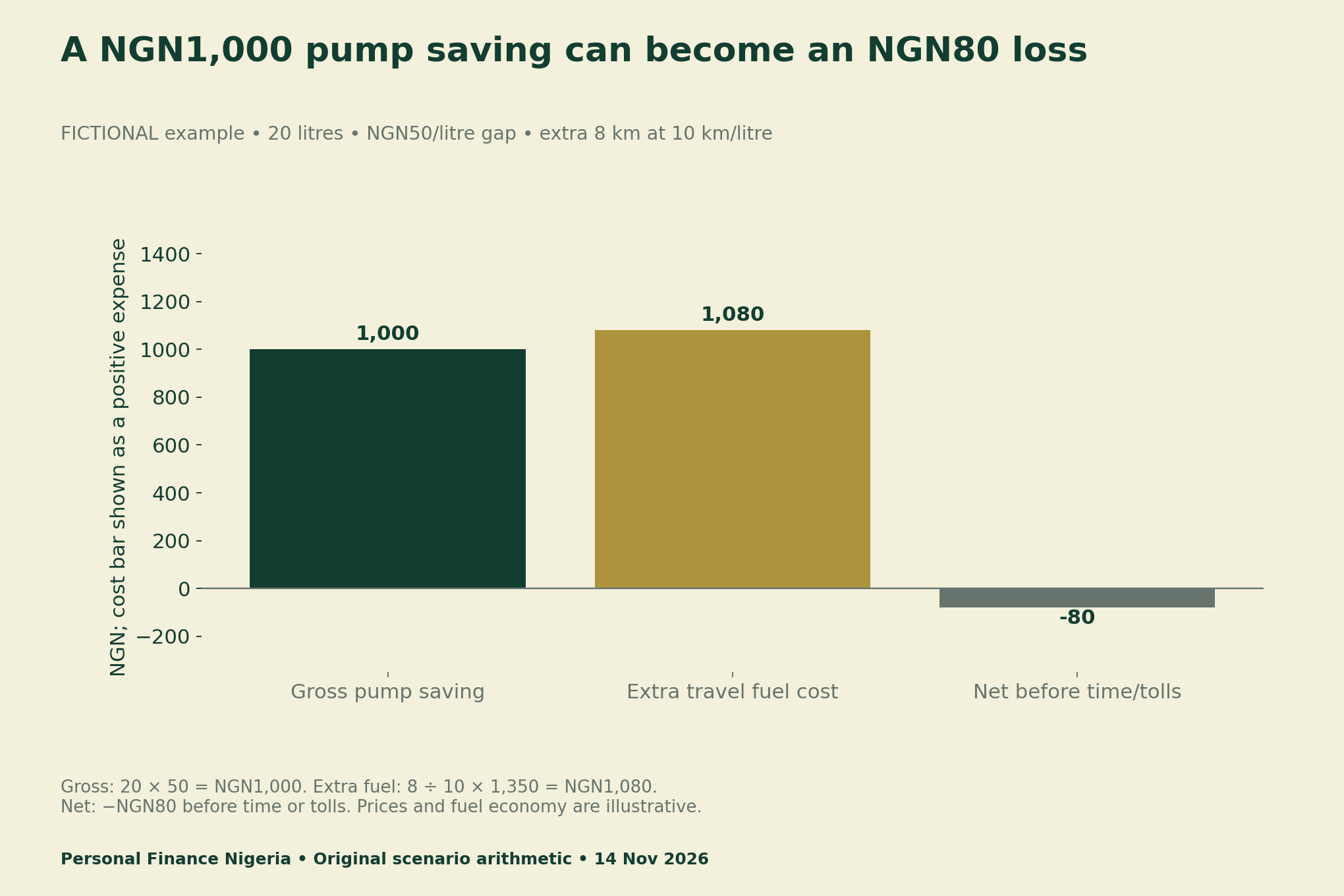
Write the fuel valuation assumption down. We use the alternative purchase price for this example. A reader using another replacement-cost basis should label it and recalculate. The important point is consistency: neither free travel fuel nor an unexplained change in valuation belongs in an auditable comparison.
Test sensitivity without turning it into a shopping target
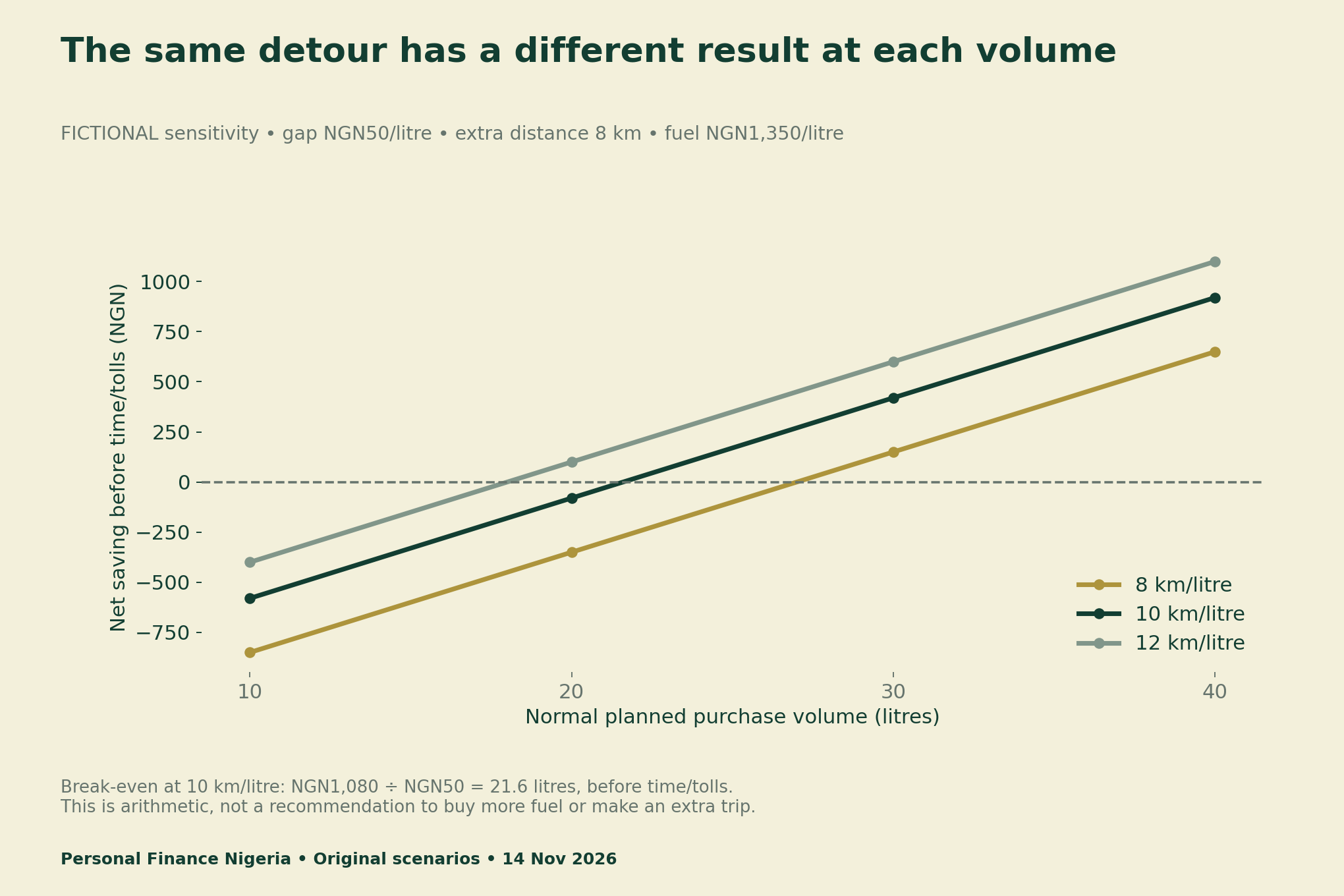
At the 10-kilometres-per-litre assumption, dividing ₦1,080 travel cost by the ₦50 price gap gives a break-even volume of 21.6 litres before other costs. That threshold explains the model; it is not a target. Keep the purchase volume tied to your normal safe requirement rather than buying extra to make a detour appear worthwhile.
Fuel economy also changes the result. At 8 kilometres per litre, the same extra journey consumes more fuel than at 12. Traffic, idling, load and actual vehicle condition can move consumption away from the chosen assumption. Use a realistic record where available and label an estimate when it is only an estimate.
Add time, charges and uncertainty deliberately
Subtract any genuinely additional toll, parking or other charge. If you choose to put a money value on time, state the assumption separately so the reader can see the result before and after it. A small positive calculation before time is not a guaranteed worthwhile trip.
Recheck the quote and availability before relying on them. A lower advertised price is of little use when unavailable or out of date. Avoid unnecessary journeys and unsafe fuel transport or storage; this worksheet does not justify carrying petrol or purchasing beyond normal safe requirements.
Download the petrol-price comparison tools
- FCCPC dated reported-price register (CSV)
- Fictional detour and fuel-economy scenarios (CSV)
- Blank dated petrol-quote ledger (CSV)
- Blank incremental-travel break-even worksheet (CSV)
Our mobile-data budget guide likewise compares the full cost rather than one advertised price. The auction worksheet shows how transport and other charges can change a purchase decision.
Your Personalized Financial Plan
Get expert financial advice tailored exclusively to your goals. Receive a custom roadmap in just 1-3 business days.
Get StartedMethods and limitations
We checked the FCCPC statement on 14 November 2026 and preserved its statement date. Its reported price ranges are context only; they are not substituted into our fictional example. The scenario file varies normal purchase volume and fuel economy while holding the price gap, extra distance and fuel valuation constant.
The model does not predict prices, traffic, vehicle performance or fuel availability. The result changes when its inputs change, and unpriced time remains excluded. Suggested citation: Personal Finance Nigeria, “Petrol Price Comparisons: Does the Cheaper Station Save Money After Travel?”, original incremental-cost analysis and CSV tools. Cite FCCPC for the dated monitoring statement.