





A bulk maize purchase cost per usable kilogram Nigeria comparison needs more than the price written on a bag. Define how much your household will use, over what period, and how much cash must remain for other bills. A lower sticker price can fail either the quantity test or the cash-timing test.
The 18 November government release discusses the wet-season Agricultural Performance Survey and planned distribution of stored commodities, with modalities still to be announced. That is policy context, not proof of a particular shop price or a household entitlement to grain.
Bulk maize purchase cost per usable kilogram Nigeria: keep harvest data in scope
ABU’s NAERLS account of the survey presentation, published 19 November, reports expected cereal output of 29.39 million tonnes, up 1.84%, with maize and rice expected to drive the increase. The quantity covers cereals, not maize alone, and the percentage concerns production rather than retail prices.
The government release also says a separate dry-season assessment was planned. Do not turn a wet-season outlook into a complete annual household-price forecast. A national output expectation does not establish the actual weight, quality, delivery charge or availability of a bag offered to you today.
Instead, collect dated comparable quotes. Record the bag’s actual stated weight, the seller, the cost and any delivery or storage charges. Keep the time horizon fixed so you do not compare a month’s bulk purchase with only a week of small purchases and call the difference a saving.
Start with an invented twenty-kilogram need
Suppose a household needs twenty kilograms within a defined period. In our fictional example, each five-kilogram small lot costs ₦9,000. Four lots total ₦36,000, giving a benchmark of ₦1,800 per kilogram. A twenty-kilogram bag costs ₦31,000 plus ₦1,500 delivery and storage, or ₦32,500 upfront.
With no shortfall, the bulk path saves ₦3,500 against the four small lots. Its initial full cost per kilogram is ₦1,625. These prices are invented for arithmetic; they are not a survey of Nigerian maize sellers, a market forecast or a quote readers can obtain.
A usable-quantity comparison asks what happens if the larger purchase does not cover the intended need. Shortfall can reflect a quantity mismatch or other unavailable usable quantity. We do not estimate a household loss rate or assume that a particular storage method is safe.
Stress-test replacement costs before counting the saving
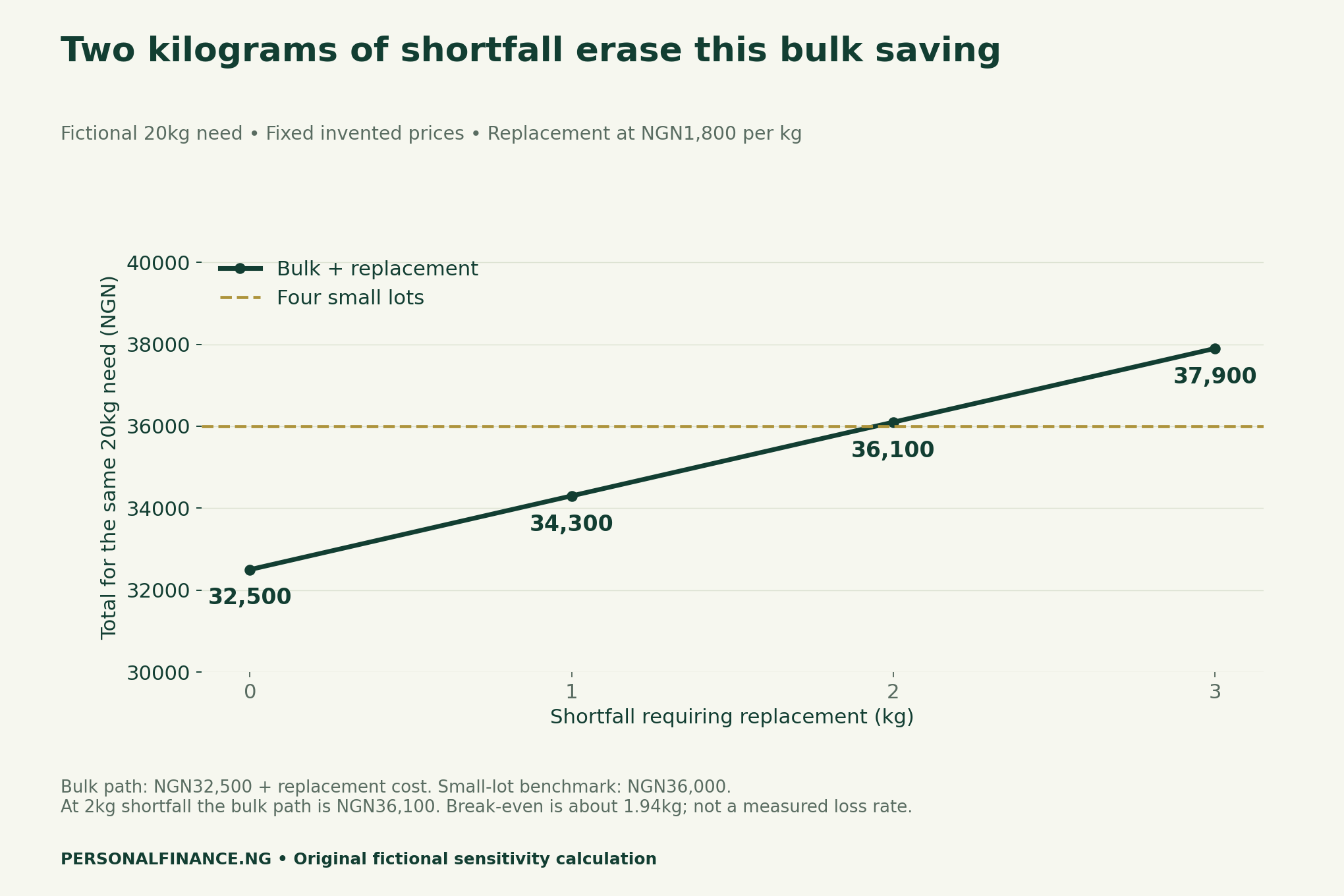
At two kilograms of shortfall, replacement costs 2 × ₦1,800 = ₦3,600. Add that to ₦32,500 and the bulk path reaches ₦36,100. It now costs ₦100 more than the ₦36,000 small-lot benchmark. The initial saving has disappeared even though the bag’s sticker price has not changed.
The break-even shortfall is ₦3,500 ÷ ₦1,800, or about 1.94 kilograms. This threshold belongs only to the fixed fictional prices. A different bag cost, delivery charge or replacement price changes it. It is not a measured spoilage percentage or a prediction about your food.
If your issue is avoidable surplus rather than replacement, record that separately. Buying more than you expect to use can tie up cash even without a physical loss. Do not force that case into this replacement model; compare a quantity that actually matches the household’s defined use window.
Check the cash needed today, not only the eventual total
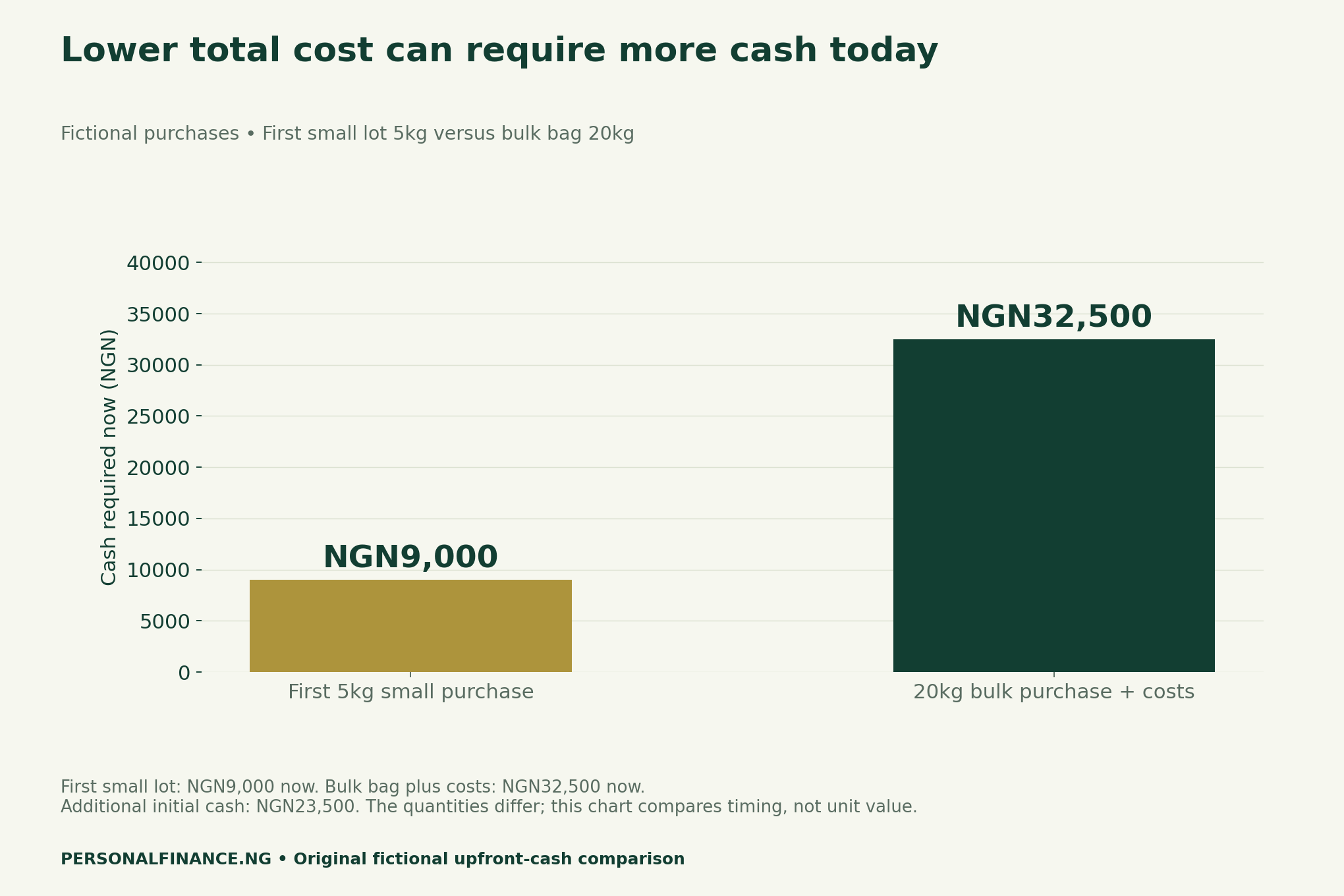
The smaller-purchase path begins with ₦9,000, while the bulk option asks for ₦32,500 now. That is ₦23,500 more cash at the first purchase. Even if the eventual bulk total is lower, the timing can leave too little for transport, rent, medicine or another payment due before the next income arrives.
Set a bill-pay cash floor before choosing. Record available cash, subtract the full purchase outlay and compare the remainder with that floor. Do not count an uncertain future saving as cash already available. If the larger purchase breaches the floor, the lower eventual total does not solve the immediate constraint.
Apply both gates to your own dated quotes
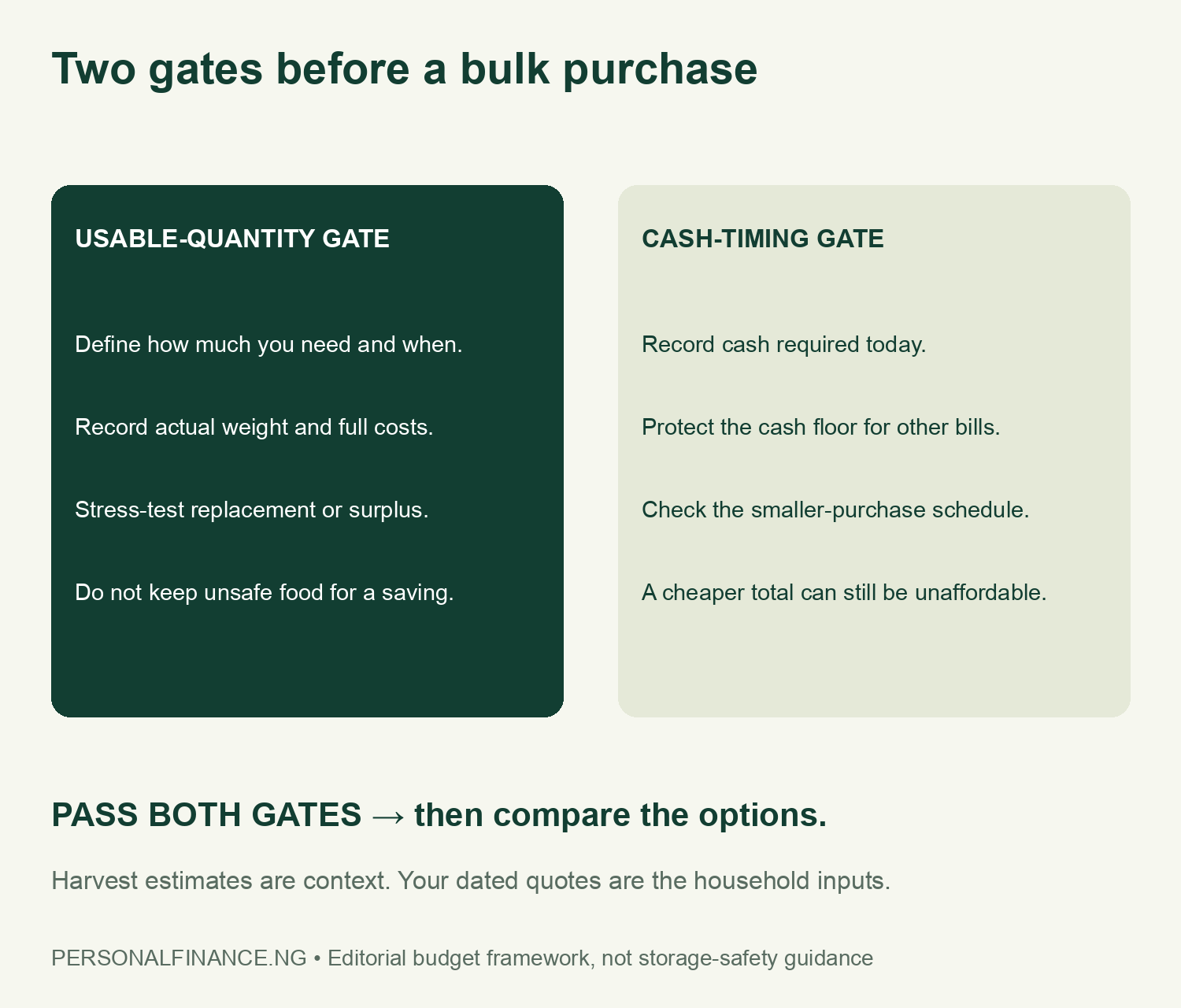
The blank worksheet asks for the quote date, seller source, actual weight, bag cost and extra charges. It then records a comparable small lot, expected use over a defined window, replacement or surplus concerns and the cash floor. Keep unknown inputs unresolved until you can check them.
Food safety takes priority over a spreadsheet saving. Do not keep or consume unsafe food to reach a break-even target. This report does not assess storage methods, contamination or a product’s suitability. Seek appropriate food-safety advice for those questions rather than using a finance calculation as clearance.
Your Personalized Financial Plan
Get expert financial advice tailored exclusively to your goals. Receive a custom roadmap in just 1-3 business days.
Get StartedMethod, limits and free calculation files
We checked the official ministry release and ABU/NAERLS account on 22 November 2026. The original sensitivity model holds a twenty-kilogram need and the ₦1,800 replacement benchmark constant. It excludes borrowing costs, changing future prices, resale and safety assessments. Every household price in the charts is fictional.
For a related comparison where the advertised price is only one part of the decision, see our Black Friday price-evidence guide. Here the additional questions are usable quantity and cash timing, rather than a retailer’s historical reference price.
- Harvest source values and claim boundaries (CSV)
- Fictional bulk-buy shortfall sensitivity (CSV)
- Blank pack-size, usable-quantity and cash-floor worksheet (CSV)
- Fictional cash-timing and break-even calculations (CSV)
Sources: Federal Ministry of Information release, 18 November 2026; ABU/NAERLS account, 19 November 2026. Suggested citation: Nigerian Personal Finance, “Maize in Bulk: How Much Must You Use Before the Discount Pays?”, 22 November 2026. Original fictional household calculations; no local price forecast.


