







Household financial access in Nigeria is about more than whether one person has an account. Can each consenting adult make a necessary payment through their own legitimate route? A private, voluntary task check can reveal a practical gap without asking anyone to share passwords or surrender control.
SysIN’s report of 11 November 2026 revisits older financial-inclusion evidence. Its publication date does not turn those observations into a new household survey. Here we use the World Bank’s Nigeria table, printed page 116, to frame the issue, then keep our invented example and blank planning tools clearly separate.
Household financial access Nigeria: start with the denominator
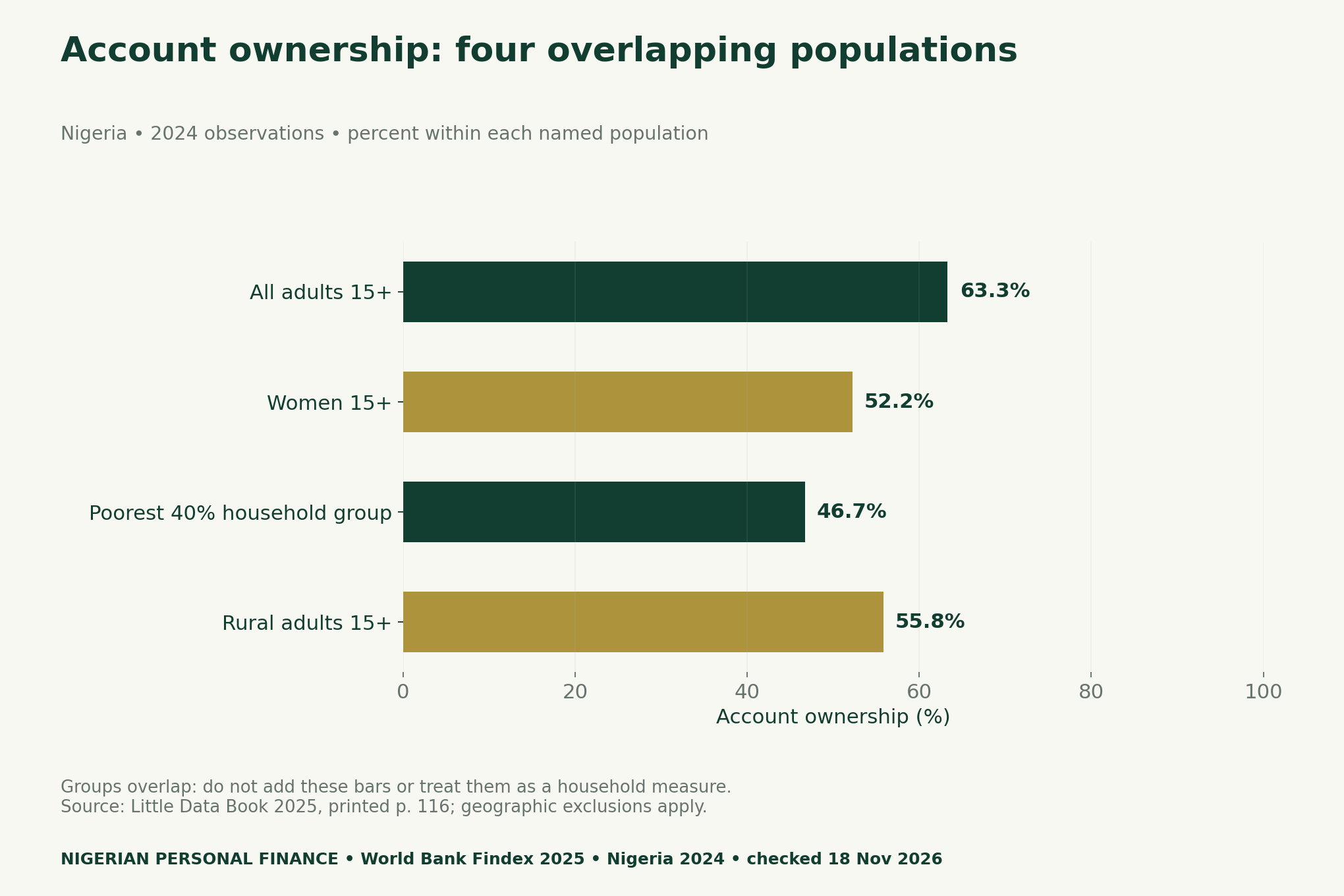
The chart reports account ownership, not a test of practical access for every adult in one home. Its groups overlap: a rural woman can also belong to the lower-income group. Therefore, adding the four percentages would have no useful meaning. Nor can the table tell us how many households have two adults who can pay a bill independently.
The survey-methodology table, printed page 287, records 1,000 Nigeria interviews and a sample that excluded Adamawa, Borno, Yobe and disputed parts of Taraba. The excluded areas represented roughly 7% of the population. These limitations matter, particularly when discussing communities the sample did not reach.
Also, this is not the only survey available. EFInA’s 2026 A2F release uses its own financial-product/service inclusion measure. Do not splice that broader measure into an account-ownership time series or treat the sources as interchangeable. This article deliberately keeps the specified Findex observations and their definitions together.
Ownership, practical access, affordability and consent are different
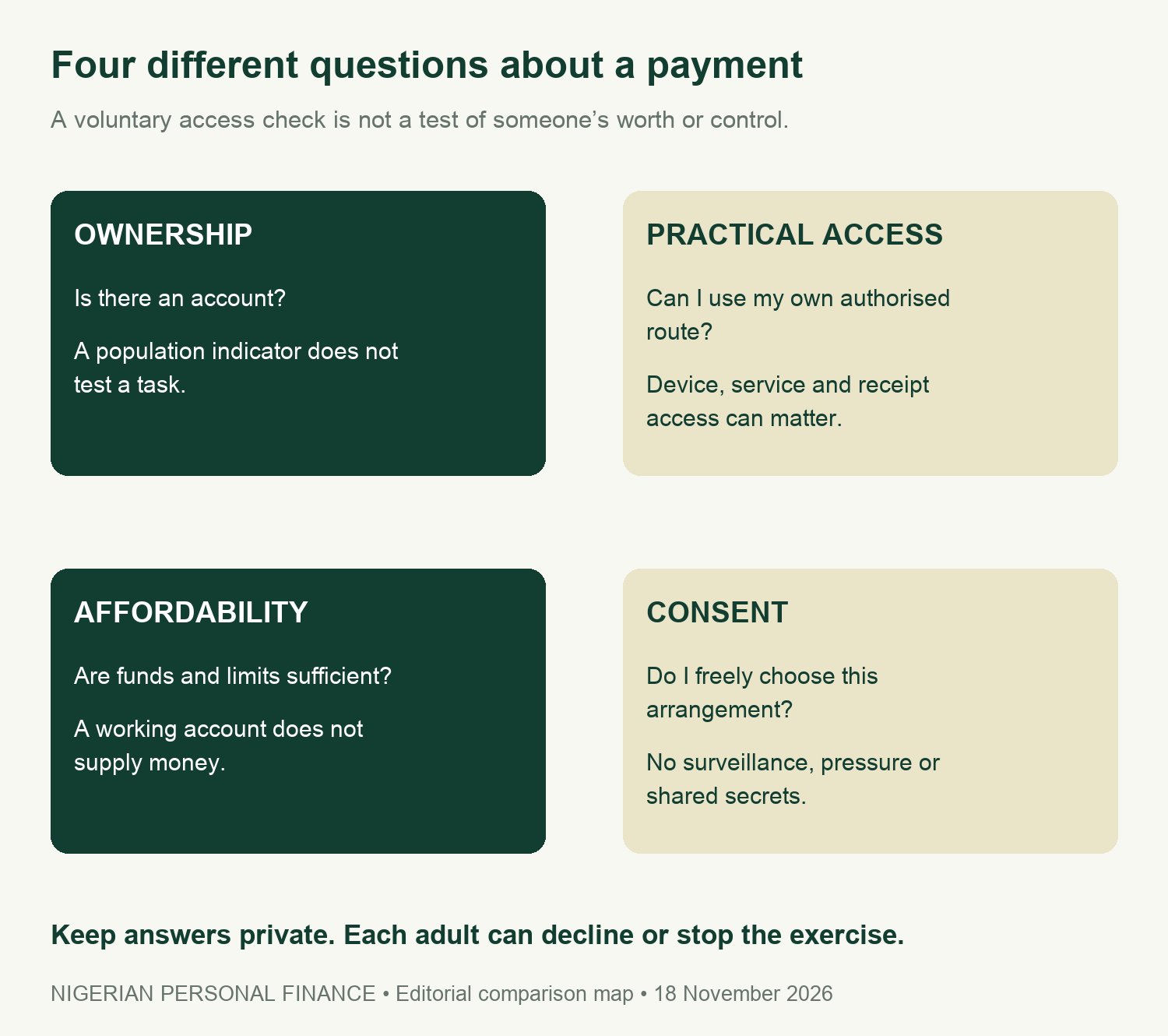
For example, an adult might have an account but lack a usable device that day. Another might know how to pay the school but have insufficient funds. A third might complete a payment yet be unable to retrieve its receipt later. Each problem needs a different response. None justifies demanding another person’s PIN or OTP.
Start with consent before discussing any task. Each adult can choose what to test, what to record and when to stop. Keep the conversation about a shared practical need, rather than judging someone’s ability or spending choices. If the exercise would create pressure or conflict, do not proceed with it.
In addition, legitimate access can take different forms. Use an account in the person’s own name or an authorised arrangement the provider permits. Confirm the rules through official channels. Do not defeat a login restriction, impersonate someone or assume that a family relationship grants permission to use their credentials.
A fictional two-adult matrix shows the practical question
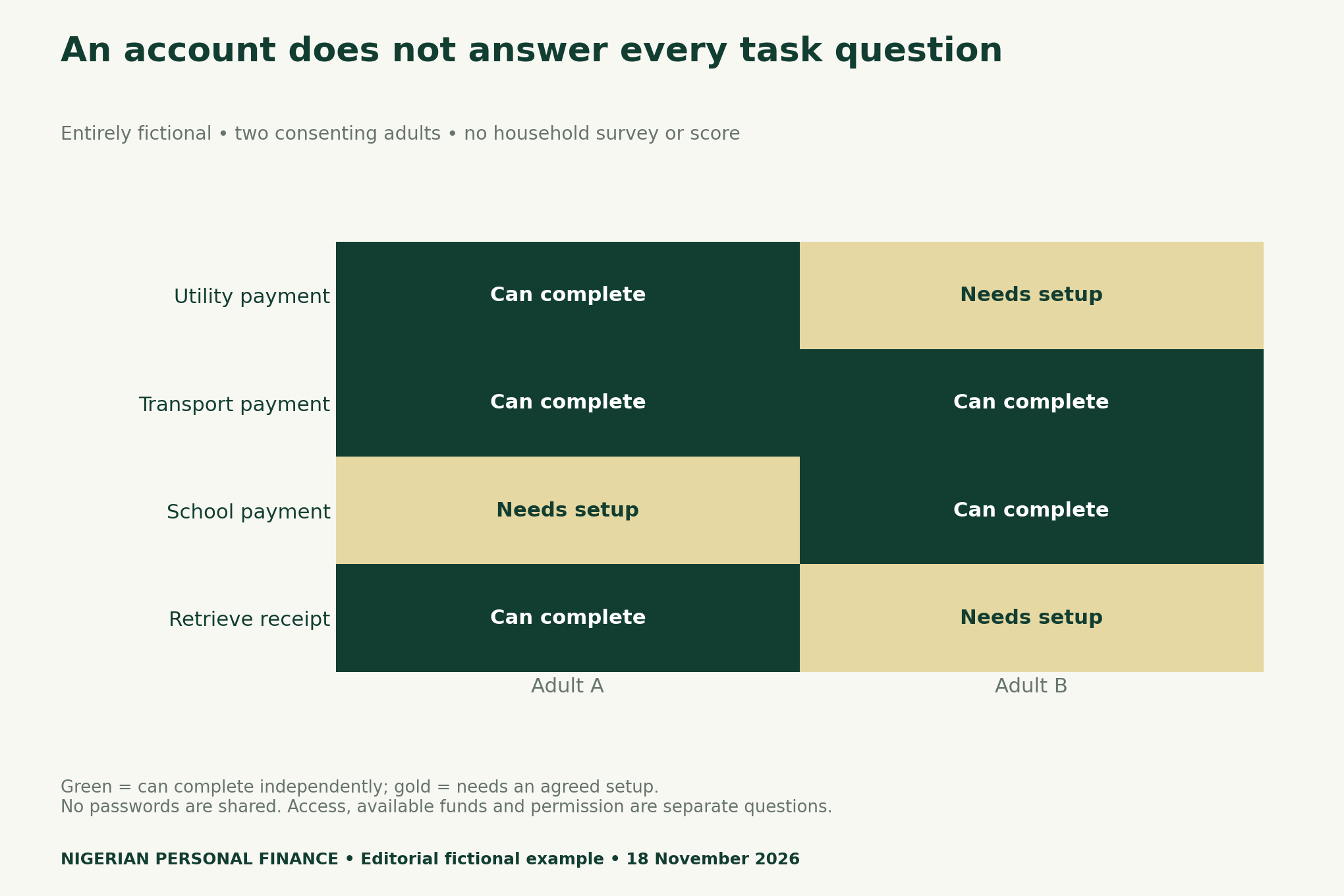
In this invented home, Adult A can complete a utility payment, arrange transport and retrieve a receipt. Adult B can arrange transport and complete a school payment. Their different routes reveal tasks worth discussing. However, the matrix does not say one adult should take over the other’s finances.
Suppose both adults freely want a backup for the utility task. They could check whether the utility offers a permitted separate payment route, what information it requires and how it issues receipts. First verify the provider’s instructions. Then record an optional next action, rather than putting a password in the worksheet.
Likewise, a receipt gap might need better private filing, not a new financial product. A service outage might need a lawful alternative payment channel and a clear fee check. There is no universal solution. The goal is to identify the specific obstacle while preserving each person’s choice and privacy.
Try a voluntary essential-payment audit
Choose a few relevant tasks, such as utilities, transport or school expenses. Not every home uses every category. For each task, ask whether the adult wants to test it and can use their own authorised route. Next, check transaction limits, costs and receipt access separately. Finally, agree only the follow-up that person actually wants.
Use aliases in the blank file. Leave account numbers, BVNs, passwords, PINs, OTPs and identity documents out of it. Keep the completed audit on a private device with appropriate access protection. The download is a blank planning file, not a form to return to us or a request for private financial records.
For a related budgeting exercise, our household power diary separates observed service from assumed costs. Similarly, our NDIC guide separates a payment brand from its legal institution. Those checks complement this task audit but do not establish that a product suits an individual.
Method and four downloadable tools
We checked the World Bank table and methodology on 18 November 2026. The first chart reproduces four rounded indicators, without combining their groups. The second chart is our invented task matrix. The comparison infographic is an editorial aid. We did not survey households, access anyone’s accounts or estimate individual financial autonomy.
Your Personalized Financial Plan
Get expert financial advice tailored exclusively to your goals. Receive a custom roadmap in just 1-3 business days.
Get StartedFor reuse, keep the source, year, denominator and example status beside every figure. A teacher or community educator can adapt the blank checklist with freely consenting adults. However, they should not publish completed personal files or describe a small voluntary exercise as representative research.
- Source indicators and denominator audit (CSV)
- Fictional two-adult task matrix (CSV)
- Blank voluntary private payment audit (CSV)
- Private backup-payment checklist (CSV)
Suggested citation: Nigerian Personal Finance, “Financial Inclusion: Can Each Adult Make Essential Payments?”, 18 November 2026. Data: World Bank, Little Data Book on Financial Inclusion 2025, Nigeria p. 116; scope: Global Findex methodology, p.287. Fresh discussion: SysIN, 11 November 2026. Fictional matrix and voluntary tools by this publication.


