






The CBN stablecoin rules 2026 make the legal claim behind a token more important than its name. “Stable,” “dollar” or “savings” does not establish deposit insurance, a permitted service or a guaranteed return. For a Nigerian household, the useful first task is to identify who owes you what, under which rules, and with what evidence.
This report reads the CBN’s 5 November circular and attached regulations. It separates the rule from verification of a particular product. You get a clearly fictional reserve calculation, a two-layer evidence infographic and four free CSV tools. No provider is recommended, rated or declared licensed by this article.
What the CBN stablecoin rules 2026 changed
The official circular PSP/DIR/PUB/CIR/001/004 and attached regulations are dated 5 November 2026. They establish requirements for non-security virtual assets and related activities, including stablecoins and Deposit Money Tokens. The framework covers licensing, reserves, redemption, customer disclosures and other controls. It also recognises the roles of other Nigerian authorities.
However, issuing rules does not prove that every existing app meets them. Section 54.1 provides a conditional transition for existing operators. It includes an application period, registration and reporting conditions, and limits on continued activity. Existing Class 2 arrangements also face specific assessment and permission requirements. Therefore, ask about the exact entity, service and current status rather than treating a familiar app as automatically approved.
This is a consumer explanation checked on 10 November. The primary document, not a social-media summary, is the source for the legal distinctions below. Product-specific conditions, later directions and applicable foreign-exchange rules still matter. A public rulebook is not a current register of fully compliant products.
Identify the token category before comparing protection
| Product or claim | What to establish | What its name cannot prove |
|---|---|---|
| Payment stablecoin | Issuer, reference currency, token approval and relevant service permissions | That it is a bank deposit or NDIC-insured |
| Deposit Money Token | Issuing bank, underlying deposit claim and applicable insurance arrangements | That every tokenised balance has identical cover |
| Return-bearing investment claim | Legal product, responsible entity and relevant regulatory treatment | That stablecoin permissions cover a separately regulated investment |
A Deposit Money Token represents a deposit liability of its issuing bank. Section 40 treats it as a deposit claim and says insurance depends on applicable law and arrangements with the NDIC. That is more specific than saying every token either has insurance or has none. Get the exact product terms and the applicable arrangement before reaching a conclusion.
For stablecoins, sections 13.8 and 27.4 require clear separation from bank deposits and NDIC protection. A reserve pool and an insurance scheme serve different purposes. Likewise, a regulator’s permission is not the regulator promising to repay the holder. The document expressly warns against presenting authorisation as a guarantee.
Full backing plus a 2% buffer is not customer interest
Sections 24.1–24.4 require continuous full backing and at least 2% additional collateral. To make the arithmetic visible, assume a wholly fictional ₦1,000,000 of circulating obligations. Two per cent is ₦20,000. Adding that buffer gives an illustrated ₦1,020,000 backing amount, before considering other applicable requirements.
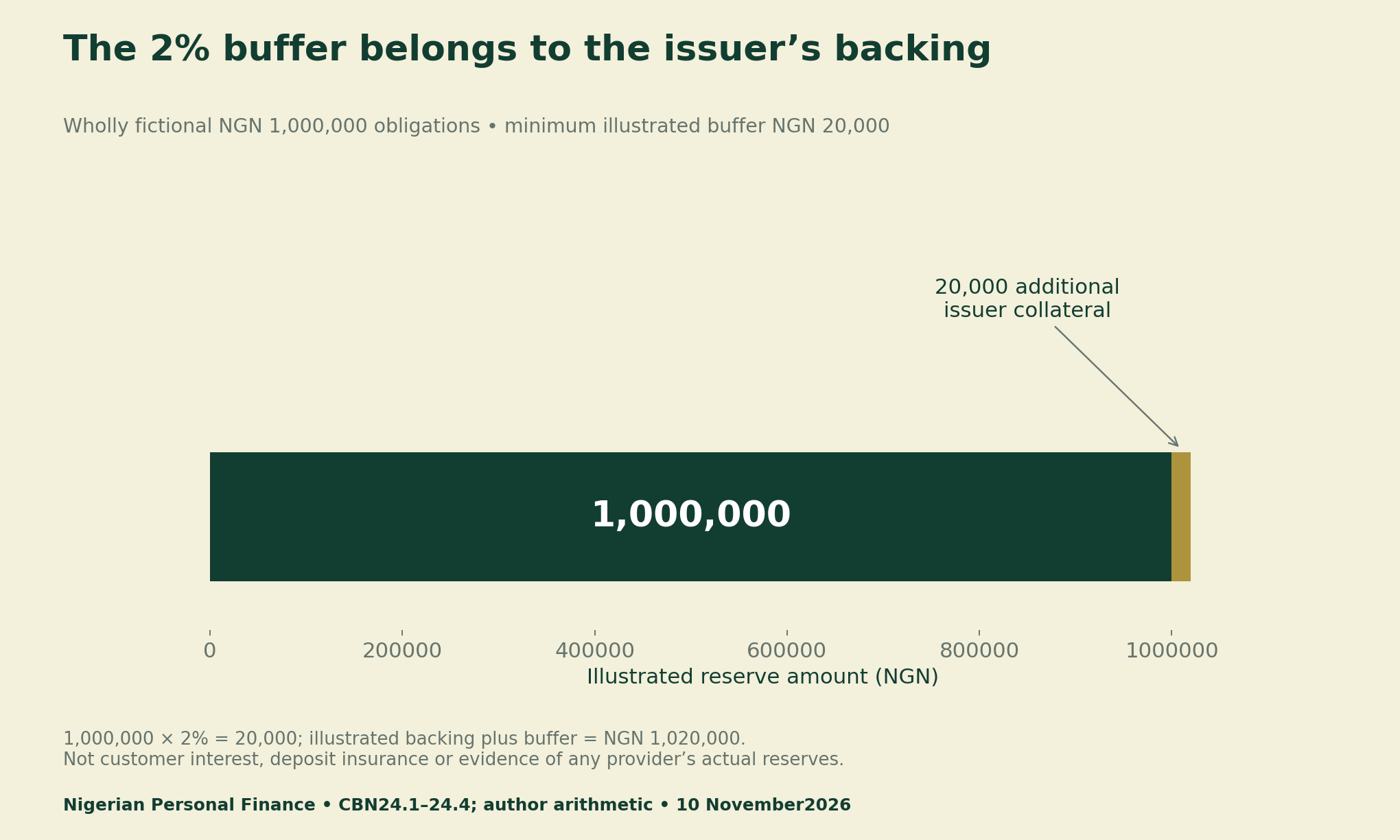
The buffer is intended to absorb reserve-valuation losses and accrued operational liabilities. It does not add 2% to your personal balance. Nor does the diagram show that any real issuer has the correct assets, valuation, segregation or liquidity today. Those are separate evidence questions, with dates and scopes that need checking.
Ask for the latest relevant reserve attestation and identify its scope. Which legal issuer and token does it cover? What is its reference date? Does it address the claim being advertised? A dated report can be useful evidence without proving uninterrupted future compliance. Preserve those limits in the worksheet instead of converting them into an invented safety score.
A holding-yield claim needs a separate explanation
Section 13.3 prohibits an issuer from paying, offering, arranging or facilitating financial benefits because someone holds or deposits its stablecoin. It also prevents circumvention through a service provider. Thus, a marketing promise of a holding return deserves a precise explanation of the legal product and arrangement.
Do not conclude that every investment product is prohibited, or that a different product becomes permitted merely by changing its name. Securities and investment arrangements can fall under a different framework. Ask a suitably qualified Nigerian financial-regulatory professional to examine the actual terms if classification or permissions remain unclear. This report does not classify a particular platform’s offer.
Redemption rights are different from uninterrupted access
Section 23 sets out the holder’s redemption right and operational requirements. Ordinarily, the licensed issuer must redeem a valid request by the end of the next business day. In a stress event, the CBN may approve a longer period, capped at five business days or a shorter legal maximum. The section also specifies exceptions and suspension circumstances.
That rule should not be presented as guaranteed instant withdrawal at all hours. The valid-request process, reference currency, intermediary route, permitted exceptions and current directions matter. Check the customer agreement and published process. Keep a private record of request and response dates if you need to understand a particular transaction.
For a different practical question, our digital-savings emergency-access guide distinguishes a displayed balance from money available when needed. It does not replace this token-classification analysis. A product can raise legal-protection questions and operational-access questions at the same time.
Your Personalized Financial Plan
Get expert financial advice tailored exclusively to your goals. Receive a custom roadmap in just 1-3 business days.
Get StartedUse two evidence layers instead of a safety score
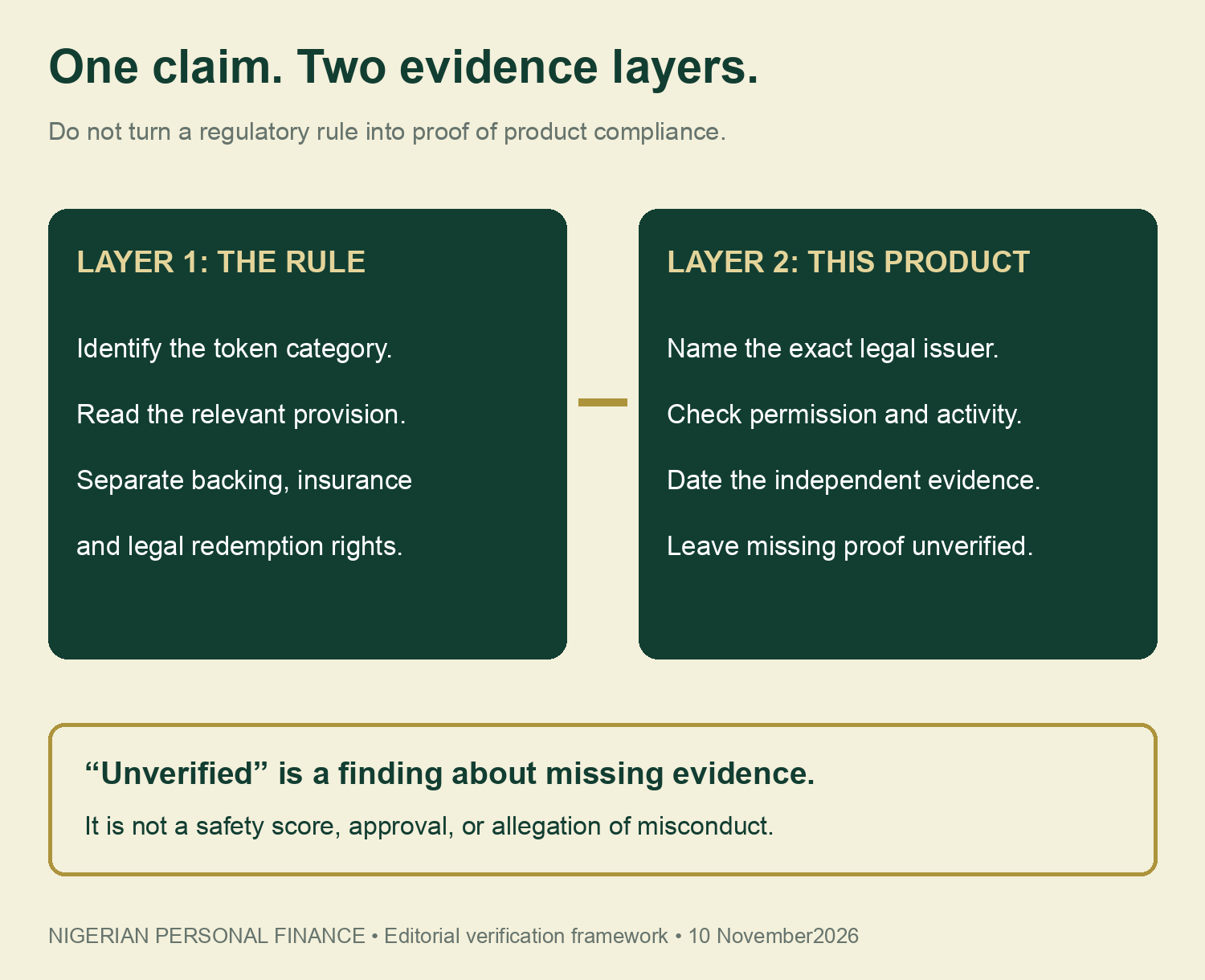
First, write down the provider’s claim exactly enough to investigate it. Next, record an independent source and date in a separate column. A company registration, app-store listing, foreign licence and Nigerian approval answer different questions. Do not substitute one for another or infer approval from a screenshot showing an official-looking badge.
Leave missing evidence marked “unverified.” That means this check did not establish the claim. It is neither evidence of wrongdoing nor permission to call the product safe. Record the unresolved question, the responsible contact and a next check date. If the answer matters to money you need, resolve it before relying on the claim.
Keep the check useful and private
Use public product documents, the issuer’s legal identity and relevant official information. You do not need to share private keys, seed phrases, wallet screenshots, account balances or identity documents with this website. Never put those details in a downloaded worksheet intended for sharing. We do not collect completed tools.
Keep the published complaint route with the customer terms. Section 27 requires issuer disclosures and complaints arrangements. A missing answer should become a clear question, rather than a public accusation or an assumption of entitlement. Where a dispute or material financial decision arises, seek appropriate independent advice on the actual facts.
Download the source matrix and verification tools
The source matrix separates document locators from interpretation limits. The arithmetic file contains invented values only. Both blank tools keep provider statements apart from independent checks. There is no hidden scoring formula, endorsement list or request to connect a wallet.
- CBN rule and source matrix (CSV)
- Fictional reserve arithmetic (CSV)
- Blank token-protection verification worksheet (CSV)
- Blank provider-questions register (CSV)
Method, limitations and update log
Research checked on 10 November 2026 against the CBN’s circular and attached regulations dated 5 November. We retained the official PDF and read the relevant classification, yield, reserve, redemption, disclosure, deposit-token and transition provisions. The chart uses author arithmetic, not observed issuer balances. No consumer survey, licence census, compliance rate or product ranking was conducted.
Suggested citation: Nigerian Personal Finance, “CBN Stablecoin Rules 2026: Check the Protection Behind a Token,” 10 November 2026. Cite the CBN document for the rule and this report for its original verification worksheet. Recheck subsequent official directions and product terms before relying on the analysis. No investment recommendation or guarantee of access is made.


