




The Abuja rent bill 2026 advance payment debate raises two different questions: what the proposed rules say and how a different payment schedule could change household cash needs. Neither question turns a bill into a current legal right. This report uses a clearly labelled proposal and fictional numbers, rather than presenting a new rent limit as enforceable law.
In our example, annual rent stays at ₦2.4 million. Two years upfront plus an invented 10% one-off agency fee on annual rent requires ₦5.04 million. One year plus a 5% one-off fee requires ₦2.52 million. However, the ₦2.52 million initial difference includes ₦2.4 million of rent paid later. It is not a ₦2.52 million annual saving.
Status checked 6 November 2026: PLAC’s 5 November report says HB.2839 passed second reading on 4 November and went to the House Committee on FCT. We have not established enactment or commencement. Do not use the proposed clauses below as a basis to withhold payments, accuse an agent or claim a refund. Seek qualified Nigerian legal advice about an actual tenancy.
Abuja rent bill 2026 advance payment: what we checked
The PLAC legislative report records the first reading on 22 October and the subsequent second reading. It links to an eight-page HB.2839 bill text. Our source references use that specific linked version, not an assumed final Act.
The PDF’s short title is Federal Capital Territory Rent and Housing Agents Regulation Bill, 2026. The news report uses a different descriptive title. Therefore, check the bill number, version and relevant clause together when comparing accounts. Proposed wording and section numbers can change during legislative consideration.
In the linked PDF, section 3 proposes a twelve-month limit on compulsory advance rent. It also contains a qualification for lawful voluntary arrangements without coercion or disadvantage for refusal. Section 8 proposes an agency-fee maximum of 5% of annual rent, or a lower prescribed rate, alongside disclosure and other conditions. These are descriptions of proposed text, not current legal advice.
Separate annual rent from initial cash
First, write down the annual rent for the same property and period. Next, identify how many months the quote requires upfront. Finally, itemise fees and other cash separately. Otherwise, a comparison can silently mix a lower price with a shorter prepaid period.
| Fictional input | Scenario A | Scenario B |
|---|---|---|
| Annual rent | ₦2,400,000 | ₦2,400,000 |
| Advance period | 24 months | 12 months |
| Advance rent cash | ₦4,800,000 | ₦2,400,000 |
| Assumed one-off agency fee | 10% of annual rent: ₦240,000 | 5% of annual rent: ₦120,000 |
| Initial cash, excluding other items | ₦5,040,000 | ₦2,520,000 |
The 10% input is an invented comparison, not a statement about common, lawful or required fees. Likewise, Scenario B illustrates a payment structure connected to the proposal. It does not establish that a reader can demand those terms today.
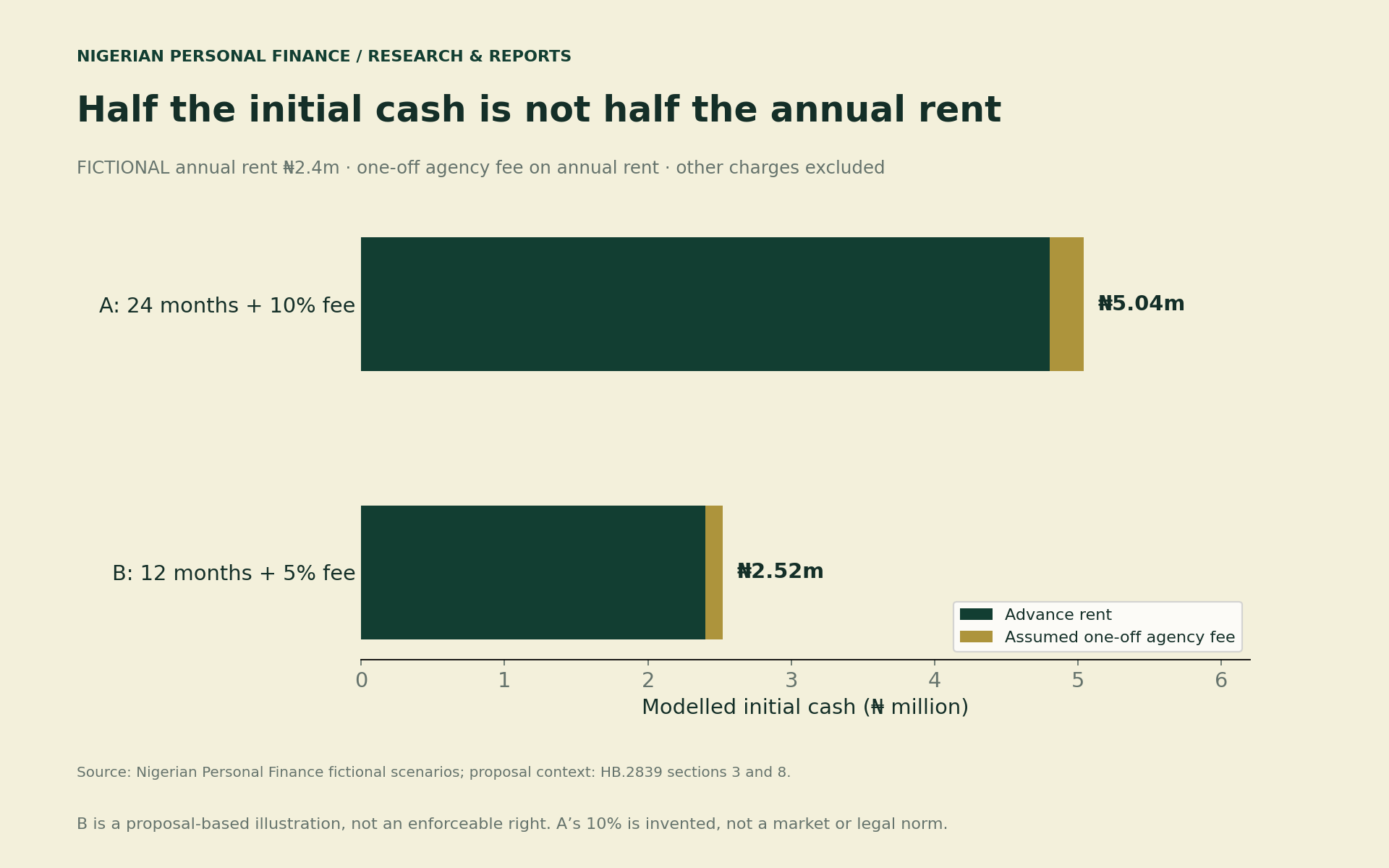
A smaller initial cash requirement may ease a funding problem. Nevertheless, it does not prove the underlying home costs less each year. For example, a household could still face the same annual rent and a substantial renewal payment later.
Decompose the ₦2.52 million difference
Subtracting the modelled totals gives ₦5.04 million minus ₦2.52 million, or ₦2.52 million. Of that difference, ₦2.4 million is the second year’s rent deferred. The remaining ₦120,000 comes from the assumed one-off fee difference.
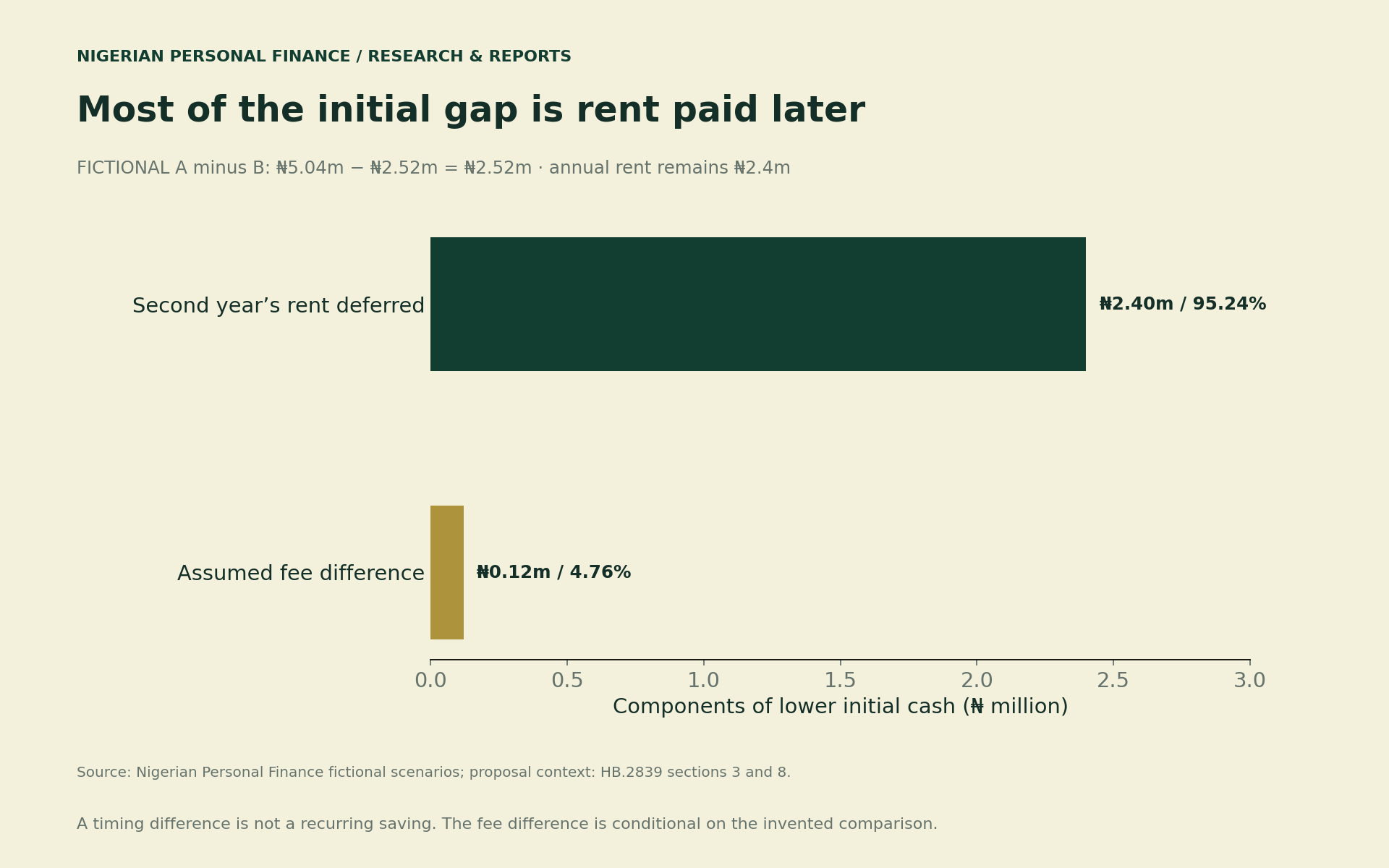
Consequently, describing the whole gap as a recurring saving would mislead a household budget. A useful comparison gives each component a name: rent for a period, a one-off charge, a refundable deposit or a recurring service cost. Then, attach a due date to each cash payment.
Our relocation-budget guide provides broader planning context. This new model adds a specific distinction: cash you retain because a payment comes later remains relevant to a future obligation. It is not automatically money available for unrelated spending.
Use the same horizon for both schedules
Now extend both fictional arrangements across two years. Assume the same home, unchanged annual rent and no additional renewal fee, other charges or discounting. Scenario A pays ₦5.04 million initially and no further modelled rent within that horizon. Scenario B pays ₦2.52 million initially, then another ₦2.4 million at the start of year two.
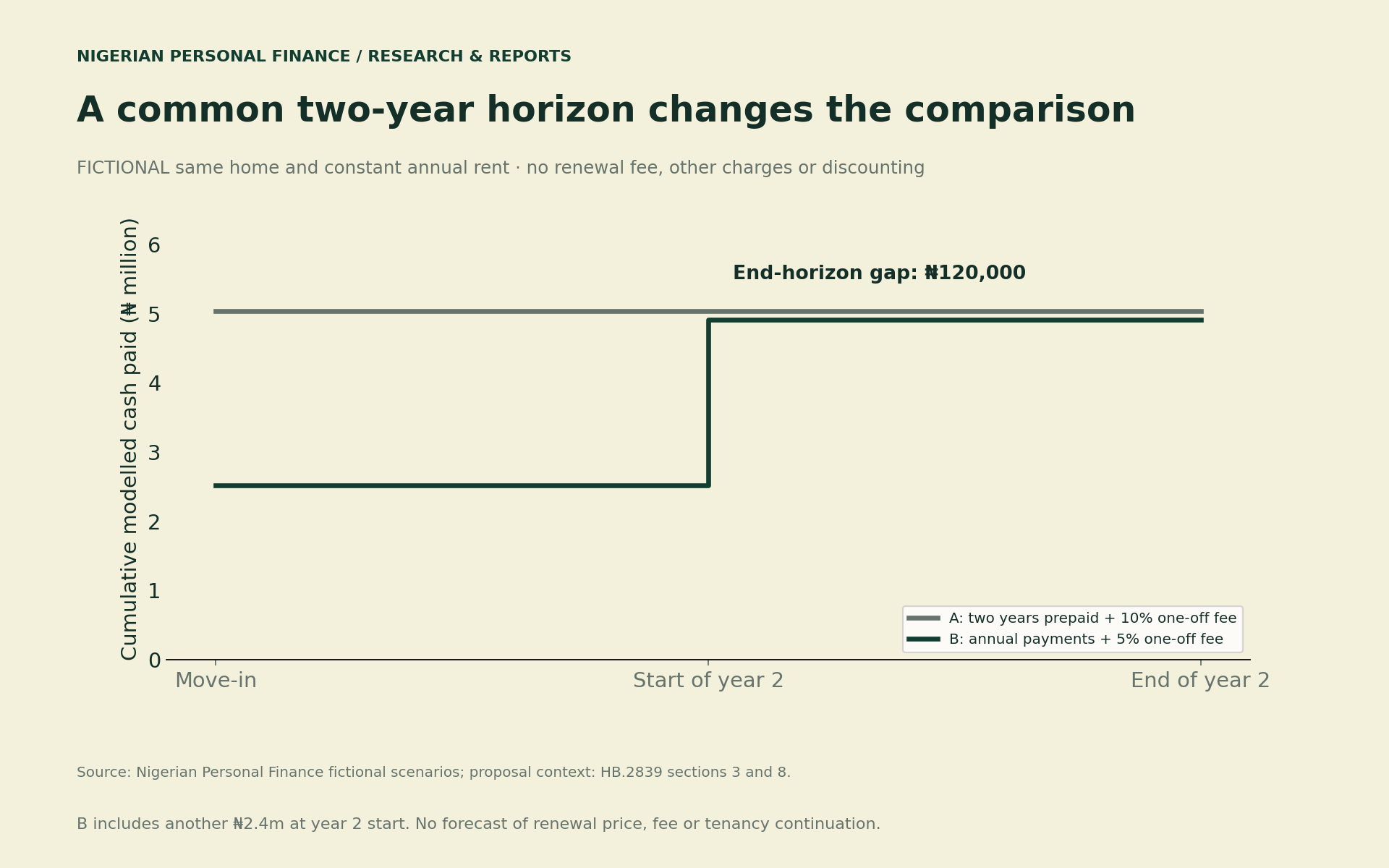
Under those assumptions, B reaches ₦4.92 million. Therefore, the two-year cash difference is ₦120,000, not ₦2.52 million. This is a cash comparison without a present-value calculation. It does not price the benefit of keeping funds longer or any borrowing cost.
If renewal rent changes, update the model. Similarly, add a renewal charge only when a verified quote or agreement supports it. Do not assume a zero input in our teaching example means a real service will cost nothing.
Your Personalized Financial Plan
Get expert financial advice tailored exclusively to your goals. Receive a custom roadmap in just 1-3 business days.
Get StartedA reserve target is not a payment agreement
For a fictional ₦2.4 million payment due after twelve equal contributions, the arithmetic target is ₦200,000 per contribution. That target assumes no existing reserve, no interest and no withdrawals. However, it does not create a right to pay a landlord monthly.
A household with variable income can instead record actual contributions and the remaining gap. Keep the agreed payment date visible. If the plan remains short, seek advice and discuss options before relying on money that has not arrived.
The agency-fee percentage needs a base
The specific linked proposal refers to annual rent. In our fictional example, 5% of ₦2.4 million equals ₦120,000. By contrast, 5% of two years’ rent, ₦4.8 million, equals ₦240,000. The percentages look identical while the amounts differ.
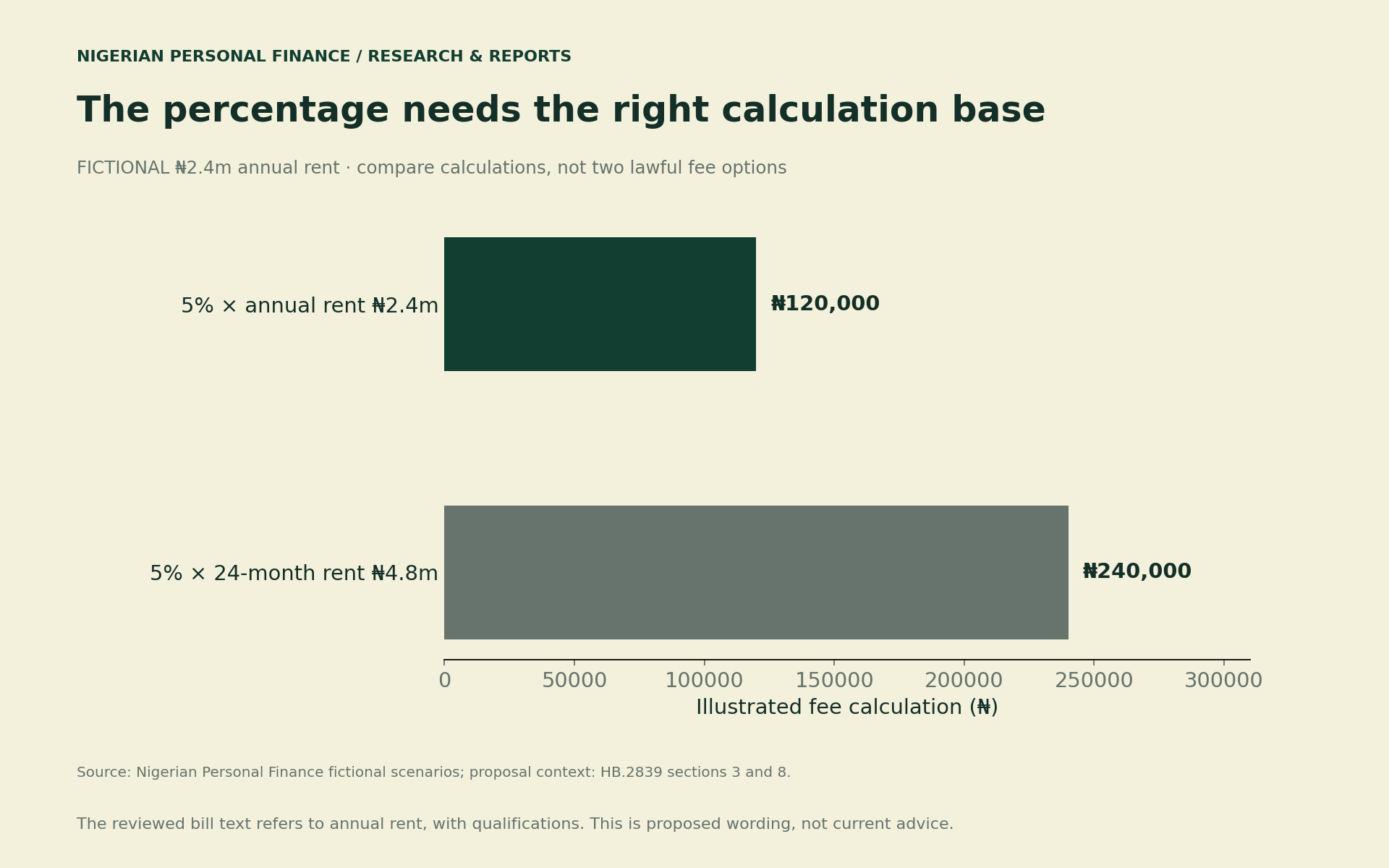
Ask for the rate, base, service and payee in writing. Also, distinguish one-off charges from anything payable on renewal. Our preparation guide for meeting an estate agent offers questions about written costs and responsibilities. Neither a worksheet nor an online summary resolves a disputed fee’s legality.
Other move-in cash still matters
The initial ₦2.52 million model excludes deposits, legal or agreement costs, service charges, moving and utility setup. Their existence, amount, timing and legal treatment require individual checking. They cannot all become zero simply because a headline mentions an agency-fee percentage.
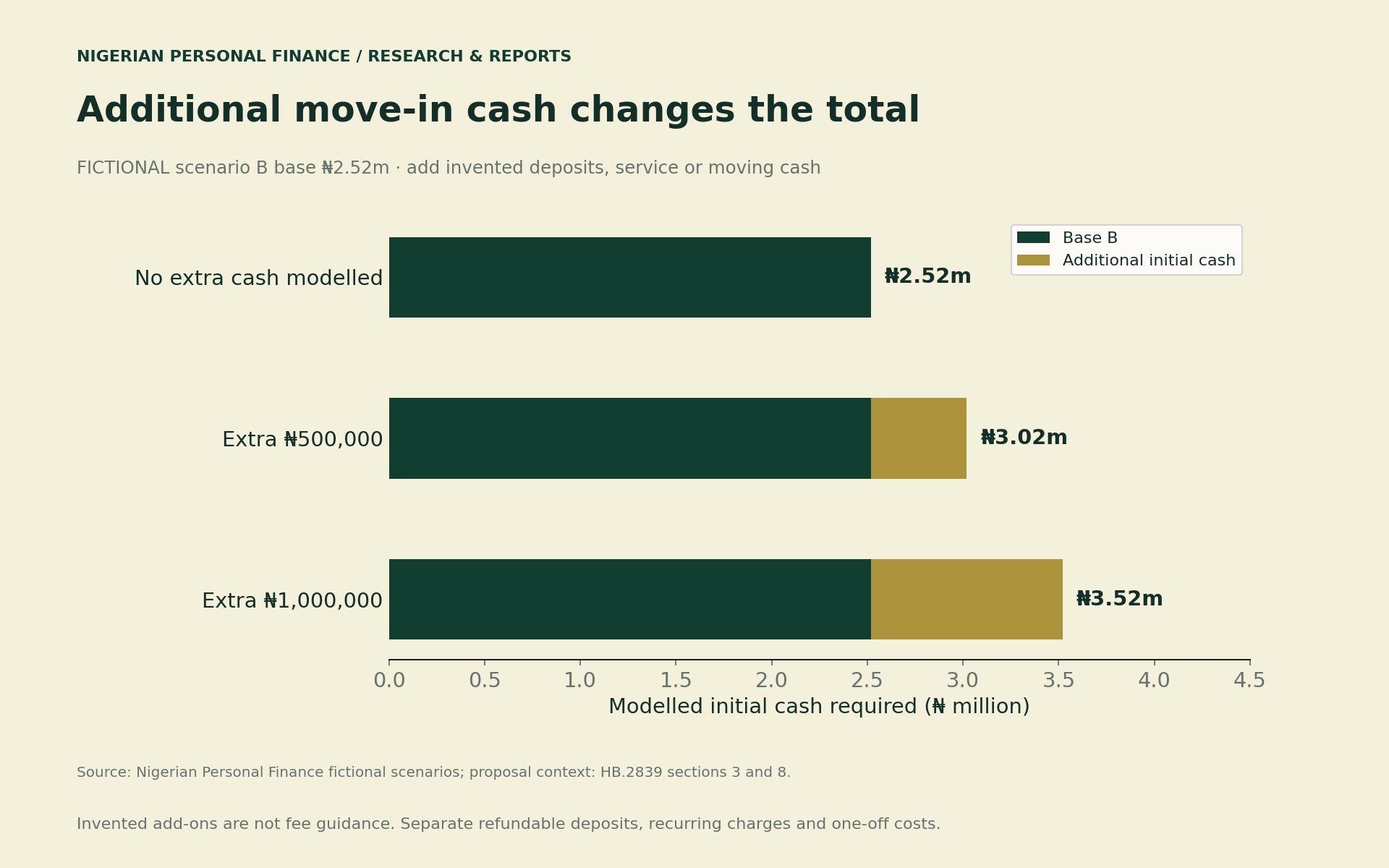
For instance, a refundable deposit can require cash today while carrying different conditions from a non-refundable service fee. Record its return conditions and keep the evidence. Similarly, a service charge may cover a different period from rent. Confirm the period before comparing two quotes.
A status-to-budget check before committing
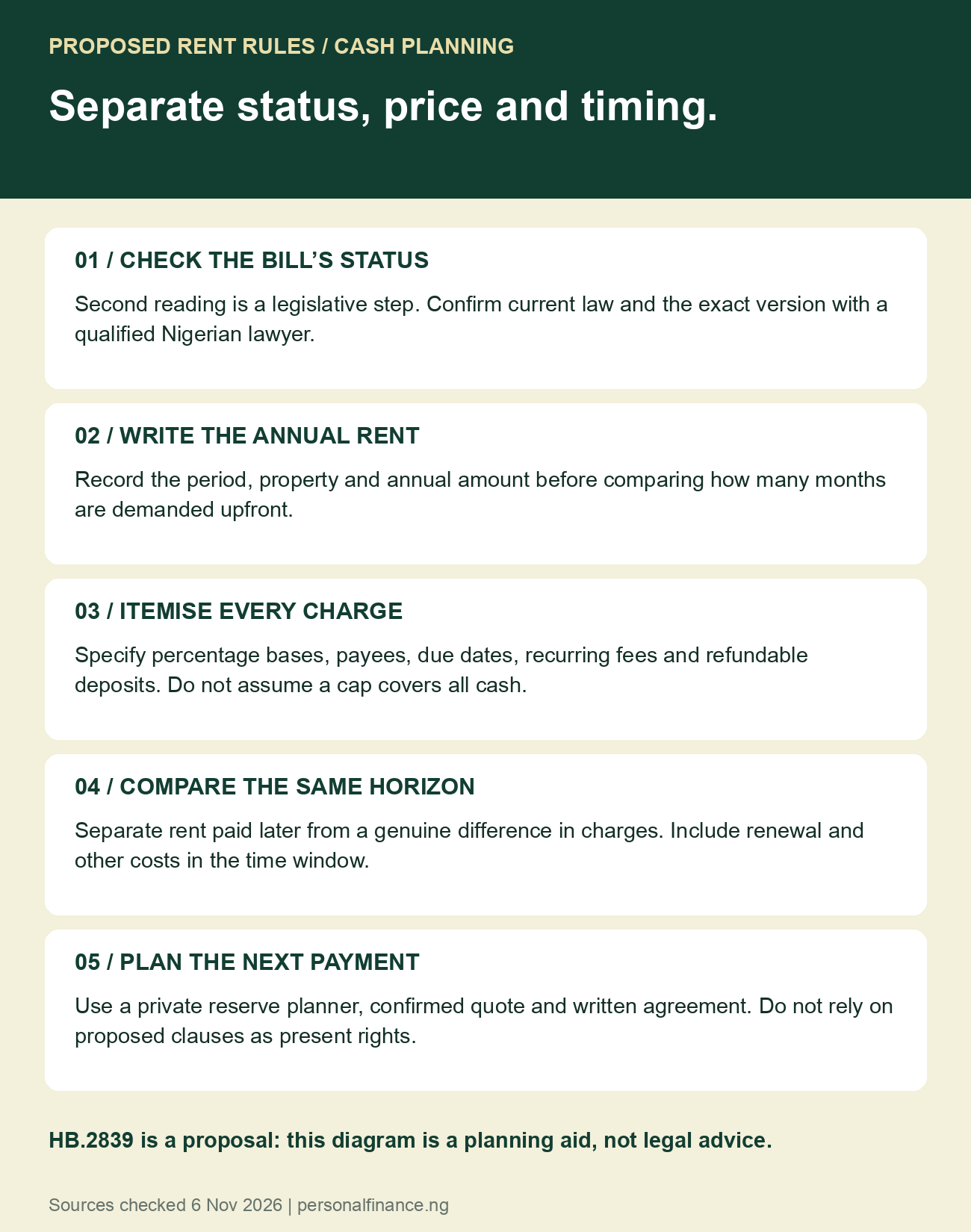
First, obtain a clear written breakdown for the actual property. Next, separate annual price from advance duration. Ask an appropriately qualified Nigerian lawyer to check the current legal position and relevant documents. Finally, build the household cash plan from confirmed obligations, rather than an assumption that a proposal has already changed the agreement.
Download the research and planning files
- Proposal source register (CSV): clause references, PDF pages, qualified summaries and the proposed status.
- Fictional upfront scenarios (CSV): six teaching combinations at three invented annual rent levels; no market-rate claims.
- Blank renewal-reserve planner (CSV): twelve contribution periods with cash, dates and assumption fields.
- Blank rental-quote audit (CSV): twelve lines covering amounts, calculation bases, payees, dates and evidence.
Methodology and limitations
We checked PLAC’s dated report and retained the linked eight-page HB.2839 text on 6 November 2026. The report supplies the stated legislative stage; the PDF supplies the clause references. This is a version-specific explanation, not proof of enactment, commencement or final wording. It makes no finding about the legality of any existing tenancy.
Our scripts calculate initial cash as annual rent × advance months ÷ 12, plus a one-off fee on annual rent. All rent, fee and additional-cost scenarios are fictional. The two-year chart keeps annual rent constant and omits renewal fees, other costs, financing and discounting. Those simplifications expose timing; they do not predict the proposal’s market effects, future housing prices or a household’s actual savings.


