




Digital savings emergency access in Nigeria is about more than a balance on a screen. The money must reach the right person before the payment deadline. Withdrawal rules, processing time and the available payout route all matter. This report combines a carefully limited research finding with an original private access audit.
Our fictional audit records ₦200,000 in total savings. Yet only ₦30,000 is immediately available under its assumptions. Another ₦40,000 arrives on day three, while ₦100,000 stays locked until day 30. The remaining ₦30,000 has unverified access conditions. These amounts are teaching examples, not a provider comparison or a suggested allocation.
What the digital savings study measured
Researcher Abdullahi Ibrahim’s 30 October account, listed by EFInA on 2 November, describes 800 survey respondents across Yobe, Kaduna, Enugu and Ondo. It also includes eight focus groups and 12 key informant interviews. The focus is active wallet saving, not simply account ownership.
The account reports that 63% of active wallet savers could raise ₦75,000 within one week, against 31% of matched informal savers. Subtracting the shares gives 32 percentage points. That is not a 32% increase, a personal success probability or an amount available in anyone’s account.
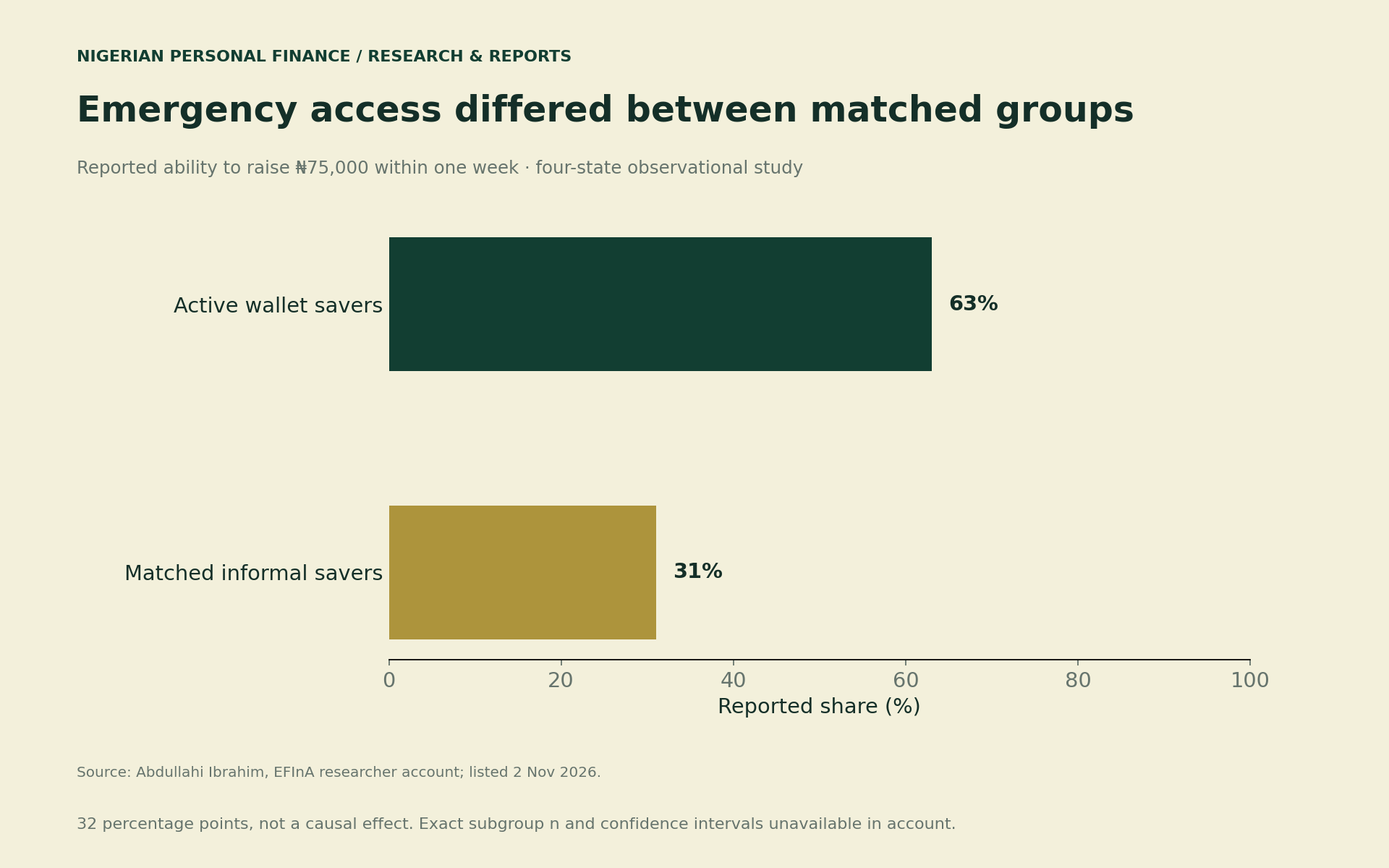
Matching does not remove every possible difference between groups. This is cross-sectional, self-reported evidence. It is geographically limited, and exact subgroup denominators and confidence intervals were unavailable in the account checked. We do not reconstruct respondent counts from rounded shares or label publication dates as fieldwork dates.
A separate harmful-coping comparison covers 233 households. Its overall difference was not statistically significant. That does not prove no effect, and the smaller subset measures a different outcome. A one-week liquidity measure cannot establish that saving through a wallet prevents every harmful household response.
Digital savings emergency access in Nigeria: a private audit
Start with your own payment need and deadline. For instance, does the recipient require cash today, or accept a transfer next week? A withdrawal arriving after that deadline cannot solve the same immediate problem. Use an actual date and a net amount rather than the vague label “emergency money”.
Then classify each pot. Our four categories describe an audit status, not a universal product rule. A bank balance, wallet, savings group contribution or other pot can fall into different categories depending on its actual conditions. An app’s name alone does not establish access.
| Audit class | Question to answer | Fictional example |
|---|---|---|
| Immediate | Can the net amount reach the recipient now? | ₦30,000 |
| Delayed | What is the confirmed earliest date? | ₦40,000 on day three |
| Locked | What release conditions and date apply? | ₦100,000 on day 30 |
| Unverified | Which conditions remain unknown? | ₦30,000 excluded until checked |
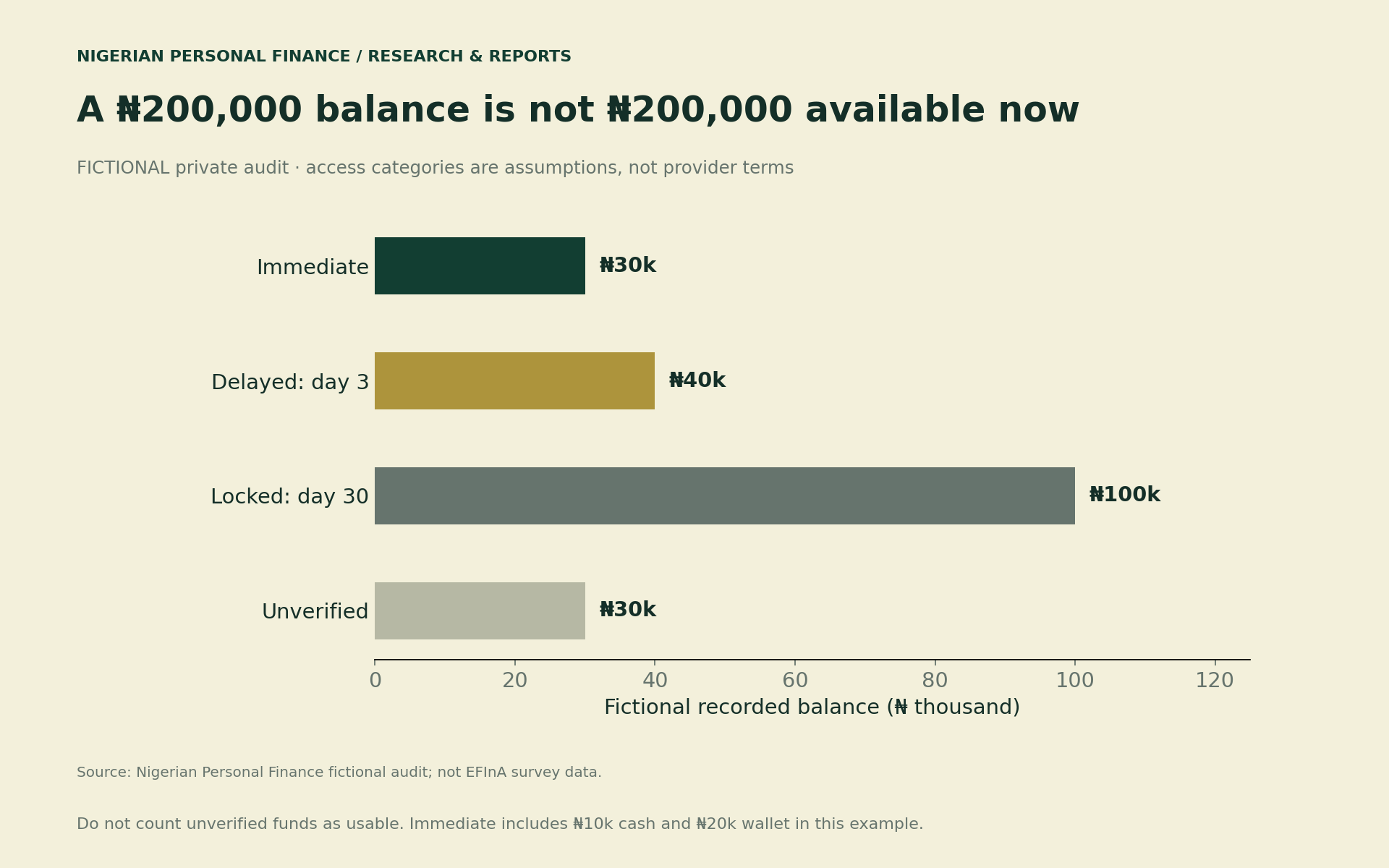
Do not count a pot twice because one screen shows an overview and another shows the underlying balance. Also, an expected salary or loan offer is not existing savings. Keep uncertain receipts and possible borrowing outside the confirmed access total. You can note them separately without treating them as available money.
Match release dates to the payment deadline
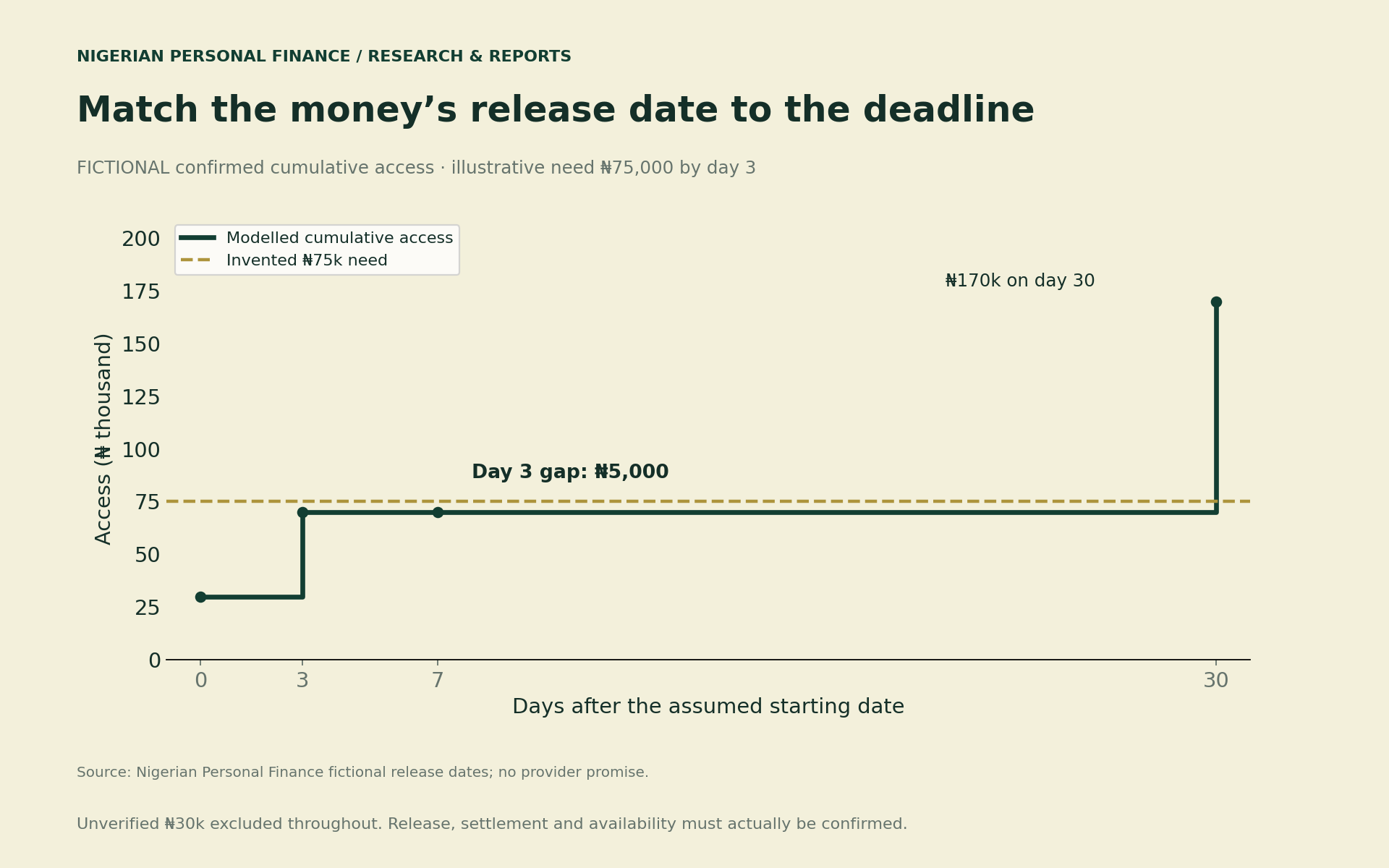
In our model, confirmed cumulative access is ₦30,000 on day zero and ₦70,000 on day three. It stays at ₦70,000 through day seven. On day 30, the assumed locked release raises it to ₦170,000. The unverified pot remains outside the calculation throughout.
Now assume an invented need for ₦75,000 by day three. The model has a ₦5,000 gap at that deadline, despite its ₦200,000 headline balance. Later access to ₦170,000 does not make the earlier payment possible. This is arithmetic with invented dates, not an instruction to unlock a product or borrow the difference.
For a real product, check withdrawal eligibility, processing time and where the payout lands. Distinguish a withdrawal request from completed settlement. If you have not confirmed a condition, label it unverified. Do not turn a best-case processing estimate into a promise.
Check net payout rather than gross balance
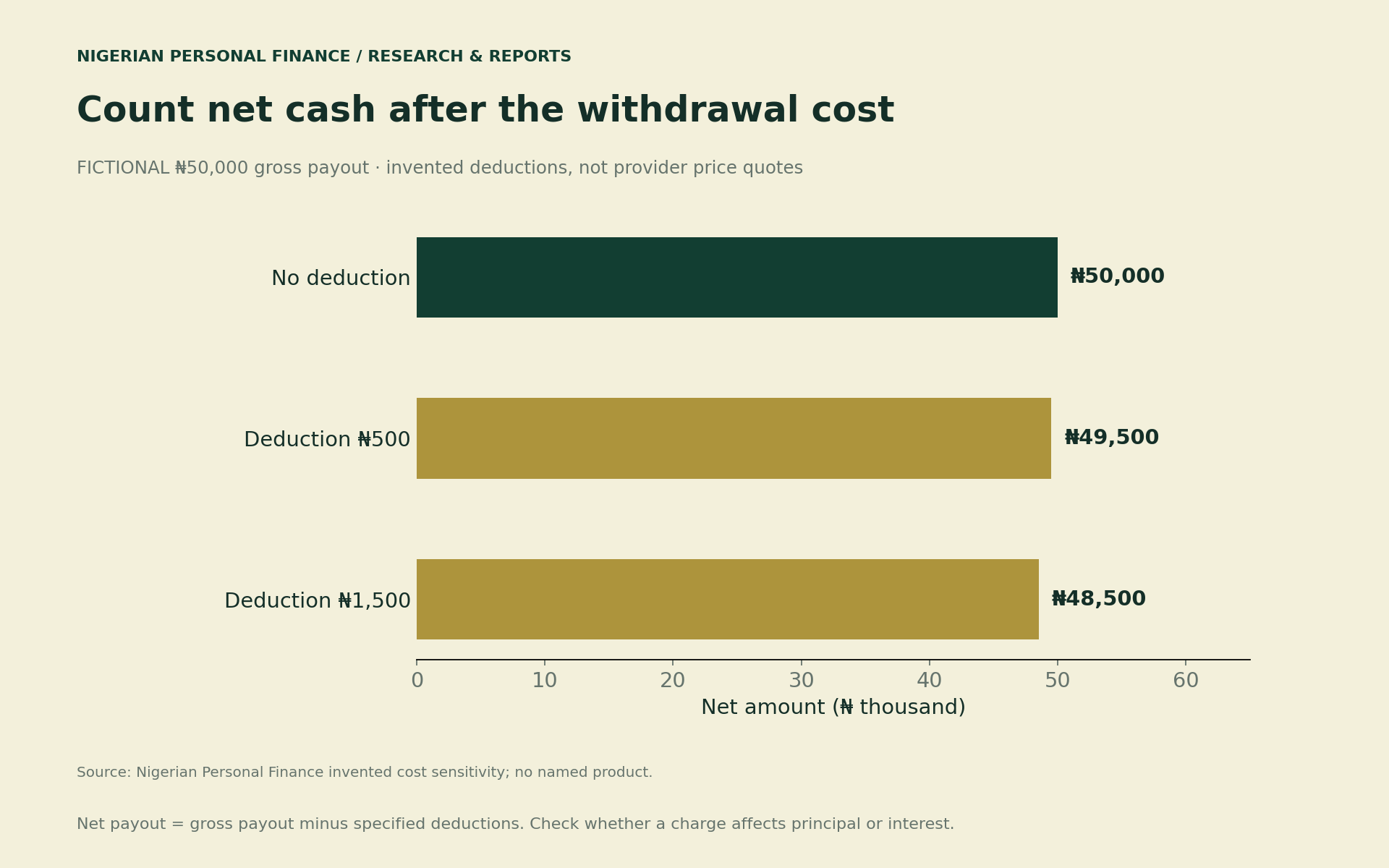
Access can also change after costs. Our next chart starts with a fictional ₦50,000 gross payout. Invented deductions of zero, ₦500 or ₦1,500 leave ₦50,000, ₦49,500 or ₦48,500. These are sensitivity cases, not prices from any provider.
The calculation is gross payout minus the specified deduction. Before applying it, identify what a real charge affects. A deduction from principal differs from forfeited interest or a transfer cost paid separately. Copy the actual written calculation, including any conditions, instead of assuming every percentage uses the displayed balance.
Our quarterly-coupon cash-flow analysis addresses a related timing distinction: an annual rate or monthly average does not create a monthly receipt. The same discipline applies here. Record when money can actually arrive, then compare it with dated needs.
Your Personalized Financial Plan
Get expert financial advice tailored exclusively to your goals. Receive a custom roadmap in just 1-3 business days.
Get StartedTwo accounts may share one point of failure
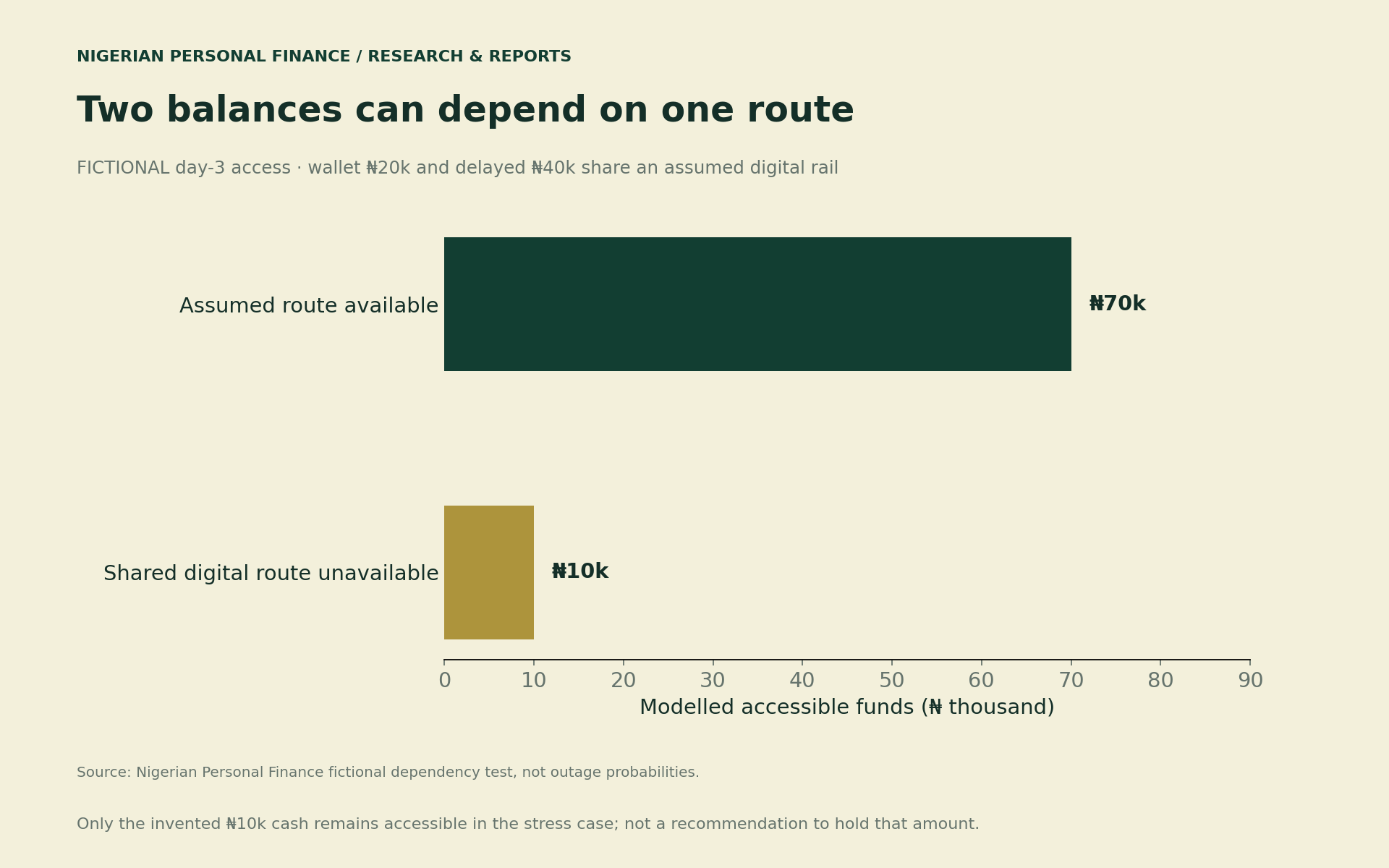
A fallback is useful only if it works when the first route does not. Imagine that the model’s ₦20,000 wallet balance and ₦40,000 delayed payout both depend on the same digital rail. With that route working, day-three access is ₦70,000, including ₦10,000 cash. If it is unavailable at the deadline, the model has only ₦10,000 accessible through its remaining assumed route.
This is a dependency test, not an outage forecast. It does not recommend keeping that amount in cash. A real plan must consider security, household circumstances, provider rules and the recipient’s payment options. Merely having two app icons does not demonstrate two independent payout paths.
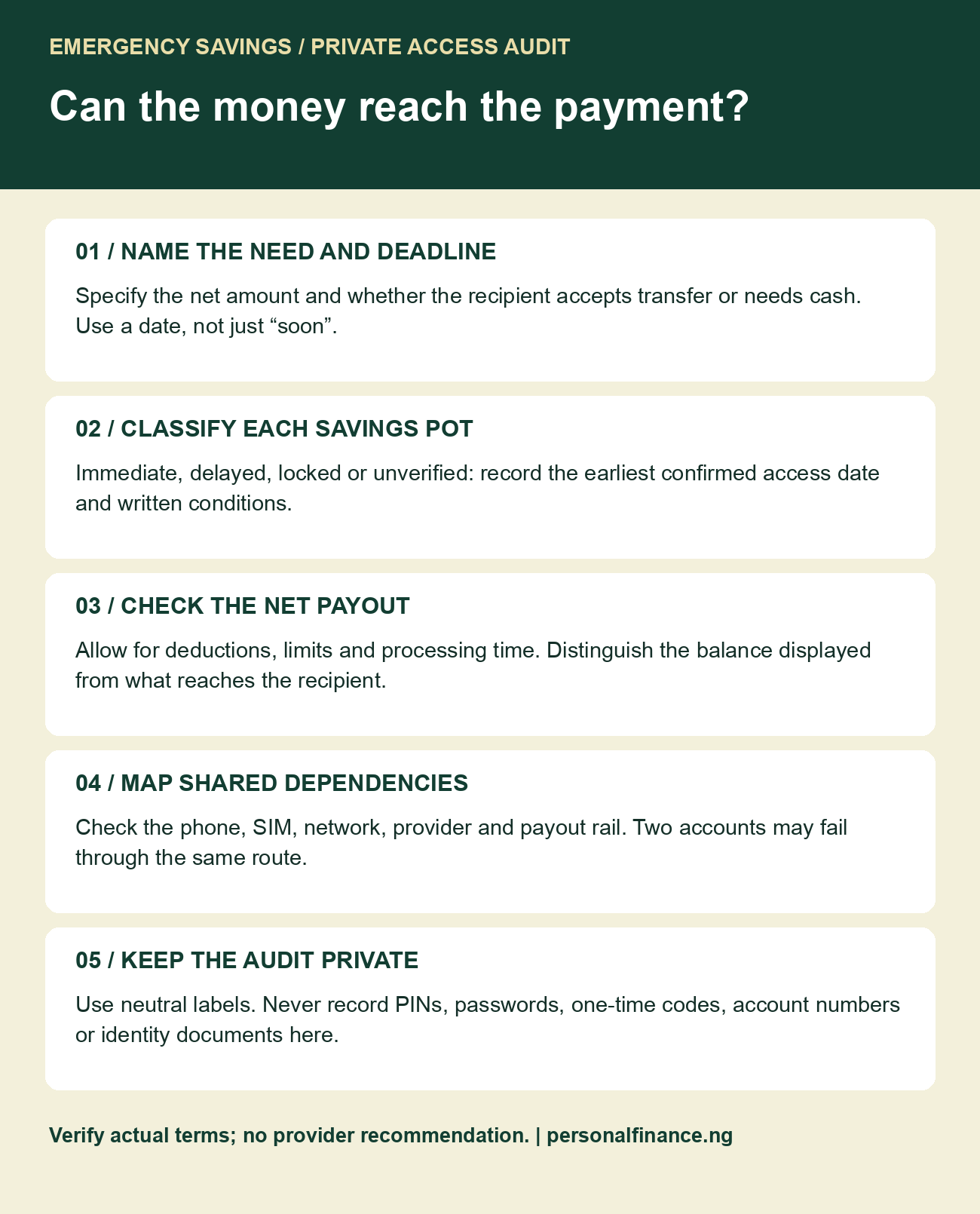
Check what happens if your phone or SIM is unavailable. Use the provider’s official recovery process and keep its support details somewhere you can access safely. If a payment needs physical cash, check the cash-out route and its availability too. Do not share credentials or bypass authentication to create a shortcut.
Download the private audit and source data
Use neutral labels such as “Fund A”. The worksheets need no PIN, password, one-time code, account number or identity document. Keep completed copies private. They organise evidence and questions; they do not certify a provider, guarantee access or recommend a product.
- Research extract with the outcome, limits and separate coping subset (CSV) preserves the reported measures.
- Fictional access, timing, payout-cost and route scenarios (CSV) reproduces the model values.
- Blank private savings access audit (CSV) records net funds, dates, limits and dependencies.
- Blank emergency payout-route checklist (CSV) records confirmed answers and unresolved barriers.
Blank cells mean unknown or not yet entered, not zero. Add only amounts you can support with current terms and evidence. When adding dated funds, use the net amount once and exclude unverified pots. After a product change or a failed withdrawal, revisit the classification instead of relying on an old successful test.
Methodology, sources and limits
We checked the original account and official listing on 6 November 2026. The retained EFInA-hosted PDF supplies Figure 1 and the statistical caveats. Our source CSV identifies the overall survey context without assigning 800 respondents to either individual group. No confidence interval or causal estimate has been invented.
Figures 2–5 are separate teaching models. They assume specified balances, access dates, deductions and route dependencies. They do not model interest, inflation, tax, provider failure probabilities or individual legal entitlements. The ₦75,000 research threshold is a study measure, not a recommended emergency-fund target. Choose your audit deadline and payment need from your own circumstances, with suitable professional guidance when needed.


