





NDIC coverage for multiple accounts in Nigeria depends on the depositor, legal institution, account capacity and eligibility. A second account number at the same bank does not automatically create another insurance ceiling. Start by identifying the arrangement before putting a limit beside a balance.
Voice of Nigeria’s 15 November 2026 report describes NDIC’s warning about unlicensed investment platforms. That is a fresh consumer-protection reminder, not the introduction of new coverage ceilings. We checked the limits below against NDIC’s official 30 September 2026 speech and its current FAQ, accessed 18 November.
NDIC coverage multiple accounts Nigeria: count the institution
Section 25(3) of the NDIC Act 2023 aggregates accounts held in the same right and capacity within one failed insured institution. Section 25(2) allows upward variation of the statutory baseline amounts; therefore the old amounts printed in the Act should not replace the later published ceilings. Our examples use the current DMB ceiling reported by NDIC.
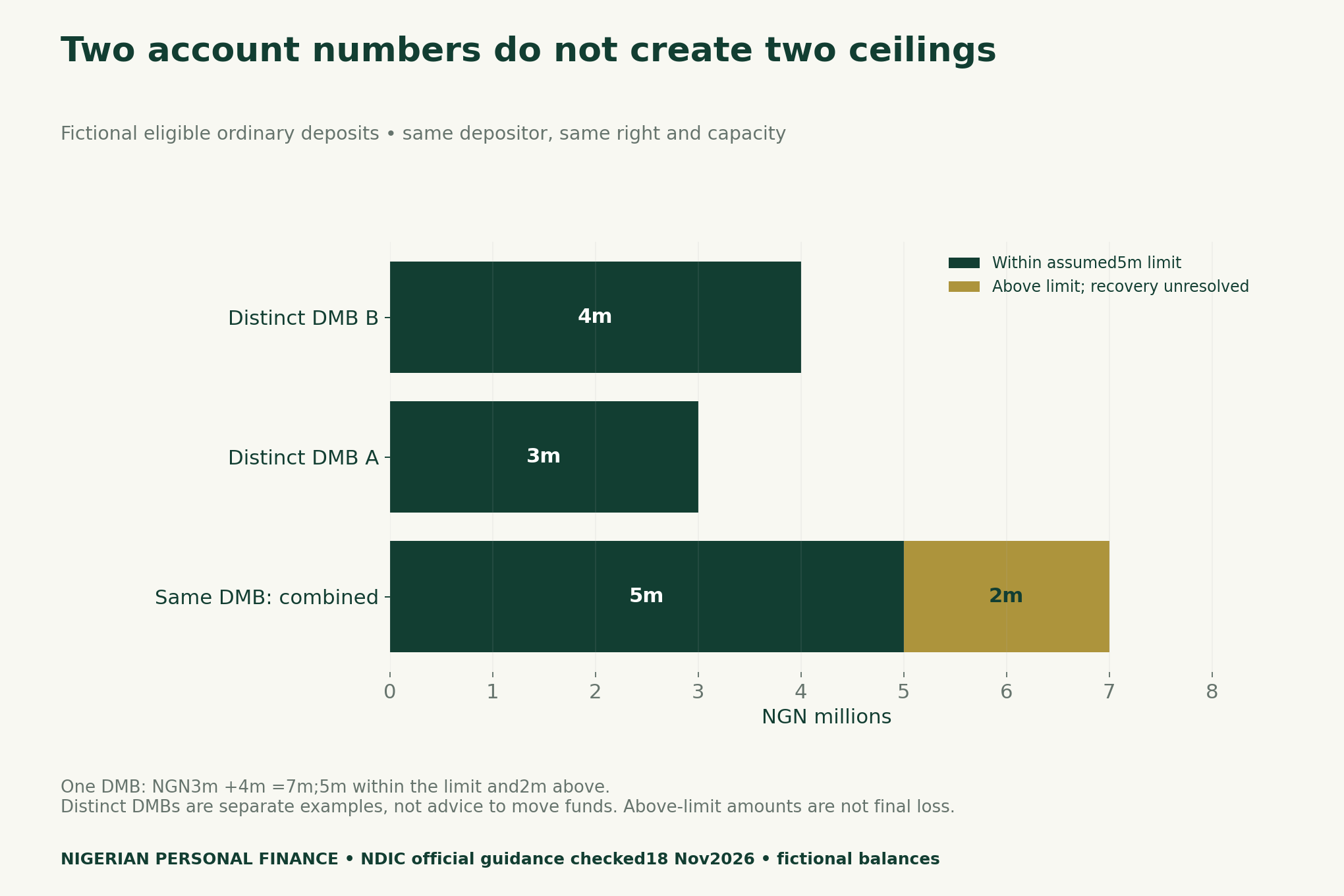
Suppose one person has eligible ordinary balances of NGN 3 million and NGN 4 million at the same deposit money bank, in the same right and capacity. The combined amount is NGN 7 million. Under the assumed NGN 5 million ceiling, NGN 5 million is within the limit and NGN 2 million is above it. Opening two account numbers does not turn the ceiling into NGN 10 million.
In a separate fictional case, NGN 3 million at DMB A and NGN 4 million at distinct DMB B each sit below the corresponding NGN 5 million ceiling. However, the condition is distinct legal institutions, not different branch addresses, account labels or app colours. These examples are deliberately simplified and do not determine an individual claim.
Use the relevant institution type and current guidance
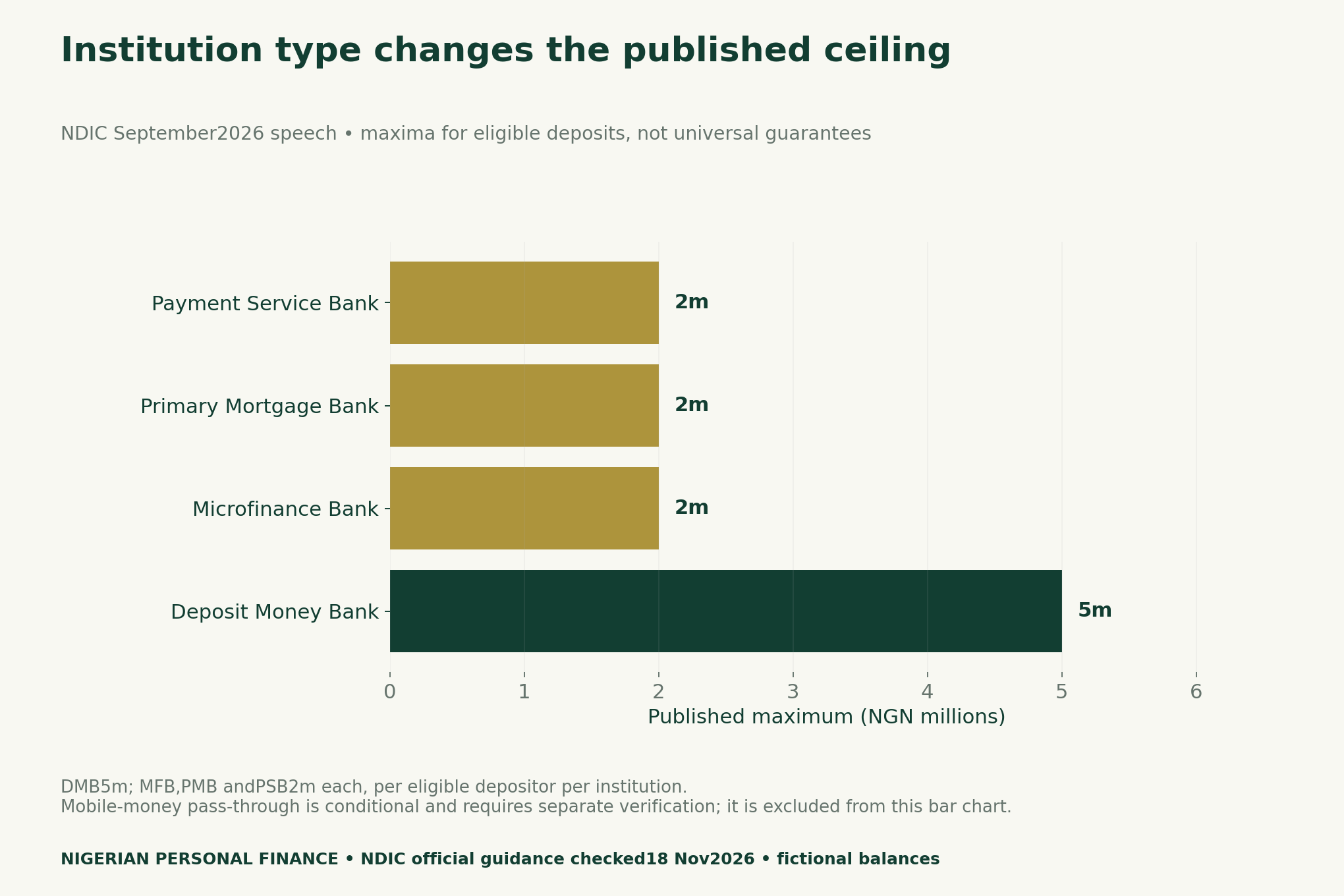
| Type or arrangement | Published ceiling | Qualification |
|---|---|---|
| Deposit Money Bank | Up to NGN 5 million | Per eligible depositor per institution |
| Microfinance Bank | Up to NGN 2 million | Per eligible depositor per institution |
| Primary Mortgage Bank | Up to NGN 2 million | Per eligible depositor per institution |
| Payment Service Bank | Up to NGN 2 million | Per eligible depositor per institution |
| Mobile-money subscriber | FAQ: up to NGN 5 million per subscriber perDMB | Pass-through eligibility, trust records and applicable aggregation must be checked |
For mobile money, the FAQ describes pass-through protection through pooled or trust accounts, subject to conditions about the trust relationship, subscriber records and identification. Its maximum-cover answer is framed per subscriber perDMB. Do not infer that every wallet or brand independently creates another NGN 5 million entitlement, especially where the underlying institution or capacity overlaps.
Likewise, joint accounts, trusts and other special arrangements need their own treatment. The simple ordinary-account examples do not resolve them. Record the question and ask NDIC or an appropriately qualified adviser about the actual arrangement. Do not change ownership labels or move money on the strength of this educational chart.
An amount above the ceiling is not an automatic final loss
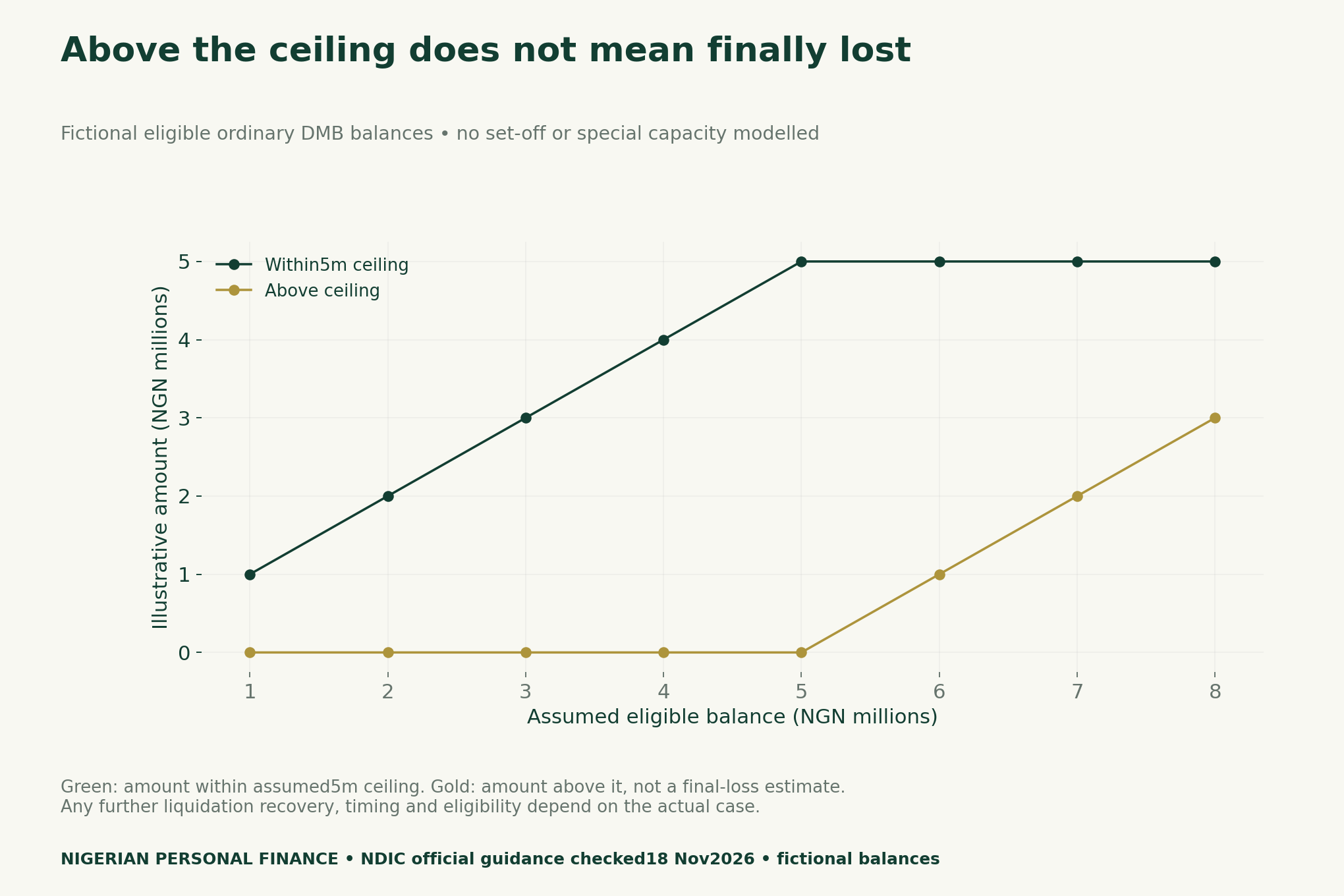
The official speech explains that NDIC can pay liquidation dividends from recoveries and asset realisations when balances exceed insured limits. Section 25(4) of the Act also preserves the possibility of liquidation dividends. That does not promise a recovery percentage, full repayment or a particular payment date.
Accordingly, label the NGN 2 million in the same-bank example as above the assumed insurance ceiling, not money definitely lost. Equally, do not present it as certain future cash. A household planning note can record the unresolved amount without pretending to know the outcome of a specific liquidation.
In addition, the calculations omit debt set-off and other case-specific adjustments. Section 26 addresses set-off powers. A private inventory may flag a debt relationship for clarification, but the blank tool does not decide how the law applies to an individual claim. Eligibility and verified institutional records remain central.
Verify legal identity without exposing private credentials
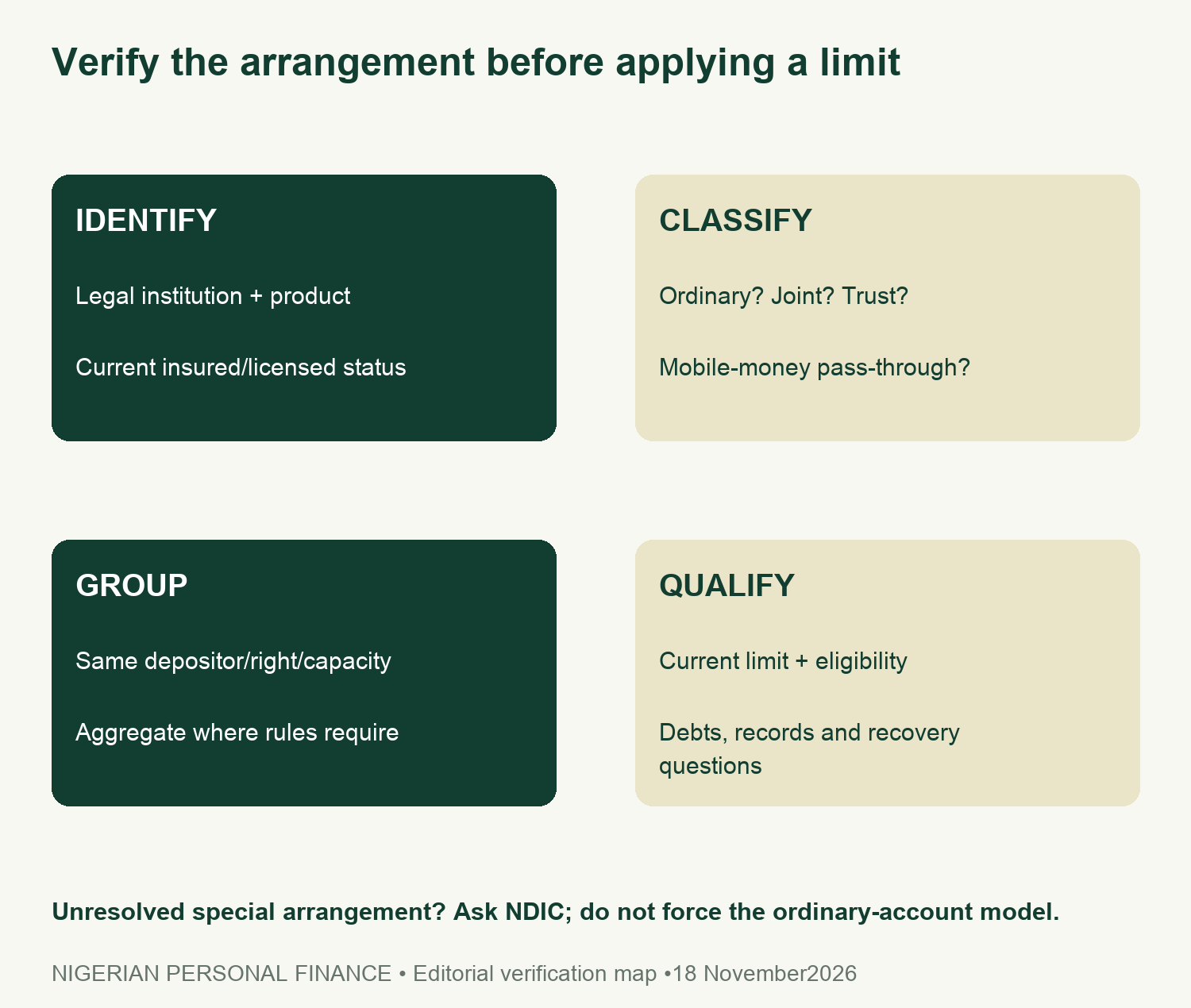
For each account or wallet, retain a private alias, the provider’s legal name, the product type and a dated official verification reference. Two marketing names can refer to a shared institution, while a familiar logo does not establish that a specific investment product is an insured deposit. Verify the institution and the product rather than relying only on branding.
Use official NDIC and CBN channels to check status. A request for an OTP, PIN or password is not part of this worksheet. Do not publish account numbers, BVNs or balances in comments or send them to unsolicited contacts. Keep the inventory private and record only what is necessary for your own review.
Finally, deposit insurance for an eligible institution’s failure is not a guarantee of investment returns or a universal refund for fraudulent transfers. These are different risks with different remedies. A provider’s insured-deposit relationship should not be used to advertise every investment or transaction as loss-free.
For a related definition check, our income-statistics guide shows why a number needs its scope and unit beside it. The same habit helps here: a coverage ceiling without the legal institution and eligibility conditions is incomplete information.
Method, assumptions and four downloadable tools
We checked the official speech, FAQ and current Act file on 18 November 2026. The three charts use published ceilings and invented eligible balances. They assume ordinary same-capacity deposits where stated and omit individual adjustments. We do not rate institutions, access depositor records or tell readers to transfer funds.
Your Personalized Financial Plan
Get expert financial advice tailored exclusively to your goals. Receive a custom roadmap in just 1-3 business days.
Get Started- Official coverage and qualification dictionary (CSV)
- Fictional same-bank and distinct-bank examples (CSV)
- Blank private legal-institution inventory (CSV)
- Coverage-verification question sheet (CSV)
Suggested citation: Nigerian Personal Finance, “NDIC Deposit Cover: Count Banks, Not Account Numbers”,18 November 2026. Sources: NDIC Act 2023, sections 25–26; 30 September 2026 official speech; current pass-through FAQ; and the 15 November warning report. Original fictional comparisons by this publication. Check current official guidance for a real claim.