





To verify Black Friday discount Nigeria checkout price claims, ask two separate questions. Is the advertised past price supported by comparable evidence? And does the full price today beat another comparable offer? A large percentage label does not answer both.
Jumia Nigeria’s 2026 campaign page lists 30 October to 30 November and promotes discounts of up to 60%. That is a campaign ceiling, not an average saving or our verification of any item. This report uses invented prices to show how to check a claim without making a purchase.
Verify Black Friday discount Nigeria checkout price: read “up to” carefully
An “up to” statement describes a maximum within a promotion’s scope. It does not establish the discount on the item, seller, size or variant you need. First, identify the exact listing and read its own terms. Then keep the headline separate from your evidence about that product.
Jumia’s 18 November SEC-filed earnings release discusses a slower Black Friday start at Group level, primarily linked to Ivory Coast. It does not verify Nigerian item-price histories or a new discount depth. We use it as dated business context, not as evidence that a particular shopping basket is cheaper.
Also distinguish a platform’s sales performance from your household decision. More or fewer orders do not establish whether two listings are comparable. The useful evidence sits at the exact product, seller, delivery and conditions level, with a date attached.
A synthetic discount label: correct arithmetic, unverified history
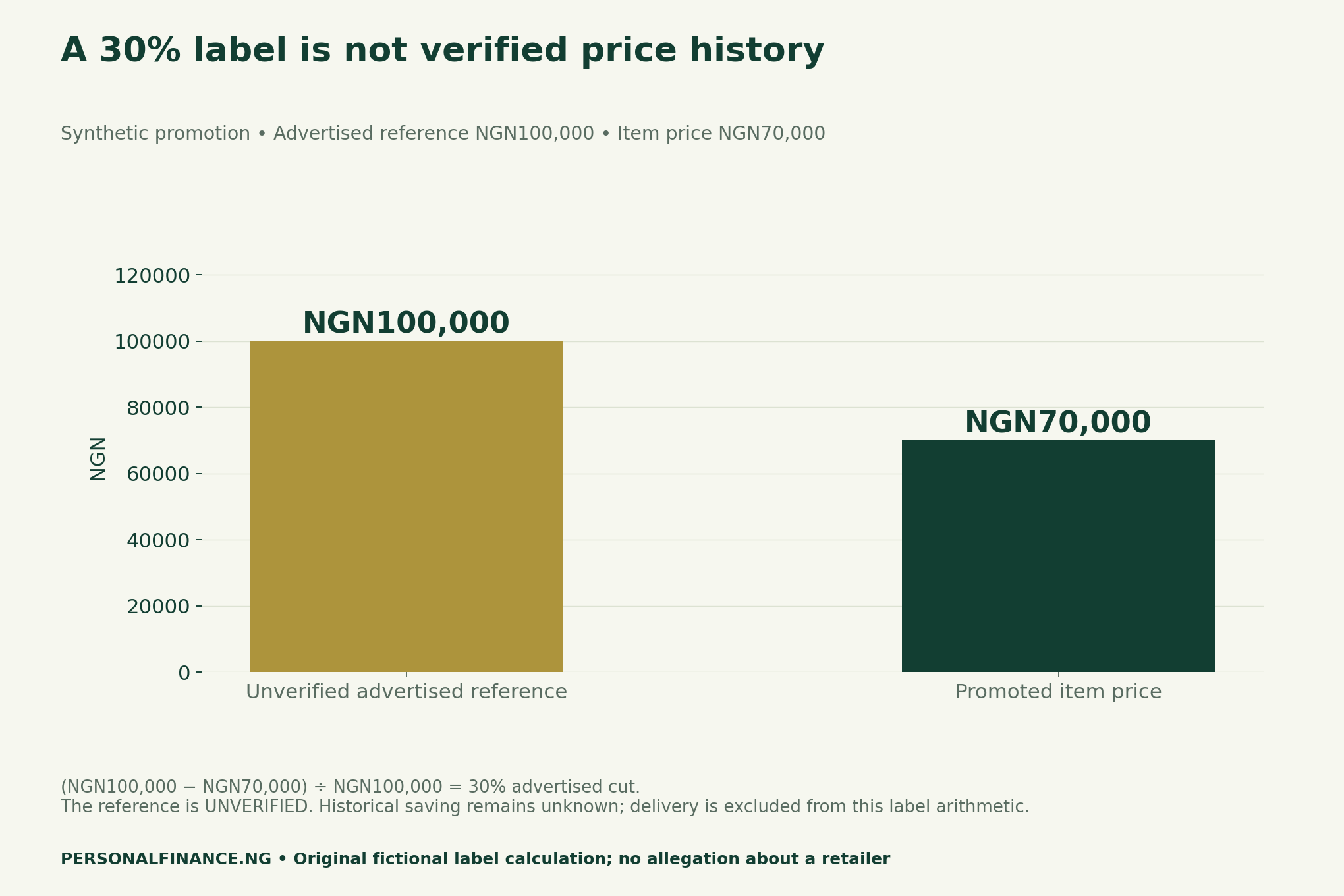
Suppose a fictional listing shows ₦70,000 beside a struck-through ₦100,000. The displayed arithmetic is (₦100,000 − ₦70,000) ÷ ₦100,000 × 100 = 30%. That tells you how the label works. It does not prove the item previously sold at ₦100,000 under comparable conditions.
Put the struck-through figure in the advertised-reference field. Put a genuinely supported prior paid price or date-stamped quote in a different field, with its source. If you do not have that evidence, leave historical savings blank. Unknown history is not a zero saving or proof of deception.
Check the comparison date and product identity as well. A price for another storage capacity, a used item, a different quantity or a bundle cannot silently become the prior price of your chosen product. Record those differences rather than forcing a percentage calculation.
Compare what leaves your account at checkout
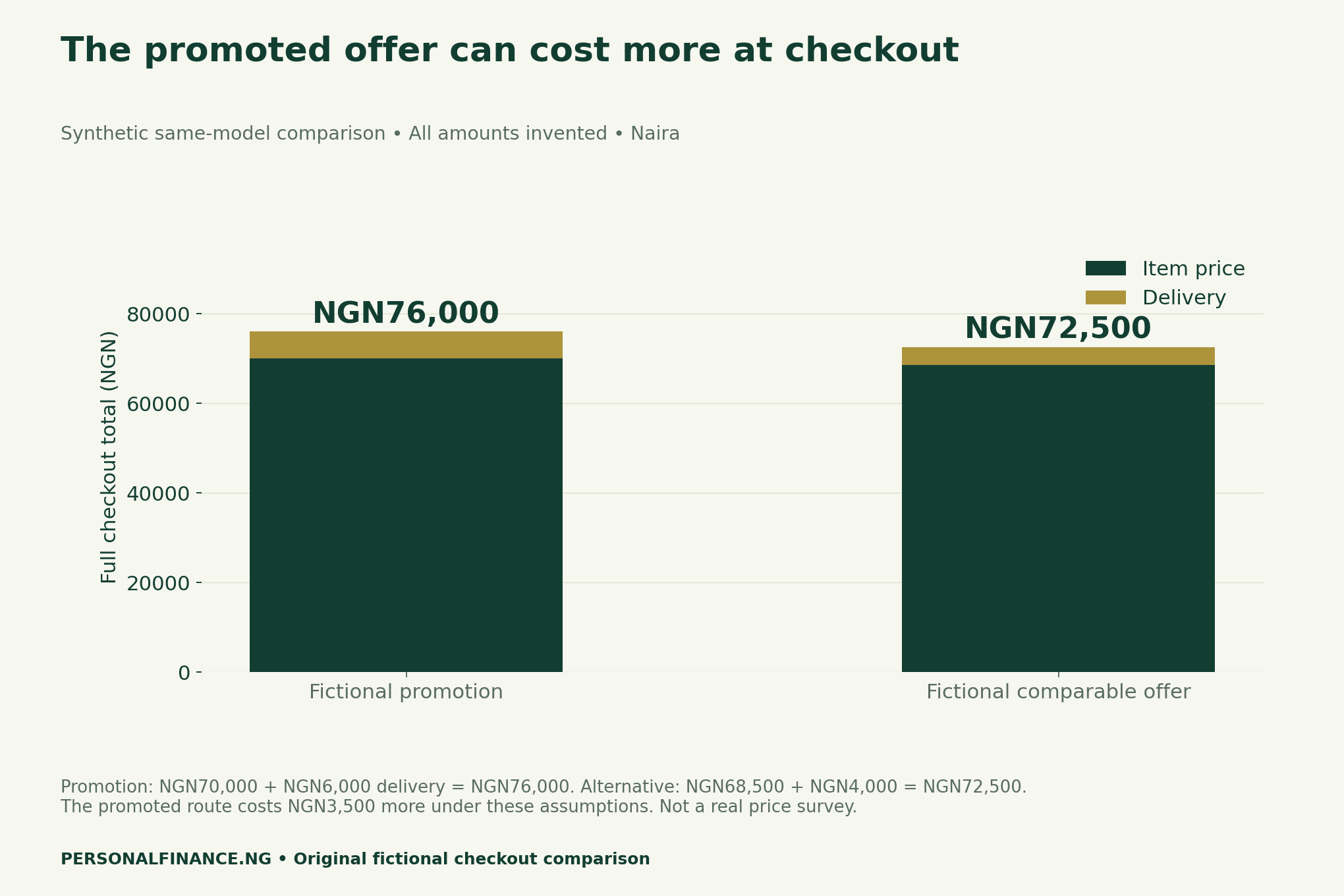
Now add ₦6,000 delivery to the fictional ₦70,000 promotion. Its full total is ₦76,000. Assume another comparable offer has an item price of ₦68,500 and delivery of ₦4,000. That total is ₦72,500. The promoted route costs ₦3,500 more under these invented assumptions.
Notice that this comparison needs no verified past price. It compares one current full total with another current full total. You can make that narrower comparison while honestly leaving historical savings unresolved. However, the conclusion only holds while the offers remain available on the same relevant terms.
Include unavoidable charges for the destination and quantity you would actually use. If delivery changes after entering an address, compare that final amount before payment. Do not complete an order just to test a worksheet, and do not count an optional extra as unavoidable without explaining the choice.
Use two evidence columns before deciding
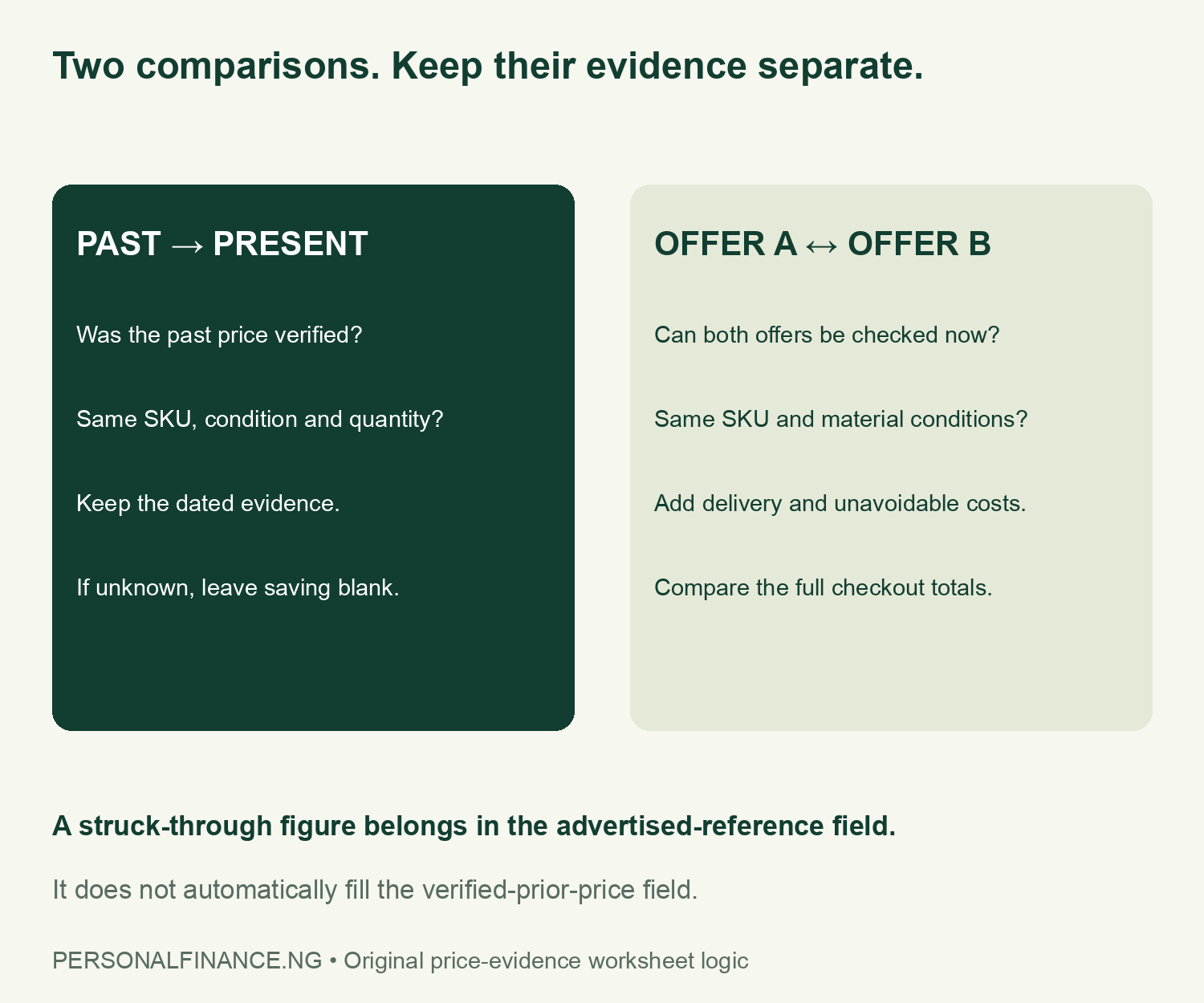
The blank worksheet starts with the observation time, seller, URL, exact SKU, variant, condition and quantity. It then separates advertised reference from verified prior evidence. Finally, it records item price, delivery, other unavoidable costs, full checkout amount, warranty and return conditions.
A lower total does not remove material differences in warranty, returns or seller identity. If those terms differ, describe the trade-off instead of ranking the offers on price alone. If the exact model is unclear, pause the comparison and ask the seller through the platform’s official channel.
The FCCPC’s consumer-rights explanation discusses understandable information and full price disclosure. It is existing general guidance, not a new November enforcement notice. Specific return rights and exceptions depend on the circumstances; this worksheet does not promise a blanket refund rule.
Method, limits and downloadable comparison tools
We checked the campaign page, dated earnings release and FCCPC explanation on 22 November 2026. The two charts reproduce our synthetic arithmetic, not observed shopping data. We did not survey item prices, test a seller, verify stock or establish whether a live discount was genuine.
Your Personalized Financial Plan
Get expert financial advice tailored exclusively to your goals. Receive a custom roadmap in just 1-3 business days.
Get StartedUse the source-boundary register when citing the news context and the calculation dictionary when adapting the model. For another budgeting example where one percentage does not describe the whole cost, see our CNG commute-budget report. Its fares are also fictional and clearly labelled.
- Black Friday source and claim boundaries (CSV)
- Synthetic checkout comparison and blank historical fields (CSV)
- Blank price-evidence and checkout worksheet (CSV)
- Discount and full-cost calculation dictionary (CSV)
Sources: Jumia Nigeria campaign page; Jumia SEC-filed results, 18 November 2026; FCCPC consumer-rights explanation. Suggested citation: Nigerian Personal Finance, “Black Friday Discounts in Nigeria: What Was the Real Comparison Price?”, 22 November 2026. All numerical shopping examples are fictional original editorial calculations.


