






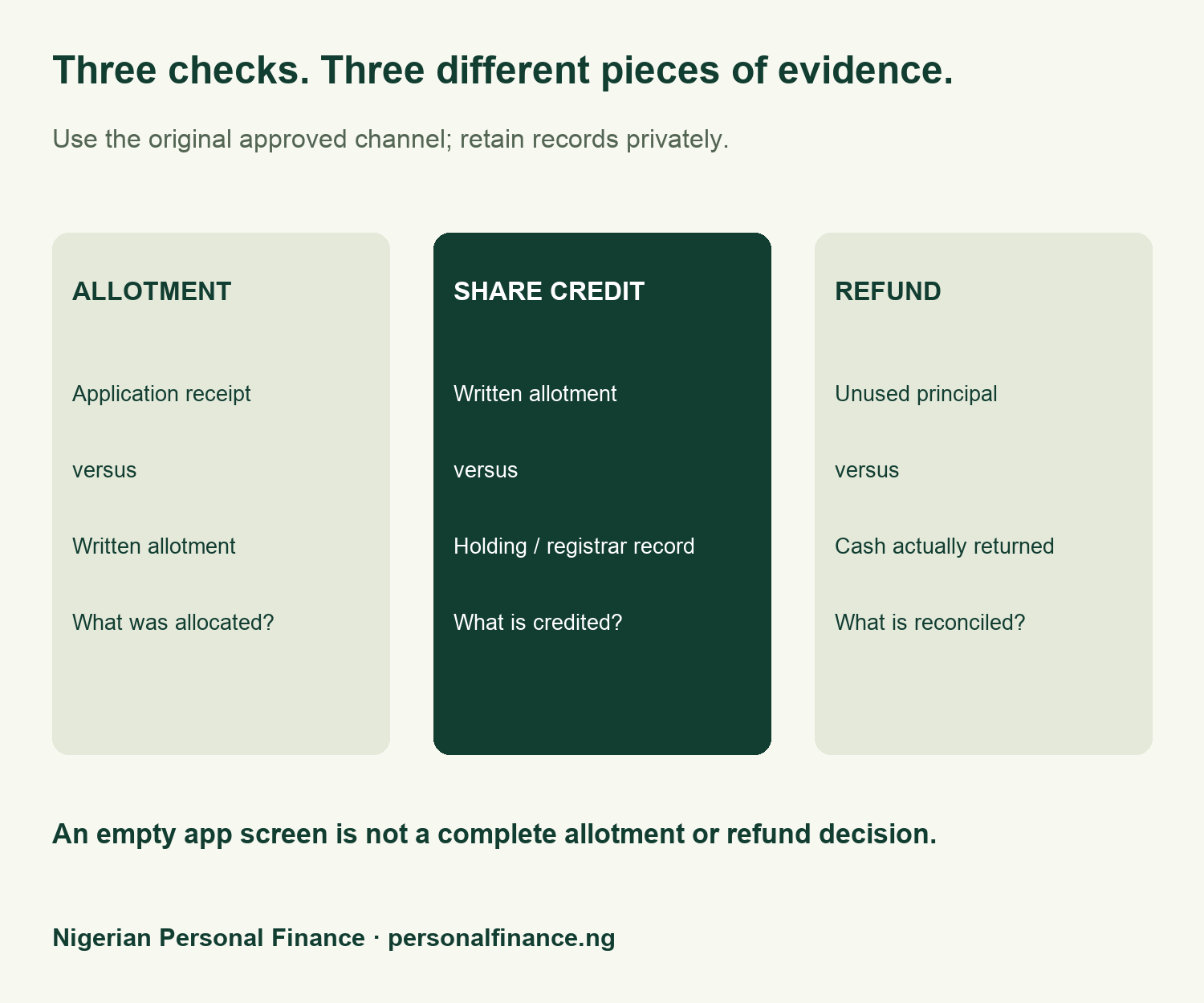
Dangote IPO allotment and refund checks answer different questions. For example, a written allocation, a credited holding and money returned to your bank are separate records. If you already applied, start with the approved bank, app or broker you used and reconcile each stage on its own evidence.
This report includes two charts, a three-ledger infographic and four CSV tools. It does not determine your allocation or tell you to buy or sell. The public offer closed on 27 October 2026. Do not treat this post as an invitation to submit a fresh subscription.
What the 25 November update reports
The refinery’s 25 November update reports approval of the allocation plan, with 5.196 billion shares in the schedule at ₦525 each, against 11.15 billion shares applied for. It describes an early-December listing target without a formally confirmed exact date. However, these are issuer-reported aggregate figures, not a personal holding statement or verified trading start.
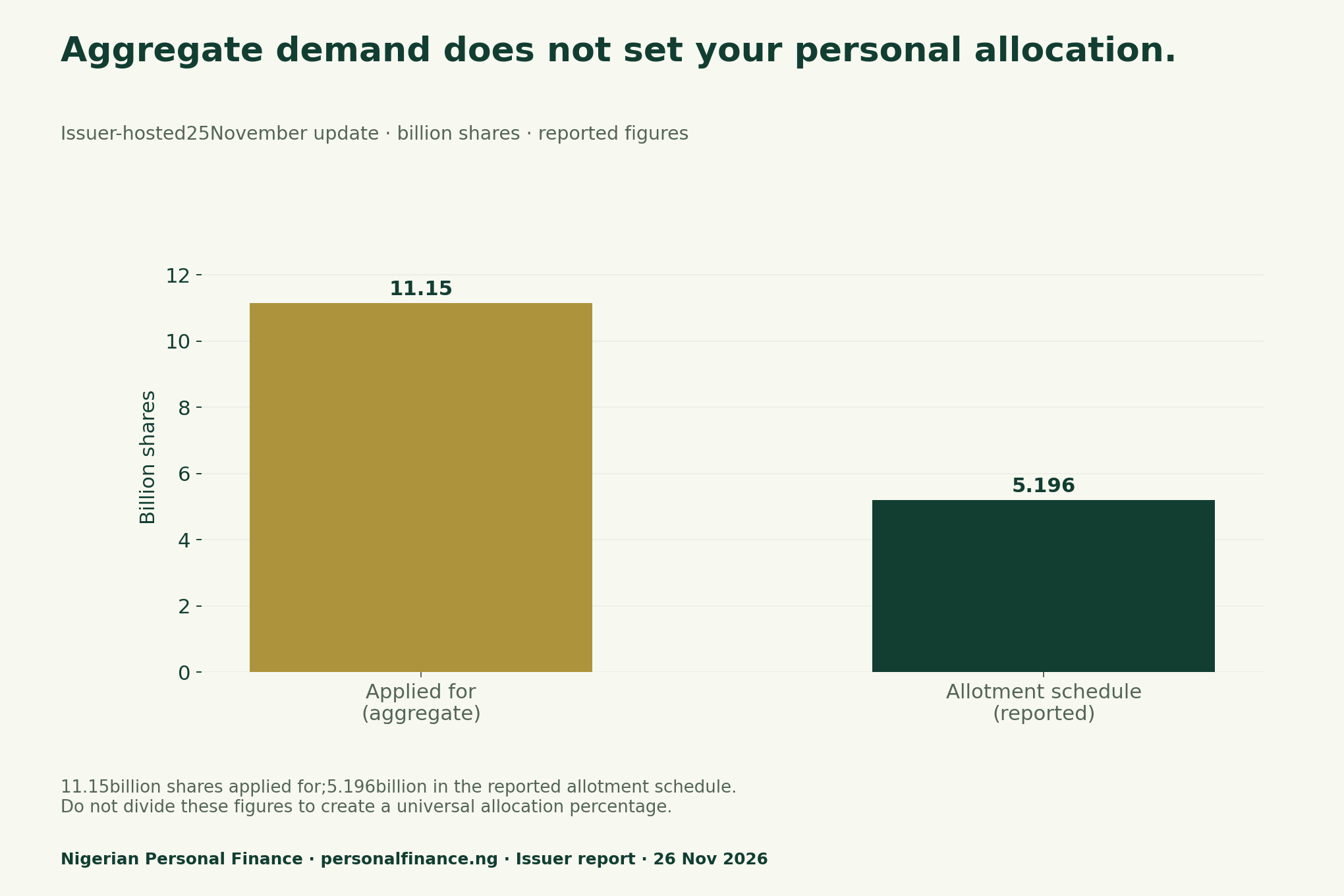
The issuer report also says subscription categories up to 10 million shares were expected to receive full requests. That matters when reading our small hypothetical example below. Therefore, a 100-share application with a supposed 60-share allocation is not presented as the announced treatment of a small applicant. If your own records show such a mismatch, ask the original channel to verify it.
Check one: application receipt versus written allotment
First, find the receipt or confirmation from the channel through which you applied. Keep the requested quantity and the local reference beside the written allotment information. However, a payment debit proves a different event from a confirmed allocation. Therefore, if you cannot find the written outcome, record “not confirmed” rather than estimating shares from the aggregate demand chart.
The official offer portal’s post-close instructions direct applicants to their original bank, app or broker. The portal still displays application-checking information when checked on 26 November. Its general status screen and the dated issuer report are different updates; neither replaces the application-specific written result you need to reconcile.
Check two: allotted shares versus the credited holding
Next, compare the written allocation with the holding evidence. However, do not assume that a blank app view means the registrar allotted no shares. Record what the statement actually shows and which system it comes from. Ask the channel how to verify the credit with the relevant account or registrar record.
The official post-close guidance explains that applicants without a CSCS account can have shares held under a Registrar Identification Number until the required CHN and CSCS details are supplied. Use the official registrar route. Our worksheet deliberately contains no BVN, account number, PIN, password or OTP field; keep identity and account evidence private.
Dangote IPO allotment and refund: replay the principal arithmetic
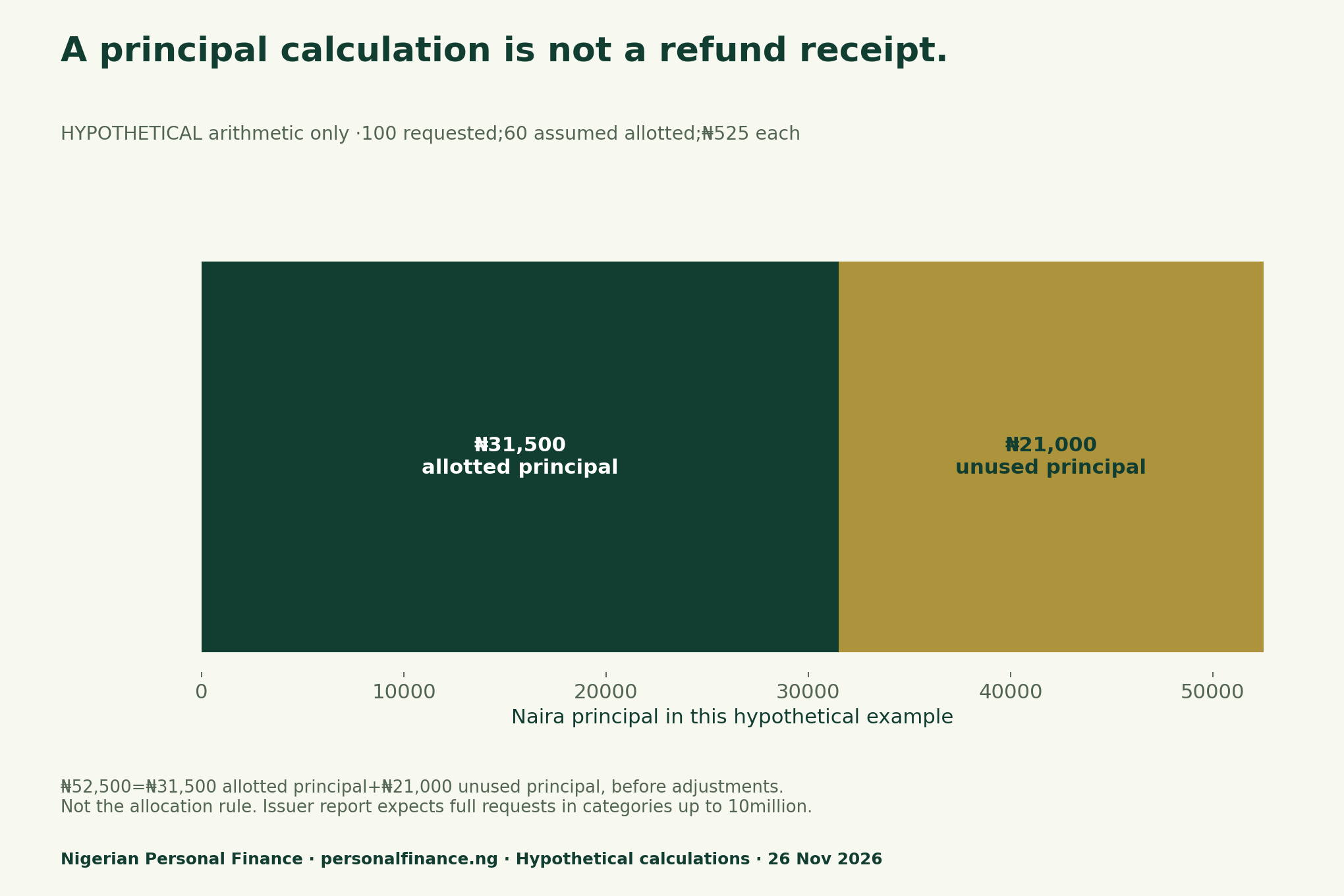
For arithmetic practice only, suppose 100 shares were requested and a written result showed 60 allotted at ₦525 each. The subscription principal would be 100 × 525 = ₦52,500. The principal represented by the 60 shares would be 60 × 525 = ₦31,500. The unused subscription principal would therefore be 40 × 525 = ₦21,000.
This is a hypothetical reconciliation exercise, not the official allocation formula or a prediction for small applicants. The issuer report’s expected full treatment of categories up to 10 million shares should not be replaced by our invented 100/60 inputs. For a real case, use the actual written quantities and query any discrepancy.
| Hypothetical item | Calculation | Result |
|---|---|---|
| Requested principal | 100 × ₦525 | ₦52,500 |
| Allotted principal assumed | 60 × ₦525 | ₦31,500 |
| Unused principal | (100 − 60) × ₦525 | ₦21,000 |
Check three: unused principal versus cash actually returned
Similarly, a calculation and a bank receipt are different evidence. Keep the unused-principal calculation separate from any interest, profit or other confirmed adjustment. Then record the cash actually returned and the date shown in your private records. Leave an unexplained difference open until the channel provides a written reconciliation.
Before describing a refund as overdue, verify the applicable official terms, the relevant announcement or trigger date and the evidence for your own application. A news date, a general target and the date you noticed an empty app are not automatically the same deadline. This article does not calculate a personal payment due date.
Confirm listing separately and use verified channels
Finally, share credit does not itself prove that exchange trading has begun. Check a current official exchange or issuer confirmation for that separate event. Therefore, a target month is not a guaranteed start date or a promised future price. Do not use the offer price as a forecast of what you could receive in a later sale.
The SEC’s IPO circular advises use of approved channels and verification of websites and operators. Be cautious with unsolicited messages offering guaranteed allocations. Never put a PIN, password or OTP into a public worksheet or share it with someone claiming to fix a refund. Contact the channel through a destination you have independently verified.
Download the three-ledger tools
The source-facts file preserves reported aggregates and their limits. The arithmetic file exposes every hypothetical input. The blank ledger separates the three checks, and the boundary register explains what each record can establish. We use two charts because extra charts would not produce missing application-specific evidence.
Your Personalized Financial Plan
Get expert financial advice tailored exclusively to your goals. Receive a custom roadmap in just 1-3 business days.
Get Started- Reported offer facts and source boundaries (CSV)
- Hypothetical principal calculation, not an allocation rule (CSV)
- Blank allotment, credit and refund ledger (CSV)
- Evidence checks and limits register (CSV)
Browse Investing and Research & Reports. Suggested citation: Nigerian Personal Finance, “Dangote IPO Allotment and Refund: Check Three Records”, 26 November 2026.