






A loan interest rate change notice in Nigeria needs more than a policy-rate headline. If an instalment changes, compare the agreement, the notice and the revised repayment schedule. Then hold the balance, remaining term and interest method constant before deciding which part of the difference comes from the rate.
This report provides two reproducible charts, a document-comparison infographic and four CSV tools. The figures describe an invented loan, not a lender offer or a ruling on your account. Keep personal account details and supporting documents private when using the blank worksheet.
What the November policy decision tells you
The CBN’s 24 November 2026 MPC communiqué records a hold at a 23% Monetary Policy Rate after the 23–24 November meeting. That is a policy benchmark. It does not by itself rewrite an existing loan agreement, establish your personal interest rate or explain a different debit on your statement.
For example, an unchanged benchmark and a changed instalment can coexist. However, that observation does not show that the lender’s calculation is correct. First identify the exact contract provision and the inputs behind the revised schedule. A headline alone cannot supply the missing link.
Read the loan interest rate change notice in Nigeria
The CBN Consumer Protection Regulations apply to institutions within the CBN’s regulatory scope. Section 3.2.5 ties variations to an express contract provision. Section 4.4.6 calls for prior notice explaining the reason, start date, a revised schedule where necessary and available alternatives. Read these requirements alongside the actual agreement.
Section 4.4.7 of that 2019 text distinguishes ten working days for deposit money banks from five for other covered institutions. Therefore, do not turn one number into a universal notice period for every lender or product. Confirm the institution’s status, the applicable rules, the notice receipt evidence and the proposed effective date before assessing a particular case.
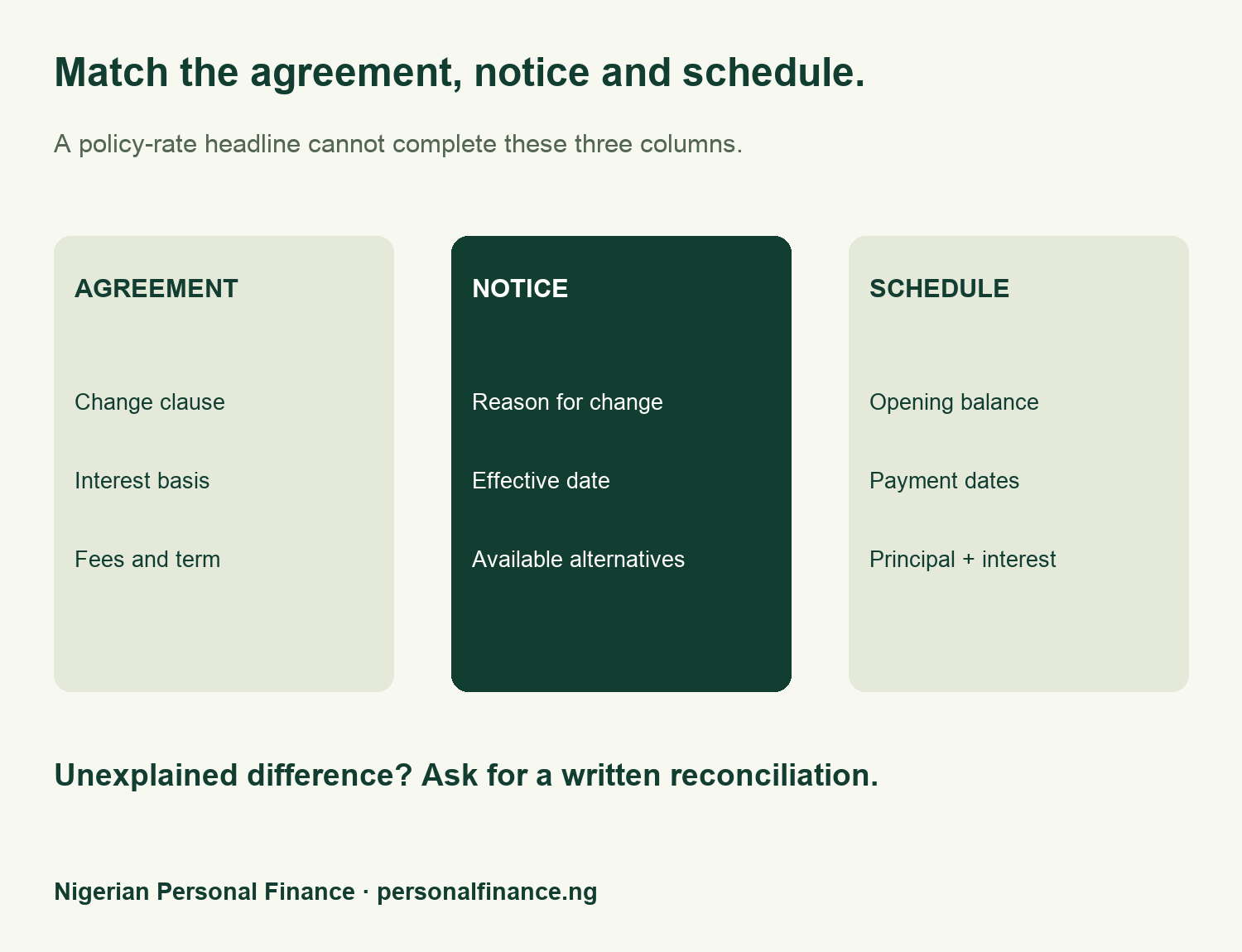
Our blank register turns the document check into columns. Copy the relevant wording or a private local reference into each column. If the notice mentions a revised rate but omits the calculation basis, mark that field “not explained” and ask a precise question. An empty cell is a question to resolve, not proof of a breach.
Replay a fictional loan on equal terms
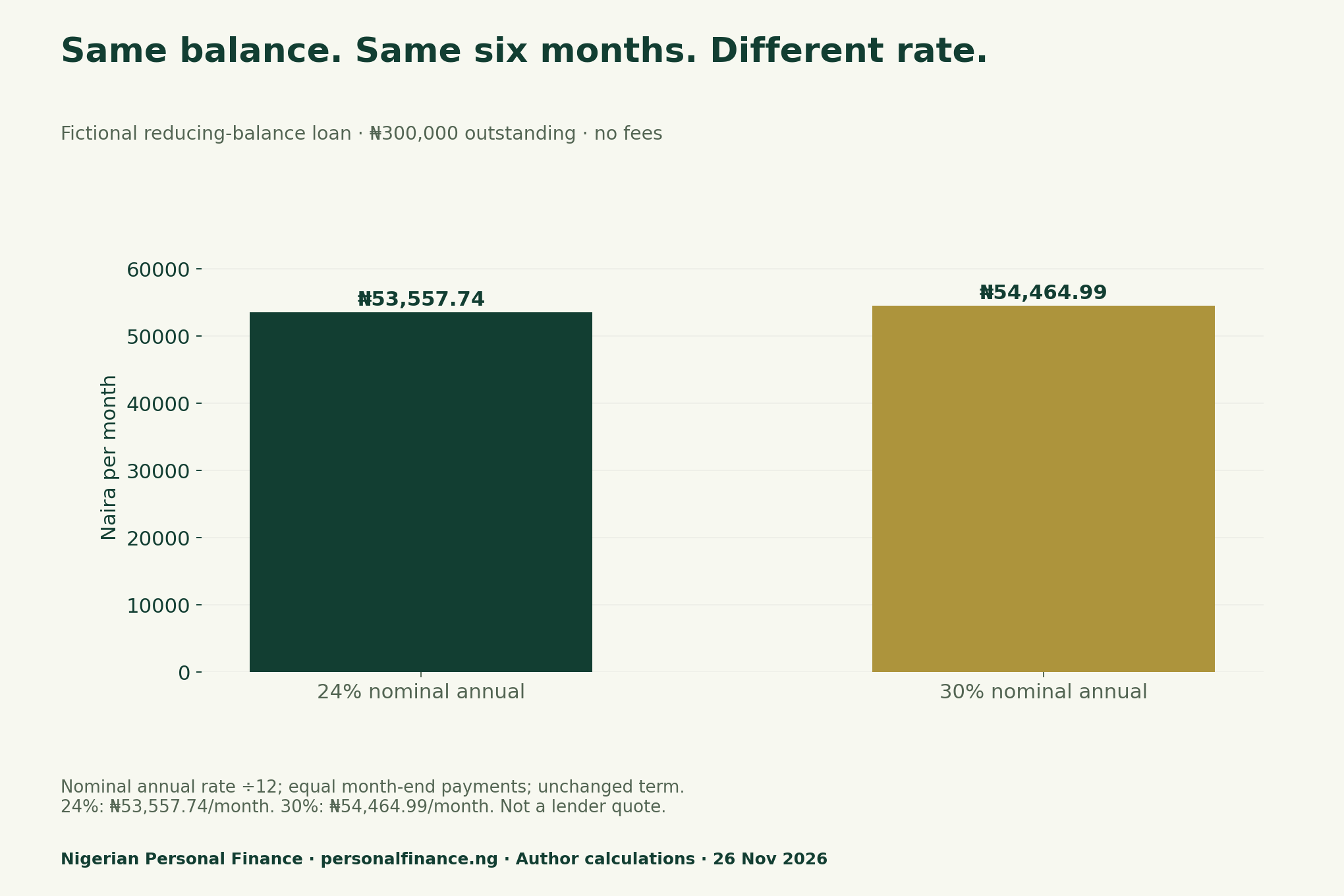
Suppose ₦300,000 remains outstanding, with six equal monthly payments left. For this example, interest runs on the reducing balance. We divide a nominal annual rate by twelve and place each payment at month-end. We exclude fees, insurance, arrears and any change in term. These assumptions stay the same in both scenarios.
The payment formula is P × r ÷ [1 − (1 + r)−n], where P is the opening principal, r is the monthly rate and n is the number of remaining payments. Thus, the 24% annual scenario uses r = 0.02, while the 30% scenario uses r = 0.025. Both use n = 6.
| Model input or result | 24% annual scenario | 30% annual scenario |
|---|---|---|
| Principal outstanding | ₦300,000 | ₦300,000 |
| Remaining month-end payments | 6 | 6 |
| Monthly rate | 2% | 2.5% |
| Payment, displayed to two decimals | ₦53,557.74 | ₦54,464.99 |
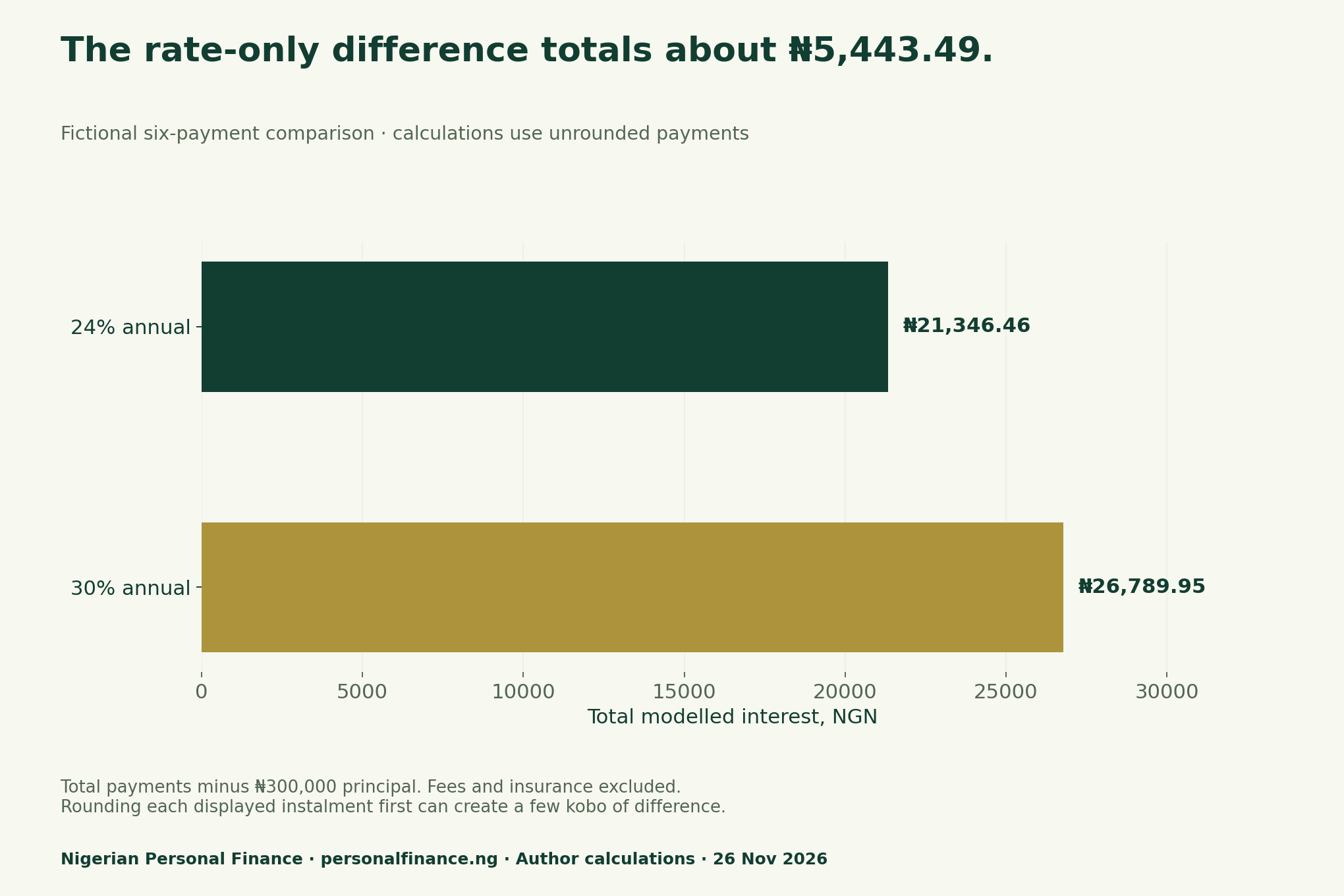
| Six payments, using unrounded figures | ₦321,346.46 | ₦326,789.95 |
The monthly difference is about ₦907.25. Across six payments, the difference is about ₦5,443.49 using unrounded values. However, multiplying the two-decimal display figures first can produce a small kobo difference. The downloadable schedules retain the underlying precision so another reader can reproduce the result.
Separate rate changes from other moving inputs
Next, compare the opening balance on the same date. A new disbursement, an unpaid instalment or a posted charge can change that balance. Similarly, five payments left and six payments left are different comparisons. Do not attribute the whole difference to interest when the term or principal also moved.
Check whether the old and new rates use the same basis. For example, a flat-rate description and a reducing-balance schedule cannot be compared by matching the headline percentages alone. Ask the lender to identify the method, payment frequency and each separate fee. Keep those questions beside the relevant schedule row.
A residual difference is simply the amount your controlled replay cannot yet explain. It might reflect rounding, dates, a different rate convention, fees or an incorrect input. Therefore, label it “unexplained” until you receive a written reconciliation. The worksheet does not decide which party is right or replace specialist advice.
Ask a specific written question
For example: “Please identify the agreement provision supporting this variation, confirm the reason and effective date, and provide the revised schedule showing opening balance, interest, principal and fees. Please explain the alternatives available and reconcile the difference from my attached calculation.” Use verified lender channels and retain the acknowledgment privately.
Finally, distinguish final rules from consultation material. The CBN’s 21 April 2026 Guide to Charges circular describes an exposure draft inviting public comments. A filename containing “Signed” does not turn that draft into proof of a final operative fee rule. This report does not use its proposed charges to validate a debit.
Your Personalized Financial Plan
Get expert financial advice tailored exclusively to your goals. Receive a custom roadmap in just 1-3 business days.
Get StartedDownload the notice and schedule tools
The twelve-row schedule file exposes each month’s opening balance, interest, payment, principal and closing balance. The summary retains unrounded results. The blank comparison register collects document questions without requesting account numbers, PINs or OTPs. The source register keeps the policy benchmark, notice rules and draft status separate.
- Both fictional six-month repayment schedules (CSV)
- Fictional scenario inputs and unrounded totals (CSV)
- Blank agreement, notice and schedule comparison (CSV)
- Official sources and scope boundaries (CSV)
Explore Debt Management and Research & Reports. Suggested citation: Nigerian Personal Finance, “Loan Interest Rate Change Notice Nigeria: Check the Schedule”, 26 November 2026. Two charts answer two distinct questions; additional figures would not establish missing contract facts.