






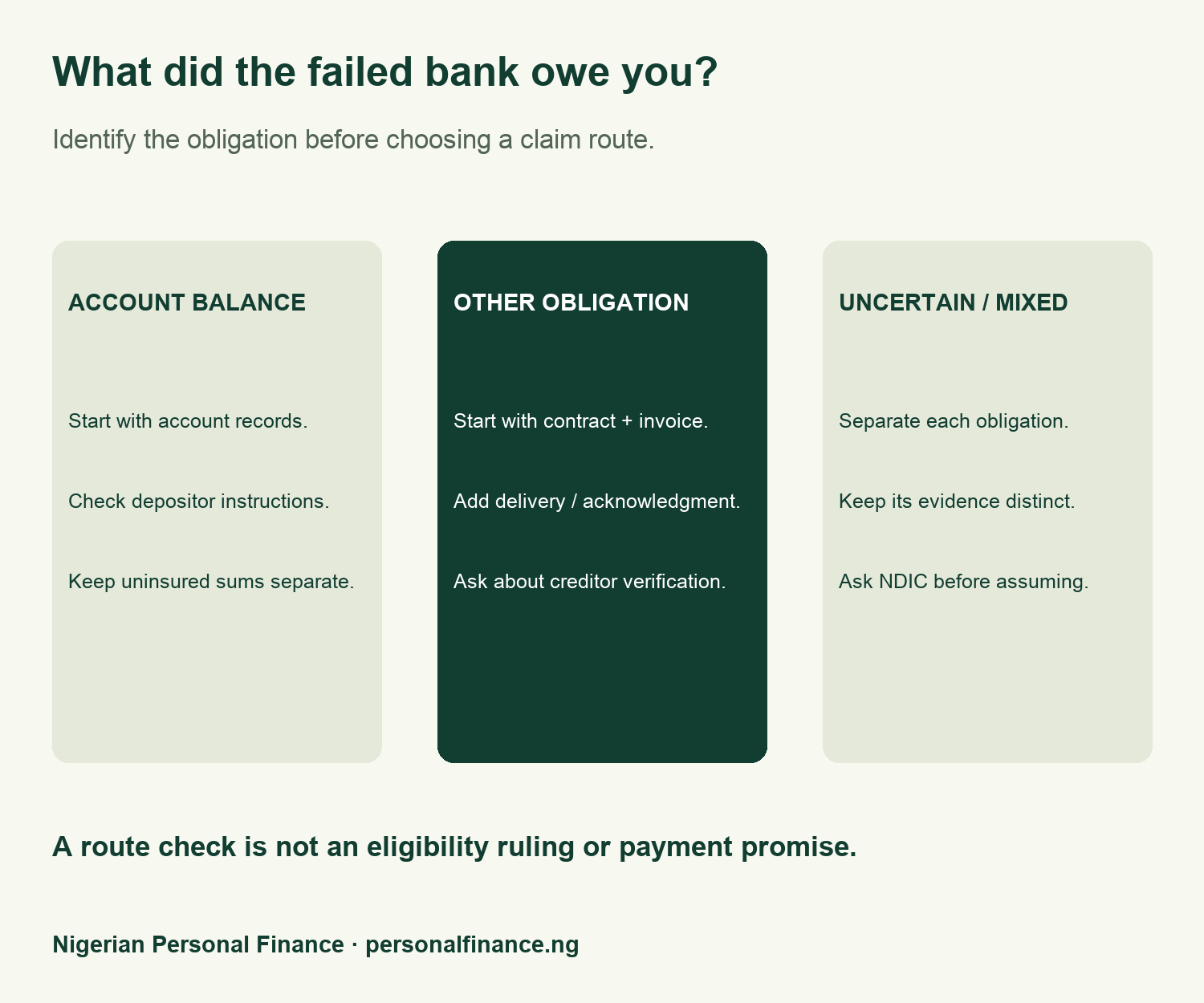
An NDIC creditor claim versus depositor claim starts with what the failed bank owed you. An account balance and an unpaid service invoice need different evidence. Therefore, do not choose a depositor form simply because the organisation owing you money used to be a bank.
This report uses the 24 November 2026 Financial Merchant Bank notice as a current route-check example. It includes a decision-map infographic, one evidence-boundary chart and four CSV tools. It does not admit a claim, set legal priority or promise a payment date. Keep identifying documents and account records private.
Read who the current notice names
The NDIC notice to Financial Merchant Bank creditors says the liquidator is processing a first tranche of liquidation dividends for eligible creditors. It directs them to the website’s Your Claims area and Creditors Form, or the offices listed for verification. The official announcements index dates the notice 24 November 2026.
However, the notice does not publish a distribution percentage. It does not turn every debt someone says the bank owes into an accepted claim. Read the named institution, claimant group and verification instructions together. A notice for a different bank or a different class of claimant may describe a different process.
NDIC creditor claim versus depositor claim: identify the obligation
The NDIC’s failure-resolution explanation distinguishes insured deposit payments from later liquidation dividends linked to recoveries. The NDIC Act 2023, section 57 supplies a framework for liquidation and proved claims. Neither source lets this article determine the correct legal classification or outcome of a reader’s individual claim.
For a deposit balance, begin with the account evidence and the relevant official depositor instructions. For a non-deposit obligation, begin with the transaction that created it. For example, a service contract, invoice and delivery record can explain why a supplier says the bank owes money. Those records answer a different question from a savings-account statement.
If the basis is mixed or unclear, separate the records before asking NDIC for guidance. A person may hold account evidence and a service invoice, but that does not make the two amounts one deposit. Similarly, a document headed “invoice” does not itself settle legal classification. Record uncertainty rather than forcing a route.
Audit a fictional ₦120,000 service invoice
Suppose a small service provider holds an unpaid ₦120,000 invoice. This is an invented teaching case, not a named claimant or an NDIC-approved debt. First, retain the contract or instruction, invoice, evidence of completed work and any acknowledgment. Then note which evidence exists and which part remains disputed or missing.
The invoice face value is ₦120,000. However, the admitted amount is unknown until the relevant decision confirms it. The distribution rate for the notice is not announced in the source. Cash received is also unknown in this example. Therefore, the worksheet leaves those fields as unknown rather than inventing zeroes or a percentage.
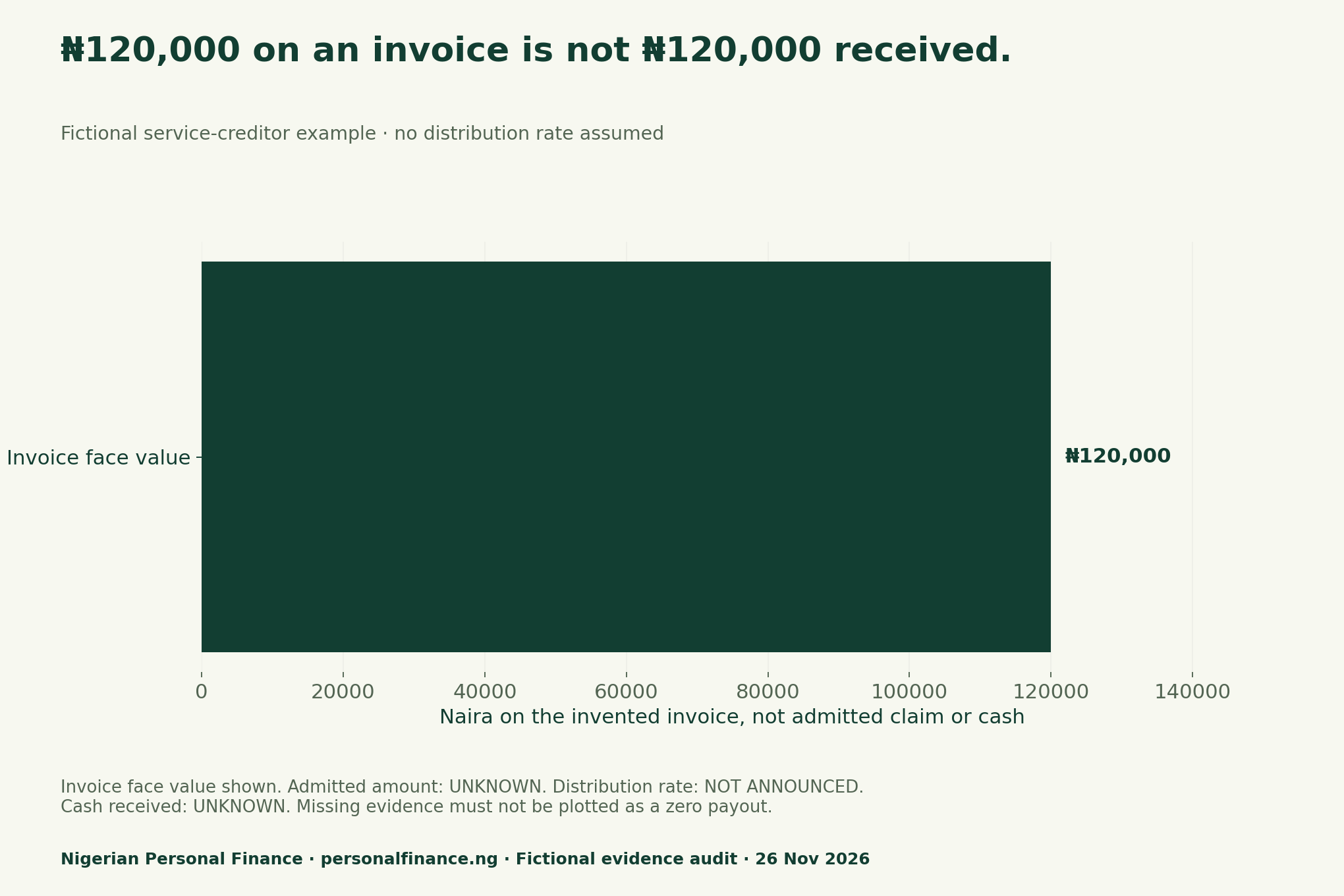
| Evidence stage | Fictional case | What remains unresolved |
|---|---|---|
| Invoice face value | ₦120,000 | Whether and how the claim is admitted |
| Admitted amount | Unknown | Written verification decision |
| Distribution basis | Not announced in this notice | Applicable confirmed distribution terms |
| Cash received | Unknown | Actual payment evidence |
A calculation such as invoice value multiplied by an assumed recovery percentage would add an unsupported input. Even a percentage announced for another failed bank would not fill this gap. Instead, ask for the verified basis relevant to the named institution and claimant group, and retain any written response beside the claim acknowledgment.
Build the evidence pack privately
Next, use the blank register to list evidence types and local references. Keep the actual contract, invoice and receipts in a secure personal folder. The downloadable template asks no BVN, bank-account number, identity-document number, PIN or OTP. It is a private preparation tool, not an NDIC claim form.
For each record, write the date checked and the question it answers. For example, delivery evidence can support a statement that work was completed. An acknowledgment can show what the other party received or accepted. However, neither substitutes for a later verification decision. Preserve the original wording rather than describing an ambiguous message as an approval.
Then use the official website and the current notice to verify the submission route. Check the bank name and form label before uploading any sensitive document. If you plan an office visit, confirm current arrangements through the official listing. This article deliberately does not reproduce phone numbers that could become stale.
Keep acknowledgment, admission and payment separate
After submitting through the verified route, retain the acknowledgment and date. Next, record any request for further evidence or decision separately. Finally, reconcile any actual payment with the communication explaining it. A form submission, a written claim decision and money in an account are distinct events.
Do not label a payment overdue using an invented deadline. Likewise, do not treat “first tranche” as a promise of full recovery or a fixed timetable for another tranche. This report identifies questions to resolve; it does not advise a reader to abandon another remedy or miss a legal deadline. Seek appropriate professional help when classification or rights are disputed.
Your Personalized Financial Plan
Get expert financial advice tailored exclusively to your goals. Receive a custom roadmap in just 1-3 business days.
Get StartedDownload the claim-route tools
The route matrix separates account and non-deposit starting evidence. The fictional example preserves unknown fields explicitly. The blank register supports private document organisation, while the source-boundary file records what the current notice does and does not say. One chart is sufficient because missing distribution evidence cannot support a second payout series.
- Claim-route evidence matrix (CSV)
- Fictional invoice and unknown-outcome fields (CSV)
- Blank private evidence register (CSV)
- Notice and source boundaries (CSV)
For related reading, see our NDIC deposit-coverage comparison and Financial Literacy. This report concerns claim routing, rather than adding insured balances. Suggested citation: Nigerian Personal Finance, “NDIC Creditor Claim Versus Depositor Claim: Choose the Evidence”, 26 November 2026.