




PenCare consent is separate from confirmation that you are enrolled or that a particular medical expense is covered. If you are retiring in Nigeria, keep those questions in different parts of your file. A signature alone should not make an unresolved healthcare cost disappear from your household plan.
PenCom’s circular, dated 26 October 2026 and listed on 27 October, requires separate, voluntary consent during eligible Programmed Withdrawal processing. Declining PenCare must not affect retirement-benefit processing or payment. The circular takes immediate effect. See PenCom’s original circular, sections 3 and 8.
This guide, checked on 30 October 2026, turns that distinction into a practical filing and budget method. It offers educational administrative guidance, not a decision about your eligibility, personal legal advice or medical advice. Keep treatment decisions with your clinician and current benefit questions with the authorised administrator.
What the 30,000 PenCare figure establishes
The official PenCare portal describes 30,000 places for the first phase, with representation across PFAs and eligibility conditions. That number is capacity. It is not a verified count of people already enrolled, treated or paid.
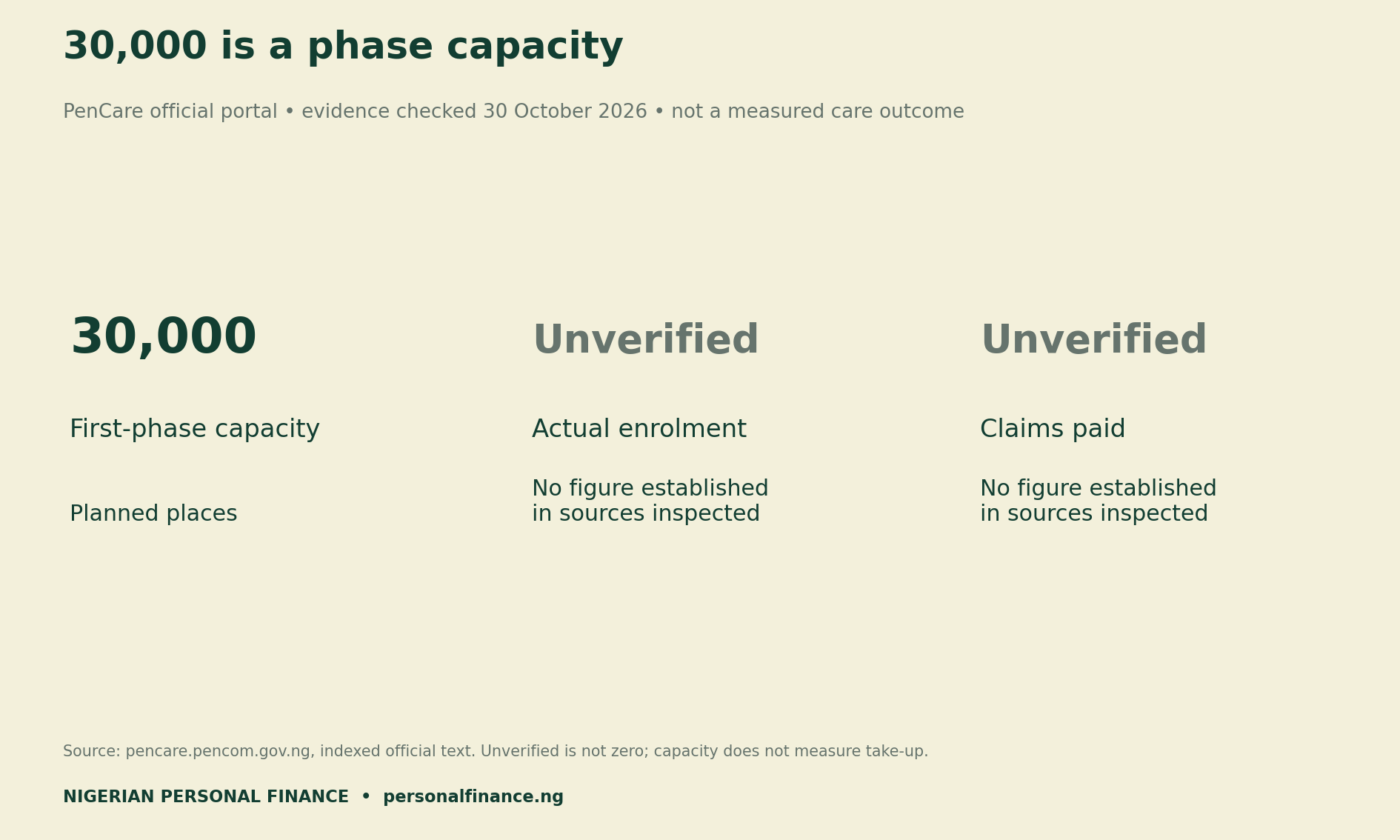
We did not obtain a complete verified benefit schedule, provider list, realised household-savings estimate or claims-paid series. Therefore, this article does not calculate a take-up rate or average saving. A capacity denominator without a reliable enrolment numerator cannot establish either figure.
The useful next question is individual: what has your administrator confirmed for you? Ask for a dated answer you can retain. A broad programme announcement cannot settle whether a specific prescription, consultation or journey will leave you with a cash bill.
PenCare consent: keep three confirmations apart
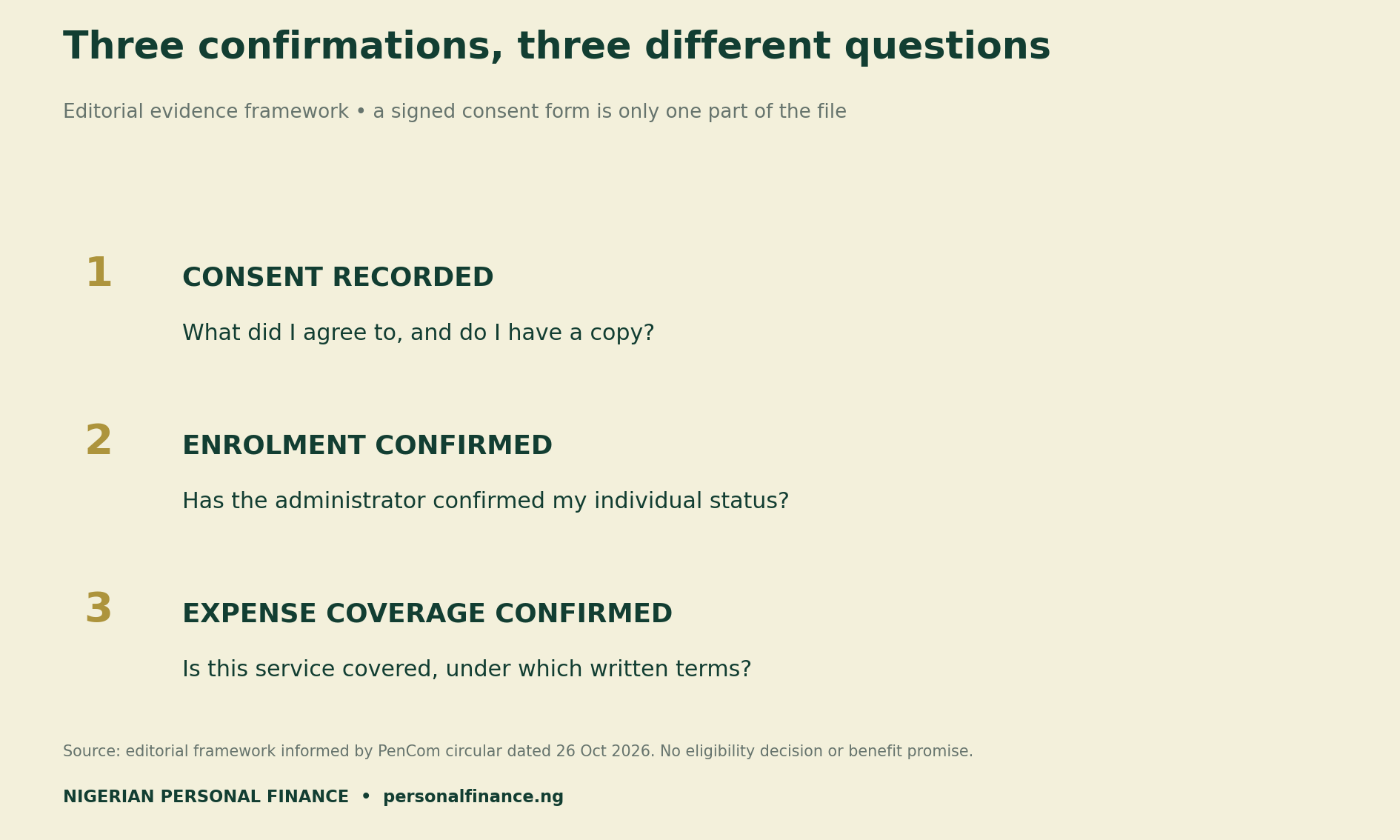
| File status | Evidence to request | Question still open |
|---|---|---|
| Consent recorded | Copy of the completed consent document | Has individual enrolment been confirmed? |
| Enrolment confirmed | Dated written status from the administrator | Which services, providers and terms apply? |
| Expense confirmed | Written terms for the particular service and payment arrangement | What cash remains payable, and when? |
Use a simple status label for each item: confirmed, unresolved, or not applicable after checking. Avoid a single “done” tick across the whole process. For example, a family member may have a signed document yet still need the service terms. That is a gap to follow up, not proof of refusal or approval.
If you are helping a parent, first agree what help they want. Keep their original documents secure and make the working copy easy to read. A shared family folder should contain only what the family has agreed to share. Do not send private papers to this website.
Questions to ask before signing
Take a short question list to the PFA. Ask what this specific form authorises, how to obtain a copy, and which contact handles questions afterwards. If wording is unclear, request an explanation before deciding. Keep your own note of the answer and the date.
Next, ask how the administrator will communicate the outcome and what further evidence it may need. Request the current official channel for supplying any sensitive document. Our checklist is only an index; it does not ask you to enter an RSA PIN, bank details or medical records.
Keep the retirement-benefit file and the coverage questions distinct. Record an unresolved issue in plain language, such as “waiting for written confirmation of medicine coverage.” That makes a follow-up easier than a folder containing unlabelled screenshots and an assumed promise.

Build a healthcare coverage matrix
List each likely expense separately. Medicine, consultation, investigation and transport may involve different questions. Write down the estimated cost, the evidence about coverage, any limit or exclusion, and how payment works. Leave a missing answer visibly unresolved.
In addition, ask whether the arrangement requires cash before a later reimbursement. A confirmed benefit does not automatically mean no upfront payment. Retain the amount needed at the point of service until the actual payment mechanics are clear. Do not cancel other cover or alter treatment because of this worksheet.
Use the matrix with an existing household plan rather than replacing it. Our guide to budgeting with unstable income provides broader cash-planning context. The Retirement Planning archive offers related reading; the current administrator’s written terms remain the source for your benefits.
A fictional example: unknown coverage stays in the budget
Consider an invented monthly plan of ₦50,000. Medicine is ₦18,000, consultation ₦10,000, investigation ₦12,000, transport ₦6,000 and other expenses ₦4,000. These are teaching inputs, not prices measured in Nigeria and not PenCare benefit terms.
Your Personalized Financial Plan
Get expert financial advice tailored exclusively to your goals. Receive a custom roadmap in just 1-3 business days.
Get Started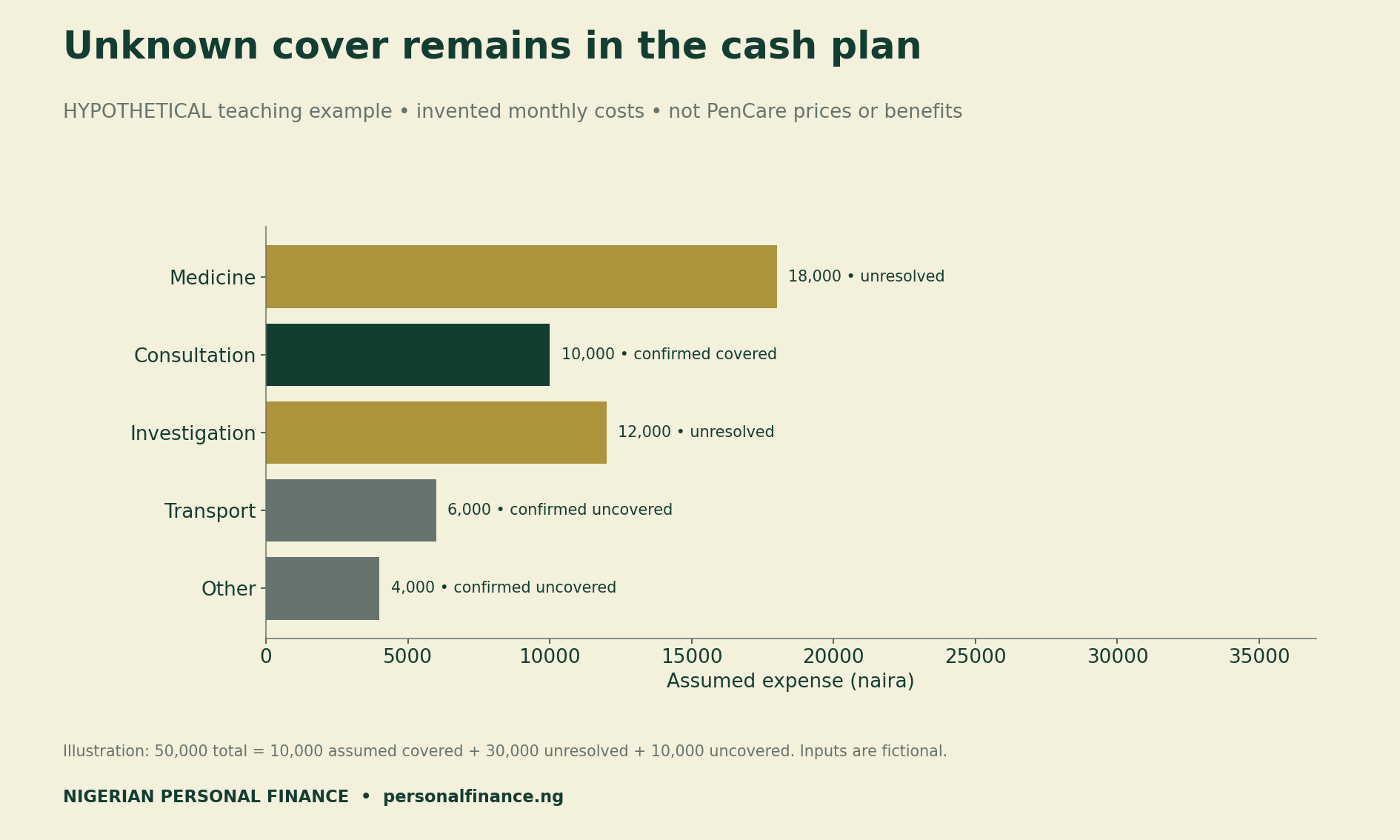
Suppose the example has written confirmation that consultation needs no household cash payment. Medicine and investigation remain unresolved. Transport and other expenses are assumed uncovered. The provisional cash requirement is then ₦40,000: ₦30,000 unresolved plus ₦10,000 uncovered.
Provisional household cash = verified uncovered costs + unresolved costs retained provisionally + any covered costs that still require upfront payment. Avoid double counting: each expense belongs in one cash row. Replace the example assumptions with your own verified amounts and timing.
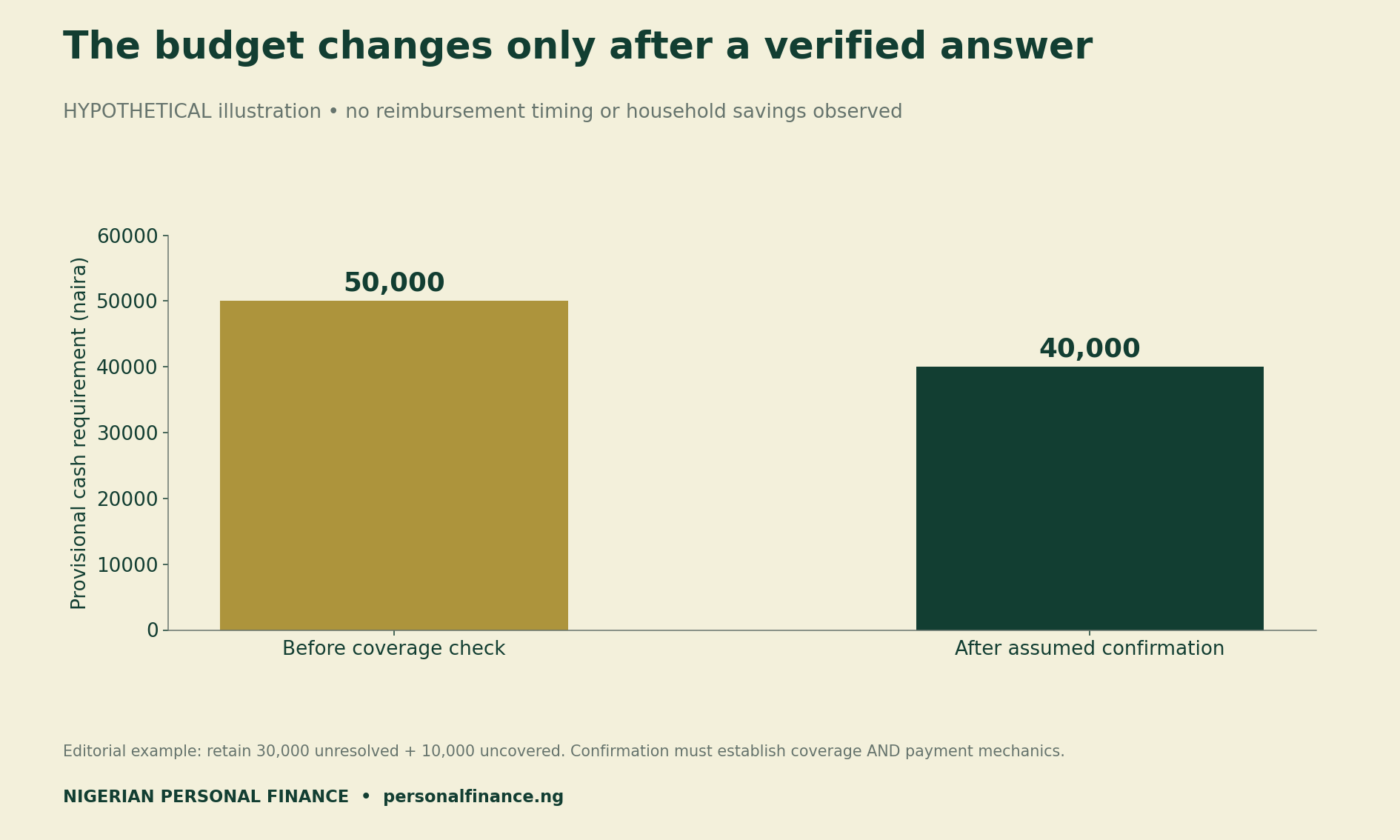
The ₦10,000 difference is an assumed cash-plan adjustment. It is not a claim that PenCare saves every retiree that amount. If the consultation instead requires upfront cash, the example must retain it until that timing issue is resolved. Likewise, a new expense would need its own row.
Download the three private working tools
Document checklist (CSV): requested item, official source, date supplied, acknowledgement and unresolved question. Treat the prefilled items as planning prompts, not a universal list of mandatory documents.
Coverage and budget template (CSV): five expense rows with blank amounts and evidence fields. Keep it on your own device. Unresolved status does not establish either coverage or exclusion.
Fictional budget example (CSV): the five invented amounts used in Figures 3 and 4. It lets you reproduce the ₦50,000 total and ₦40,000 provisional requirement without mistaking them for a household survey.
CSV files are plain tables, not automated entitlement calculators. If you edit the assumptions, recalculate the totals and retain a dated version. Keep identity and medical information out of any copy you send for general discussion. This website does not collect completed worksheets.
Retain evidence and follow up on unanswered questions
Keep a small contact log: date, official channel, reference number, question and next step. After a phone call, ask how to obtain written confirmation. Note what remains unresolved instead of filling the gap with an estimate presented as a fact.
Use the administrator’s current official contact route for individual questions. For the regulatory document itself, check the PenCom circulars listing. Avoid sending personal records through unverified social accounts or public comments. A family helper can organise questions without making the retiree’s choices for them.
Method, source dates and limitations
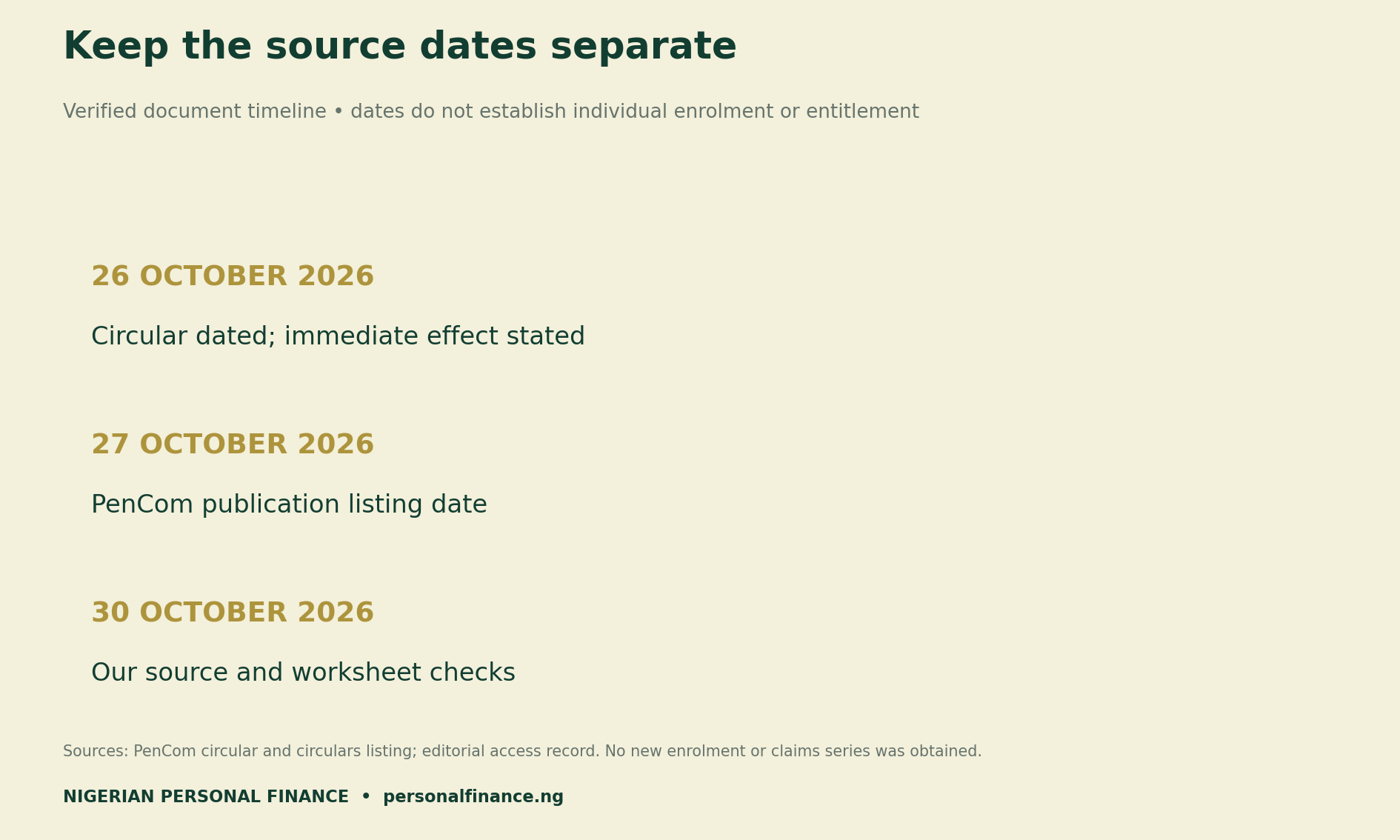
We inspected the four-page official circular and its live listing. The 30,000 capacity statement came from indexed text of the official portal; direct retrieval of the interactive page timed out during checking. That access limitation is why we have not claimed to verify a complete online benefit package.
The three-status framework, document index and conservative cash worksheet are our editorial tools. They have not been tested as a reader intervention. No retiree records, claims data or healthcare-price sample were collected. The figures cannot establish coverage, medical need, legal entitlement or realised savings.
For the numerical example, we sum five invented expenses and retain every unresolved or uncovered item. Blank inputs remain blank. All published amounts use naira, with no inflation forecast or assumed exchange rate. The accompanying CSV preserves the exact inputs and labels used in the charts.
Suggested citation: Nigerian Personal Finance, “PenCare Consent in Nigeria: Retirement and Healthcare Budget Checklist,” 30 October 2026. Cite the official circular separately for its instructions and identify our cash example as hypothetical. Update log: initial source and arithmetic checks completed on 30 October 2026.