




To compare remittance quotes fairly, hold the sender’s total cost constant and calculate the naira the recipient can actually use. A zero-fee label cannot answer that question by itself. Exchange rates, deducted charges and delivery conditions can change the result.
Our fictional $500 comparison illustrates the point. Quote A charges a $5 deducted fee and converts $495 at an invented ₦1,340 per dollar. Quote B charges no sender fee but converts $500 at an invented ₦1,325. Before other deductions, A leaves ₦663,300 and B leaves ₦662,500: an ₦800 difference.
Those inputs are teaching examples, not collected provider quotations. This guide, checked on 30 October 2026, offers five figures and four downloadable tables. It requires no signup or transfer and makes no claim that either illustrated offer is available to a household today.
Use the dated market benchmark carefully
AIICO Capital’s report published 28 October 2026 records a ₦1,347.53-per-dollar NFEM observation. The accompanying PDF, page 7, gives ₦1,352.87 for 27 October. These are the investment manager’s reported market benchmarks, not an independently observed retail transfer test.
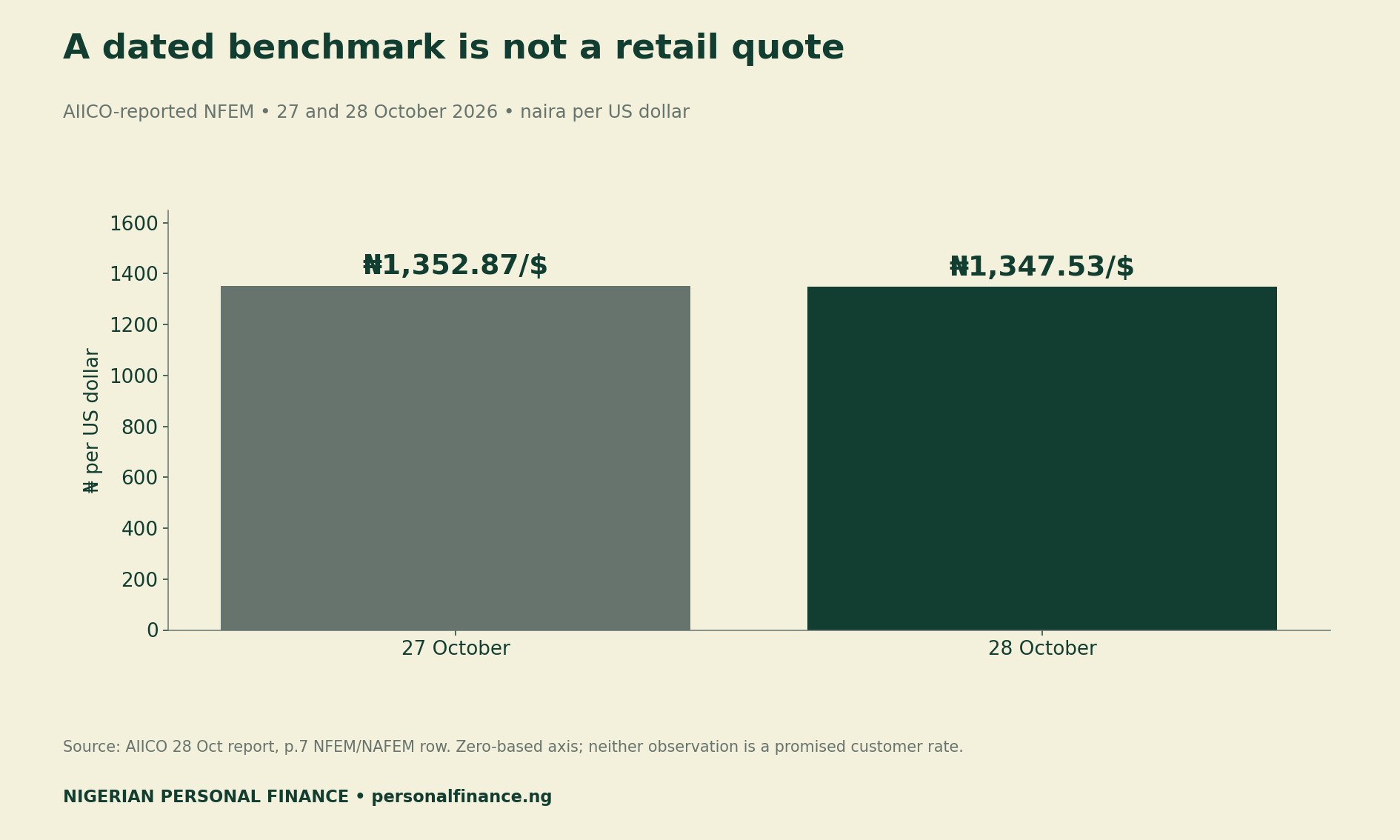
A benchmark and a remittance quote can differ because they describe different transactions and conditions. Therefore, do not insert the benchmark into a provider comparison as though the customer could obtain it. Record the actual offered rate, timestamp and terms instead.
We use only the report’s NFEM/NAFEM dollar row. Its parallel-market narrative and table contain inconsistent current values, so we exclude that series rather than choosing whichever number looks convenient. The NFEM figures used here agree between the relevant narrative and table.
Start with equal total sender outlay
First write down everything the sender must pay, in one currency. If one provider adds a fee on top while another deducts a fee from the transfer amount, the headline amounts are not directly comparable. Normalise both cases to the same total outlay before judging the result.
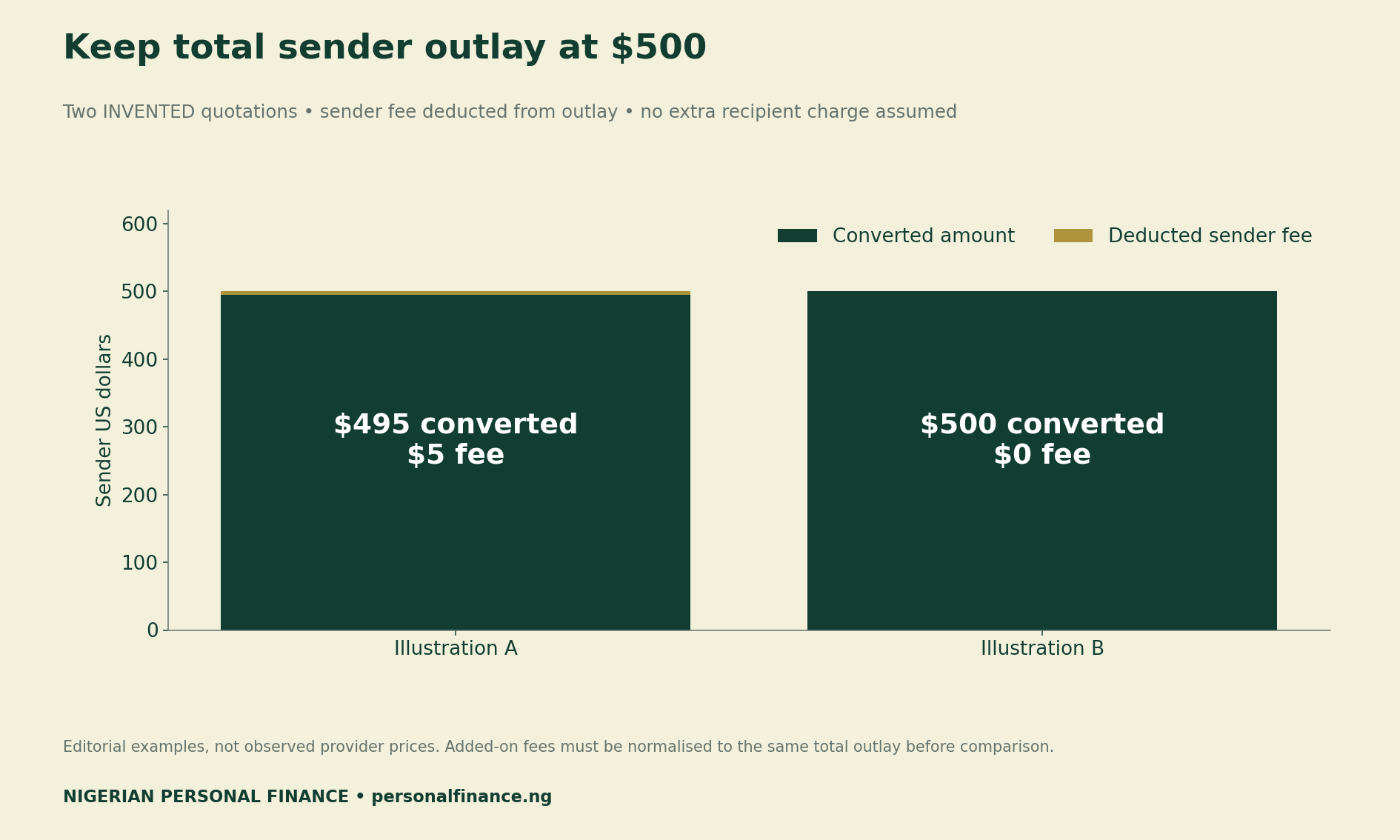
For this example, both senders spend exactly $500. A deducts $5 from that amount, leaving $495 to convert. B converts all $500. No additional recipient charge is assumed in this baseline illustration; that assumption remains visible and will change if evidence identifies a charge.
Compare remittance quotes using net naira
With the fee deducted from a dollar outlay, use net recipient naira = (total sender dollars − deducted dollar fee) × quoted naira-per-dollar rate − recipient naira deductions. Keep the units explicit. A fee charged in another currency needs a documented conversion before it enters the same equation.
| Invented input or result | Quote A | Quote B |
|---|---|---|
| Total sender outlay | $500 | $500 |
| Deducted sender fee | $5 | $0 |
| Amount converted | $495 | $500 |
| Assumed rate | ₦1,340/$ | ₦1,325/$ |
| Assumed extra recipient charge | ₦0 | ₦0 |
| Net recipient proceeds | ₦663,300 | ₦662,500 |
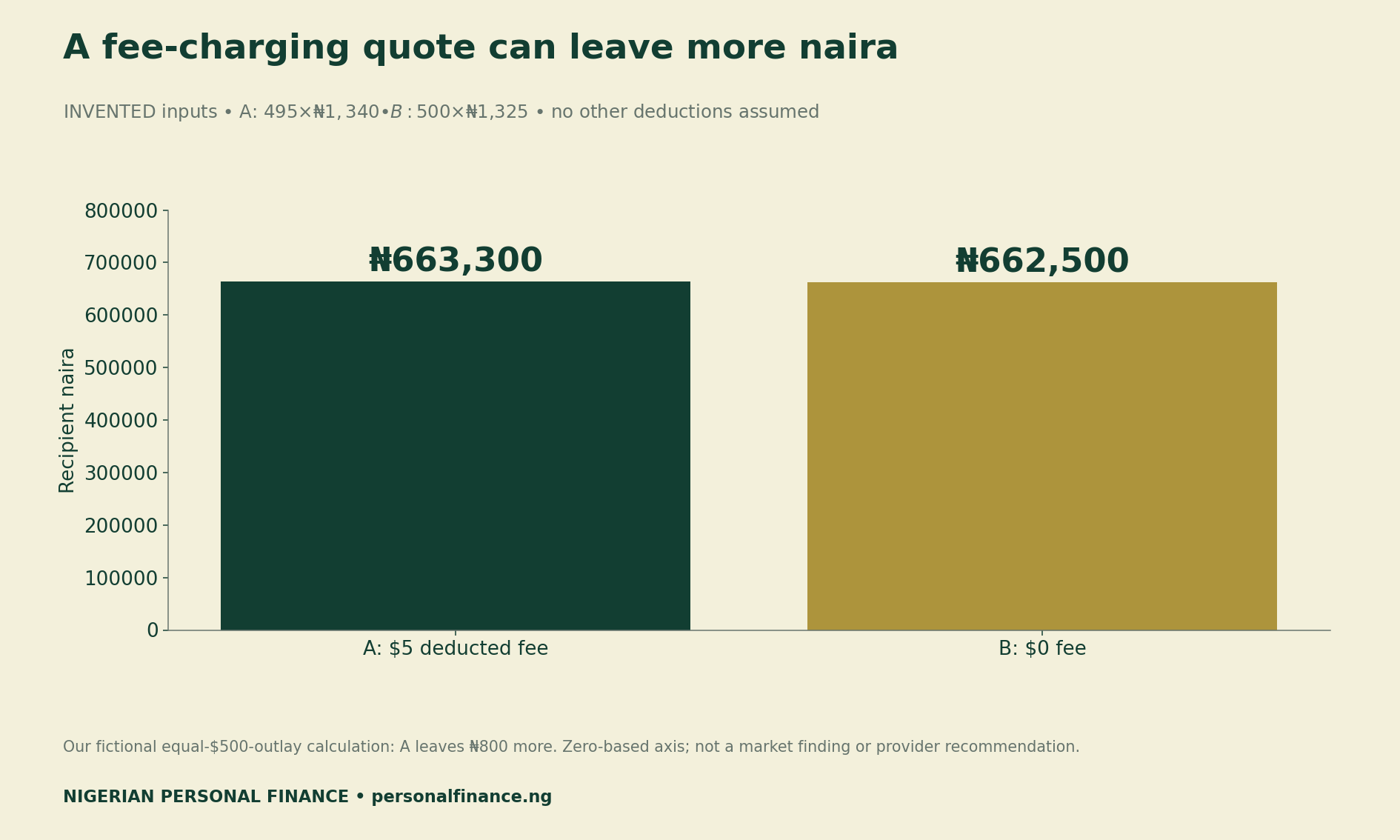
The arithmetic is $495 × ₦1,340 = ₦663,300 and $500 × ₦1,325 = ₦662,500. Subtracting gives ₦800. Thus, the fee-charging illustration can produce more naira because its assumed rate offsets the deducted fee. A different combination of rates and charges could reverse the result.
Likewise, an attractive exchange rate does not settle the whole decision. Confirm how the recipient receives the money and whether the quoted net amount is guaranteed or merely indicative. A household expecting an urgent bill payment may also need a reliable delivery estimate and a clear route for resolving a missing receipt.
Keep unknown deductions visible
A blank fee field does not prove a fee is zero. Ask whether intermediary, payout or recipient-account charges apply, and whether the displayed amount already includes them. Otherwise, a comparison can either omit a deduction or subtract the same charge twice.
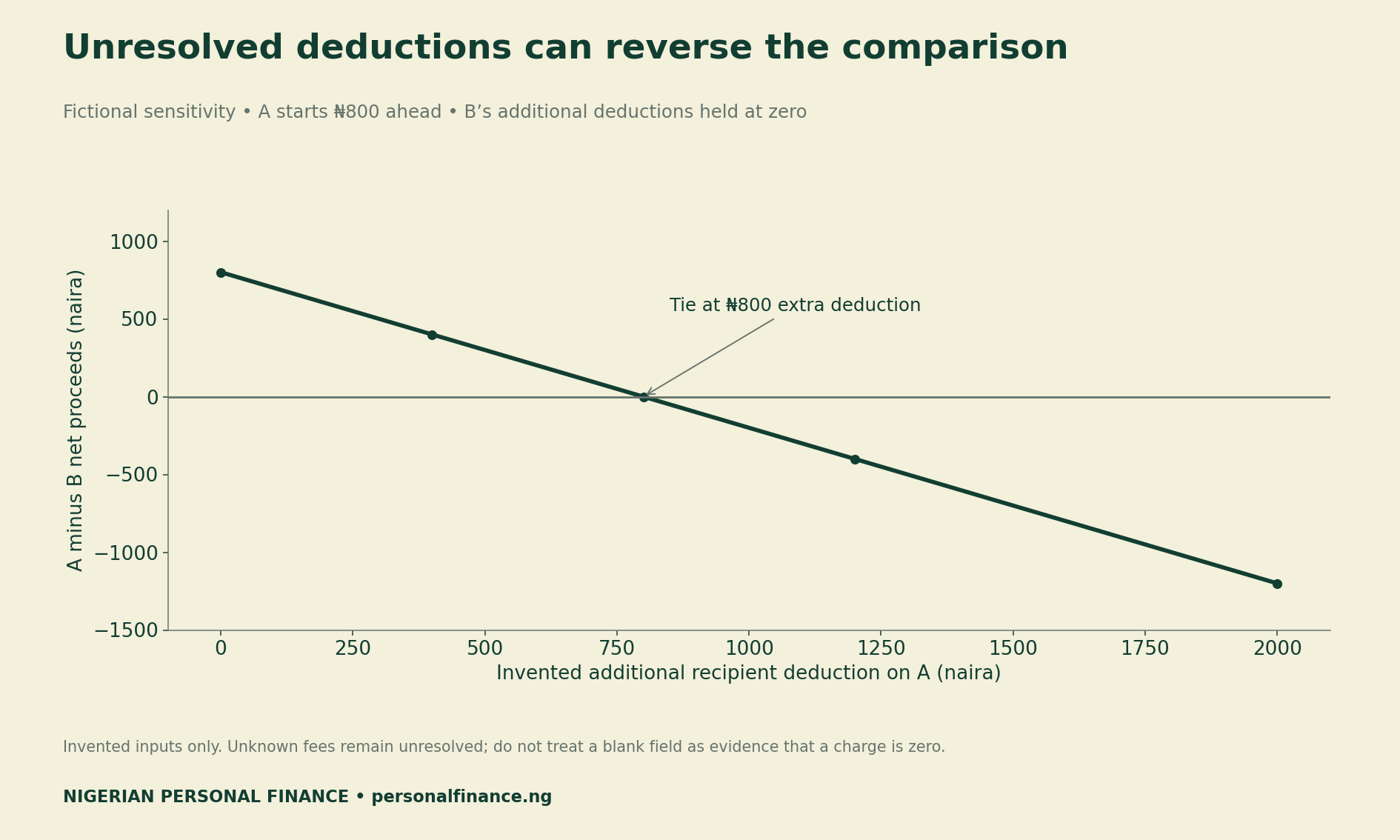
For example, an additional ₦800 deduction on A would reduce its baseline proceeds to ₦662,500, exactly equal to B. An extra ₦1,200 would put A ₦400 behind. These scenarios test the calculation; they do not establish that such deductions actually occur.

Build a comparable quote log
Capture quotes close together and record the time zone. Next, match sender outlay, funding method, transfer currency and recipient payout method. Comparing a bank-funded transfer with a card-funded transfer may introduce a difference unrelated to the advertised exchange rate.
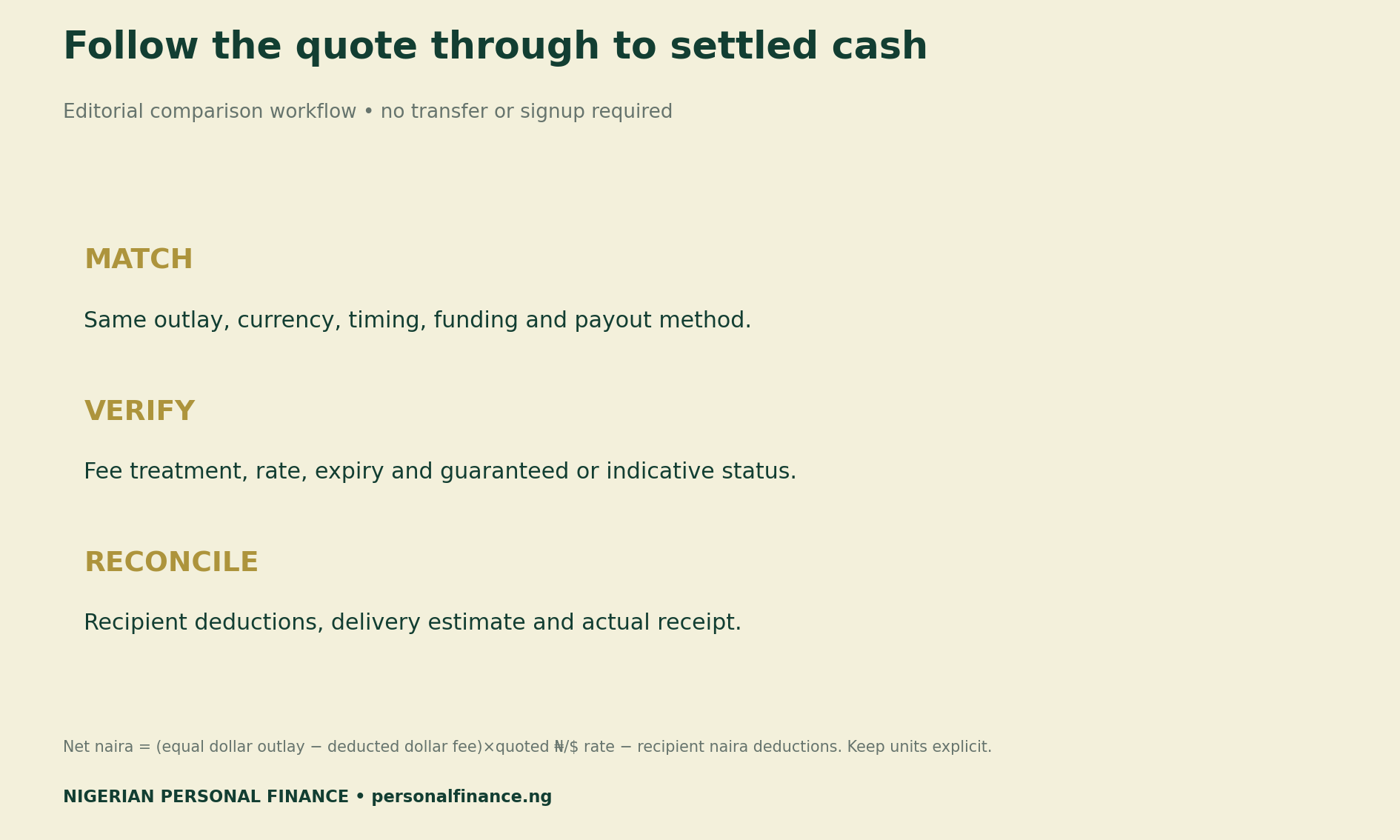
Record expiry as well as timestamp. Also, distinguish a guaranteed recipient amount from one that can change before settlement. If a provider cannot confirm a charge, keep that uncertainty in the log. Do not present a range of unresolved outcomes as a precise promised receipt.
Your Personalized Financial Plan
Get expert financial advice tailored exclusively to your goals. Receive a custom roadmap in just 1-3 business days.
Get StartedFor an actual transfer, retain the final receipt and compare it with the quoted amount and delivery estimate. Record the actual arrival date, net amount and currency. That reconciliation can identify a question to raise with the provider; it should not become a public disclosure of account credentials or private transaction details.
Download the comparison tools
Fictional equal-outlay comparison (CSV) preserves all inputs and outputs behind Figures 2 and 3. It contains two invented cases, not named-provider observations. The file is a plain data table rather than an automatic live-rate calculator.
Blank remittance quote log (CSV) includes timestamps, expiry, funding and payout methods, fee treatment, net receipt and unresolved charges. Keep completed logs private. The website does not collect completed transfer records or ask for bank credentials.
Dated NFEM benchmark data (CSV) gives the two reported observations and their source. Fictional deduction-sensitivity data (CSV) shows how extra charges could change the comparison. Neither table supplies a current customer offer.
Separate transfer value from account charges and spending plans
Our existing domiciliary-account fee guide provides background on a different question: charges associated with the account itself. This article focuses on the all-in value of a particular inbound transfer quotation. Check current provider and bank terms rather than treating older guidance as a new October rule.
Similarly, our dividend cash calendar separates an expected receipt from settled money. That distinction matters here too. An indicative transfer amount should not silently become cash already available for a household payment.
Method, limits and corrections
We checked the dated AIICO release and retained its original PDF. We transcribed the two NFEM observations from page 7. They provide market context only. The older report landing path returned a 404 during checking, so we use the working official investment-manager page and original PDF link.
Our scripts generate the figures and data from explicit invented quote inputs. Independent checks confirm equal $500 outlay, proceeds of ₦663,300 and ₦662,500, an ₦800 baseline difference and a tie after an extra ₦800 deduction on A. No provider quote collection, signup or test transfer occurred.
Rates, eligibility, funding methods and charges can change. No named-provider ranking, guaranteed delivery, universal remittance rule or suitability recommendation follows from these examples. A future provider study would need comparable fresh quotes and documented conditions. Corrections log: source, unit and arithmetic checks completed on 30 October 2026.
Suggested citation: Nigerian Personal Finance, “Receiving Dollars in Nigeria: Compare Remittance Quotes by Net Naira,” 30 October 2026. Cite AIICO for the dated benchmark; label our quote comparisons and sensitivity figures as fictional illustrations.