




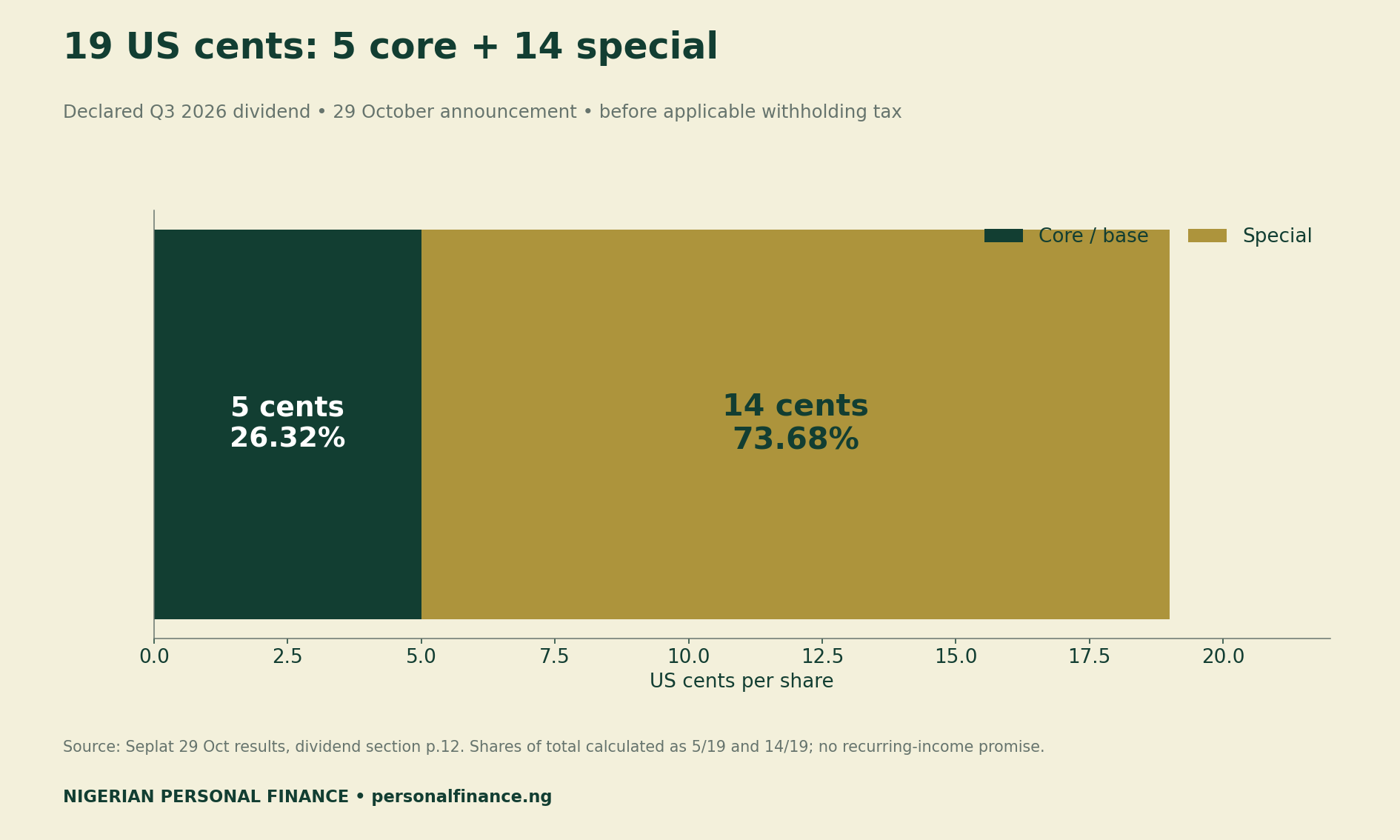
The Seplat November 2026 dividend is 19 US cents per eligible share, before applicable withholding tax. However, 14 cents of that amount is special. An existing shareholder therefore needs to check the components, entitlement and expected receipt before treating the headline as household spending money.
For a hypothetical holding of 1,000 eligible shares, the gross calculation is $190: $50 core and $140 special. The special component makes up 73.68% of the declared total. This illustration does not establish anyone’s actual holding, net payment or future income.
We checked the issuer’s original notices on 30 October 2026. This guide provides five figures and three CSV tools for receipt planning. It does not recommend buying shares, predict their price or turn a dividend announcement into a guaranteed recurring payment.
What the issuer announced
Seplat’s 29 October results, dividend section on printed page 12, declares the Q3 split. Its separate corporate-action notice sets out the administrative dates and payment arrangements. The results cover nine months ended 30 September; the dividend discussed here relates to Q3.
Keep the declared distribution separate from the transaction-dividend intention discussed elsewhere in the results. Also, keep both separate from your own confirmed entitlement. An issuer can announce a payment without proving that a particular investor has qualified or received it.
Calculate the Seplat November 2026 dividend in dollars
First confirm the eligible share count. Then multiply it by $0.05 for the core component and by $0.14 for the special component. Add those gross amounts, or multiply the eligible count directly by $0.19. Both routes should agree before deductions.
| Hypothetical eligible shares | Core gross | Special gross | Total gross |
|---|---|---|---|
| 100 | $5 | $14 | $19 |
| 500 | $25 | $70 | $95 |
| 1000 | $50 | $140 | $190 |
| 2500 | $125 | $350 | $475 |
| 5000 | $250 | $700 | $950 |
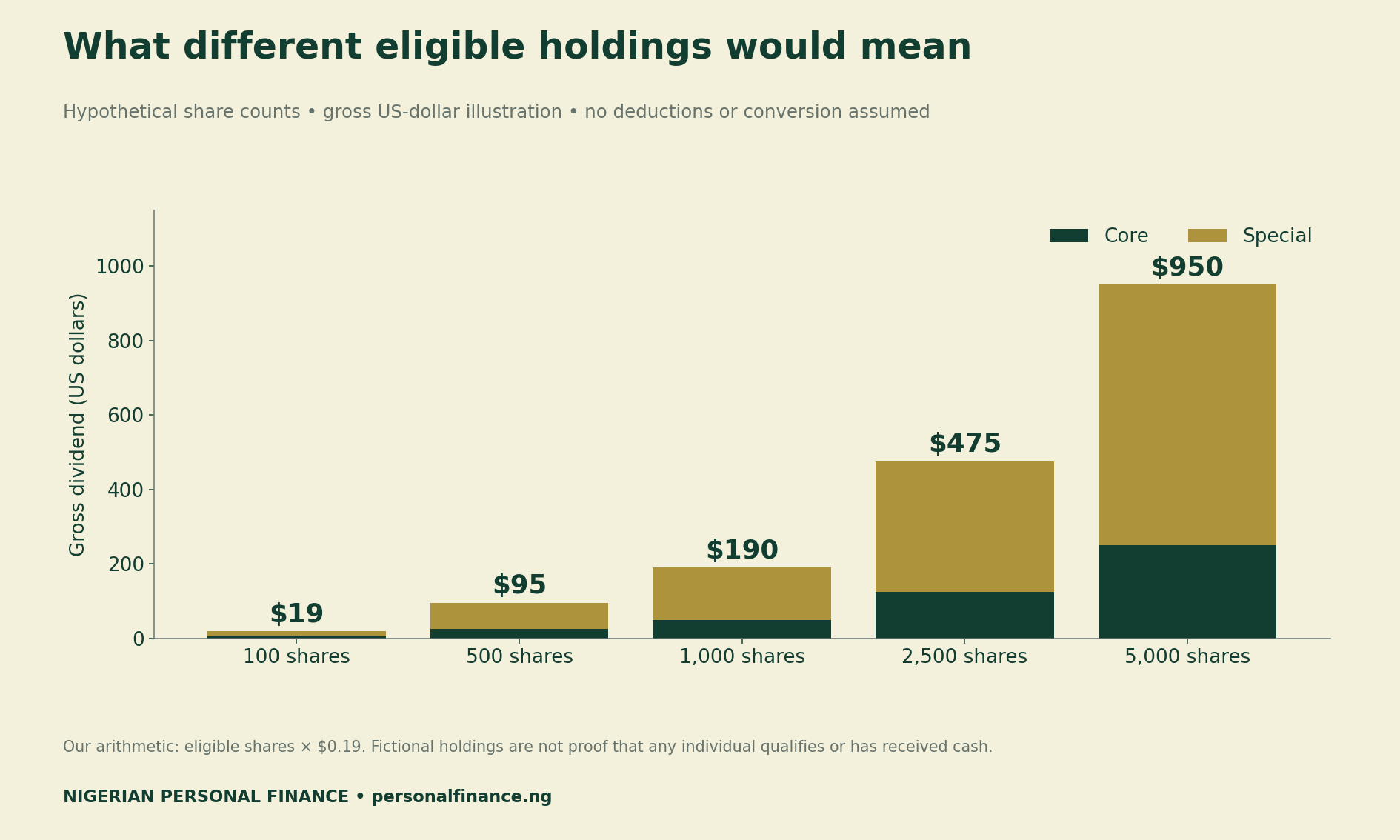
For example, 1,000 multiplied by $0.19 equals $190. That total is not automatically the amount that reaches a naira account. Applicable deductions, payment currency and confirmed conversion terms still matter. Leave an unknown input unresolved rather than replacing it with an assumed zero.
Put the announced dates on the cash calendar
The notice identifies 12 November as the qualification date and 13 November as register closure. It places electronic payment on or around 27 November. Consequently, a household calendar should distinguish the expected payment from an actual bank credit.
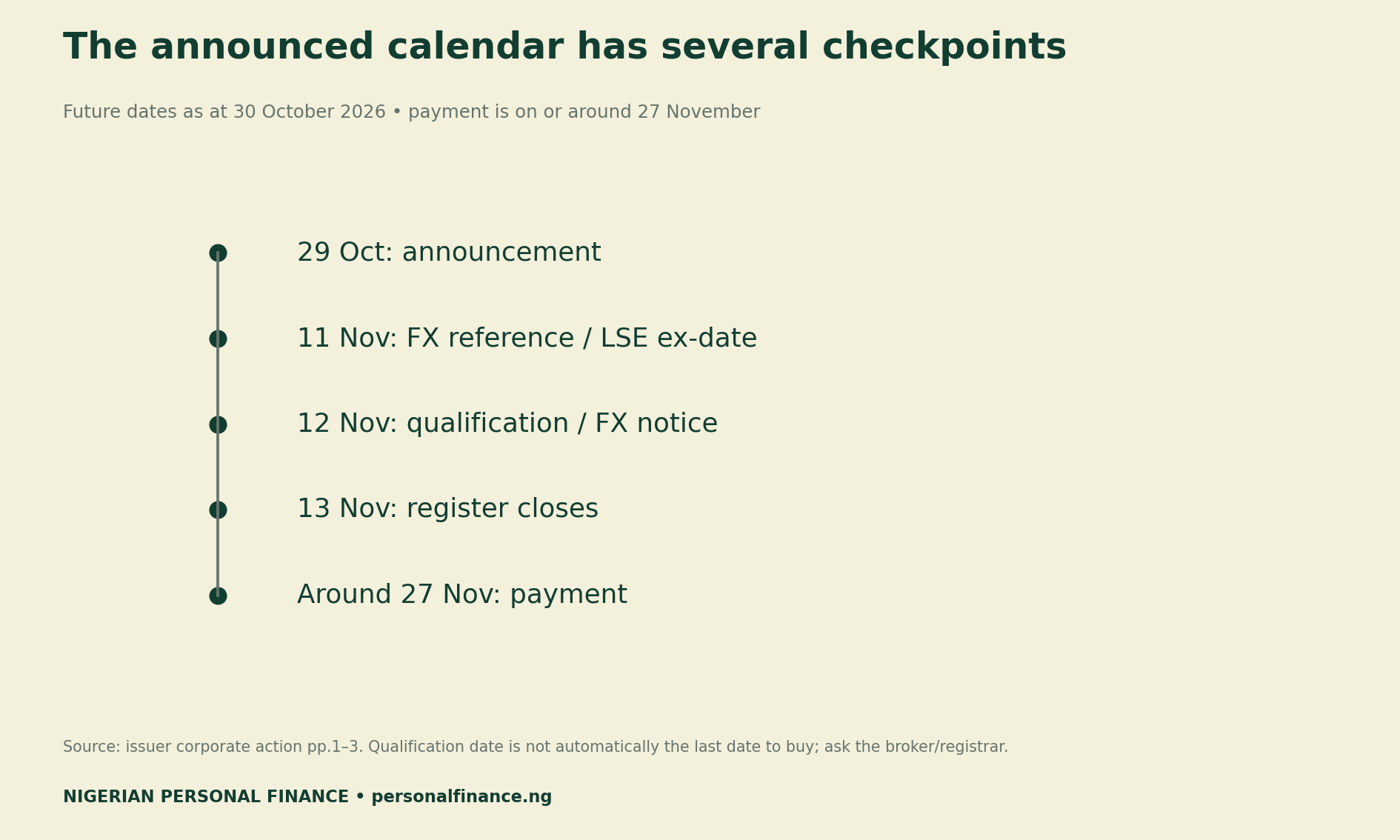
Qualification is not automatically the final date on which a new purchase would qualify. Ask the broker or registrar about settlement and entitlement rules. We do not supply an inferred last-buy date or a buy-before-dividend strategy. Those would answer a different question from organising an existing holding’s paperwork.
The notice’s currency arrangements also depend on how the shares are held. Rather than assuming one universal rule, use the original notice and confirm your own circumstances with the appropriate registrar. Its stated FX reference date is 11 November, with communication on 12 November. We therefore do not invent today’s naira payout using an unrelated market rate.
Keep the conditional transaction dividend separate
The results describe an intended 23.3-US-cent transaction dividend following completion of the proposed sale of a 10% interest in the NNPCL/SEPNU joint venture. Completion remains a condition. This separate intention is not part of the declared Q3 gross calculation above.
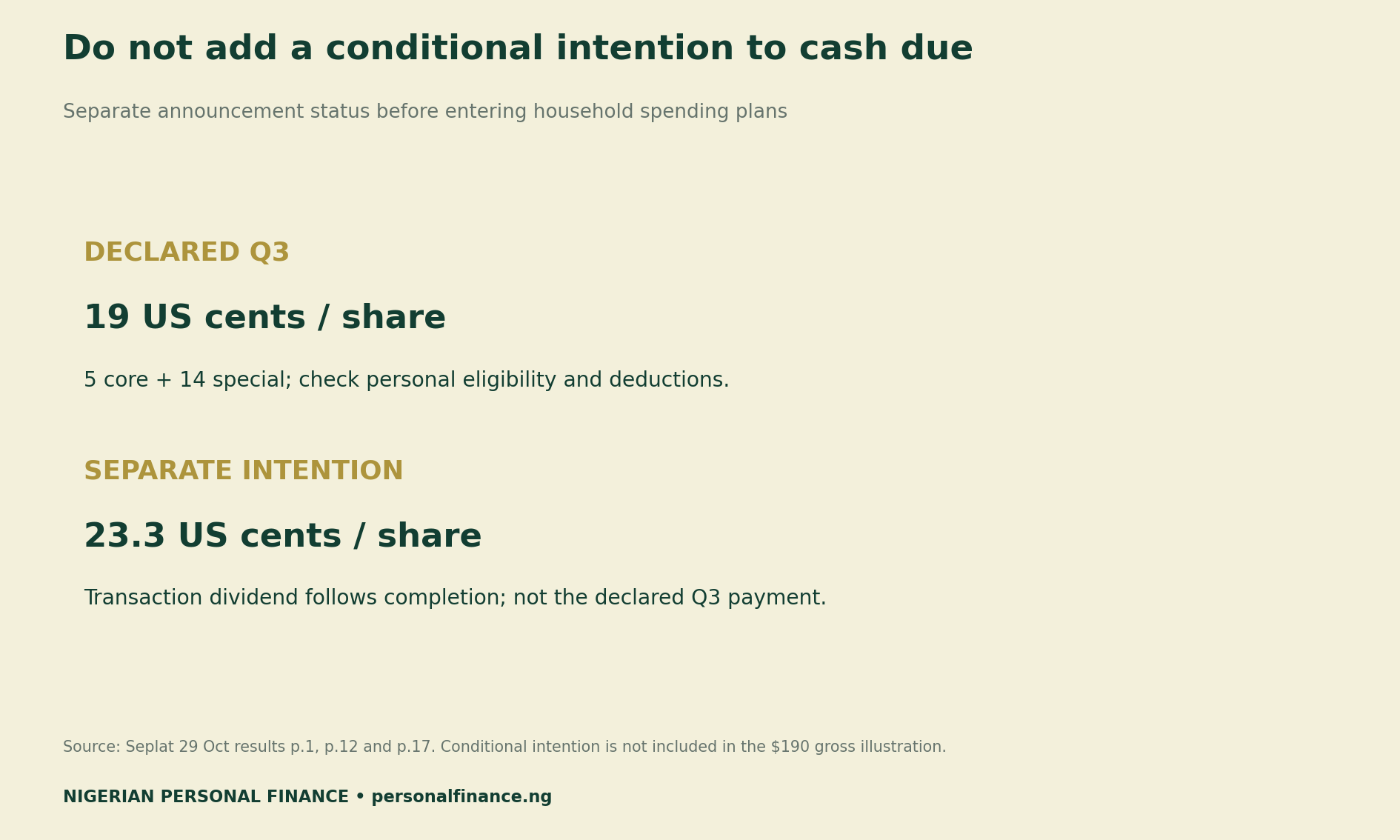
For planning, create a separate row marked conditional. Do not add it to an amount you intend to spend on a dated bill. Next, watch for a fresh issuer notice that confirms the relevant conditions and terms. Only then can the calendar change its status based on new evidence.

Reconcile gross entitlement, deductions and receipt
Once the eligible holding is confirmed, start with gross entitlement = eligible shares × declared amount per share. Then calculate net cash in the same currency = gross entitlement − applicable deductions. Record the evidence for each deduction and avoid counting a charge twice.
Handle currency conversion separately. Record the confirmed currency, rate, date and any conversion charges, with units clearly labelled. A dollar illustration cannot become a naira entitlement until the applicable terms are known. Similarly, a scheduled net figure cannot become received cash until the account credit matches it.
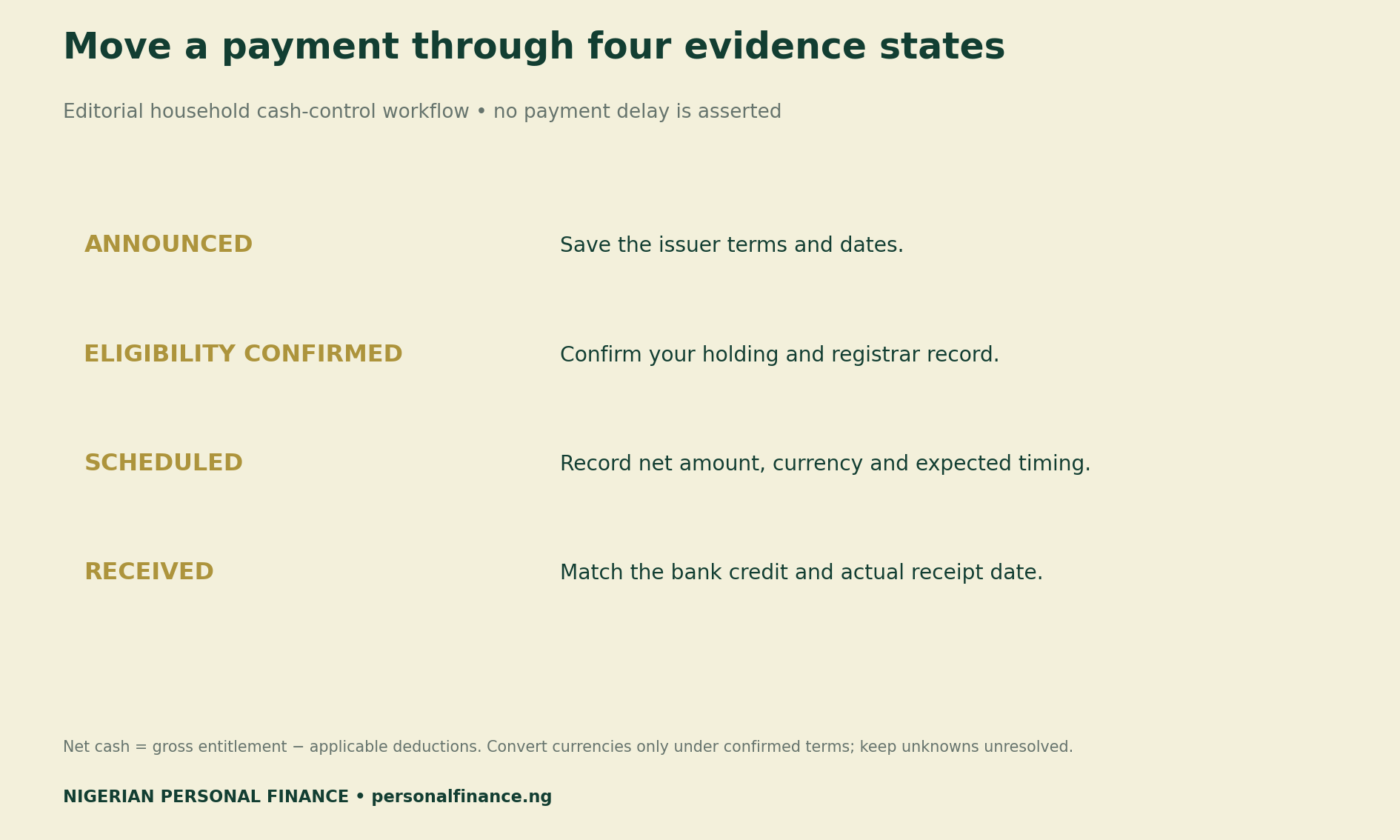
For example, the worksheet can retain an expected receipt date and a separate actual date. If receipt is later than expected, investigate the discrepancy with the registrar instead of silently moving the date. A hypothetical late-receipt scenario can help planning, but it must not be reported as an observed delay.
Your Personalized Financial Plan
Get expert financial advice tailored exclusively to your goals. Receive a custom roadmap in just 1-3 business days.
Get StartedDownload the dividend cash-calendar tools
Hypothetical holding calculations (CSV) contains the five gross examples behind Figure 2. All totals reconcile to core plus special. The file contains no assumed withholding rate, naira conversion or personal account data.
Announced date register (CSV) lists the issuer dates and source link. It labels future events and keeps the payment wording approximate. Use it as a dated research reference, then check for later announcements before relying on it.
Blank household dividend calendar (CSV) provides fields for eligible shares, status, deductions, currency, conversion evidence, expected date and actual receipt. It is a plain worksheet, not an automatic entitlement calculator. Keep completed copies private; the website does not collect bank details or shareholding identifiers.
Check the registrar record before assigning the money
Confirm the recorded holding and the steps needed for electronic payment through the official registrar route. The corporate-action notice identifies the relevant registrar arrangements. Use the issuer’s dividend information page to find official instructions, and verify current details before sending documents.
Keep acknowledgements and receipts together. Next, match the net payment against the eligible holding, deductions and conversion record. If the figures differ, record the question and seek an explanation. Avoid posting private bank or investment documents in a public comment or social-media reply.
Our mutual-fund statement audit explains another common cash-flow distinction. Likewise, the Treasury bill calculator separates cash paid from the maturity amount. Each tool focuses on checking a specific number before using it in a household plan.
Method and limits
We retained the original NGX-hosted issuer results and corporate-action notice. We checked the dividend section against the dates and payment wording in the separate notice. Our scripts multiply fictional eligible holdings by $0.05 and $0.14, then reconcile them with $0.19 per share. Display rounding follows full-precision calculations.
The special share is 14 divided by 19, or 73.68% after rounding. We do not extrapolate that split into future quarters or annualise it into a spending promise. The transaction intention remains separate. No share-price forecast, purchase recommendation, universal tax rate or invented conversion input supports these tools.
An announcement establishes the issuer’s stated terms, not your personal entitlement or payment. Confirm current notices and your registrar record for any real decision. Corrections log: original notices, arithmetic and visuals checked on 30 October 2026.
Suggested citation: Nigerian Personal Finance, “Seplat November 2026 Dividend: Calculate the Cash and Check the Dates,” 30 October 2026. Cite Seplat’s original notices for announced terms; identify holding examples and component percentages as our calculations.