






NDIC auction buying costs in Nigeria extend beyond the number written on a bid. You also need the cash to meet the payment deadline and the practical means to remove the item. A low bid can still produce an expensive purchase when condition, transport or charges remain unresolved.
This guide uses NDIC’s dated notice as a case study and supplies four CSV planning tools. It does not identify a bargain, recommend an asset or place a bid. The original example separates the deposit, bid balance and other costs so the same money is not counted twice.
What the November NDIC notice actually says
The 13 November 2026 NDIC notice schedules furniture, fixtures, fittings and equipment auctions for 18–20 November. A separate generator-and-vehicle subsection specifies a 10% certified-bank-draft deposit, the balance within 24 hours of winning and immediate return of unsuccessful drafts. It also states “as is”, “net of all taxes” and evacuation within 24 hours of purchase.
Check the exact lot and method with the official contact before relying on those conditions. In particular, do not silently apply the generator-and-vehicle deposit subsection to every furniture purchase. The notice supplies conditions, not achieved prices, inspected condition, a warranty or proof of a discount.
NDIC auction buying costs Nigeria: three different amounts
Write down the proposed bid, the cash needed by each deadline and the estimated all-in cost. Those figures answer different questions. A buyer can afford the first payment while lacking the balance, or cover the bid while leaving too little for removal and repairs.
| Amount | Question it answers | Frequent mistake |
|---|---|---|
| Bid | What am I offering for the asset? | Treating it as the whole acquisition budget |
| Cash by deadline | What must be available at the required time? | Assuming a later income payment will arrive soon enough |
| All-in estimate | What else must I pay to inspect, move and use it? | Leaving unknown costs out and calling the result complete |
Keep the deposit inside the bid total
In a fictional ₦500,000 winning bid with a 10% deposit, the deposit is ₦50,000 and the remaining bid balance is ₦450,000. Together they equal the bid. Adding ₦50,000 to the full ₦500,000 again would double-count the deposit.
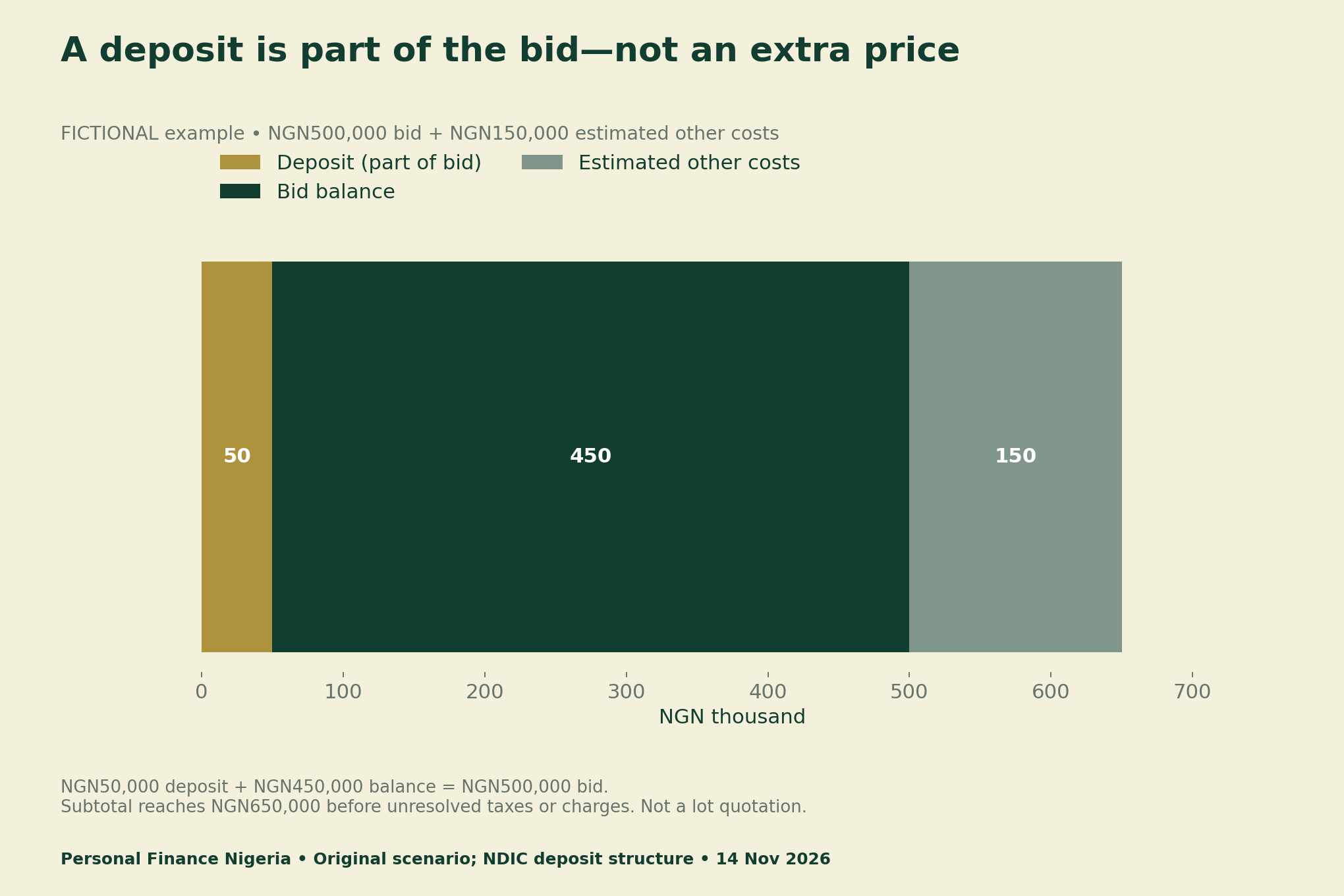
If independently estimated transport and other costs were ₦150,000, the example would reach ₦650,000 before any unresolved taxes or charges. That subtotal is deliberately incomplete. A blank tax entry means unknown unless a qualified source confirms that no amount applies.
Calculate a maximum bid from the full cash ceiling
Start with the total amount you can allocate to the purchase without relying on uncertain receipts. Subtract verified inspection, removal, transport, repairs, taxes and other applicable charges. What remains is a provisional bid ceiling, subject to the condition checks you have actually completed.
For instance, a fictional ₦800,000 all-in ceiling minus ₦200,000 of confirmed non-bid costs leaves ₦600,000 for a bid. If a material cost is still unknown, that subtraction does not solve the decision. Resolve the cost or decide whether the uncertainty is unacceptable before offering money.
Do not manufacture a tax percentage from the phrase “net of all taxes”. Ask what it means for the particular lot and how each applicable amount is calculated and paid. Retain the answer with the notice and date. The worksheet includes unknowns so they remain visible rather than quietly becoming zero.
Two 24-hour requirements need separate planning
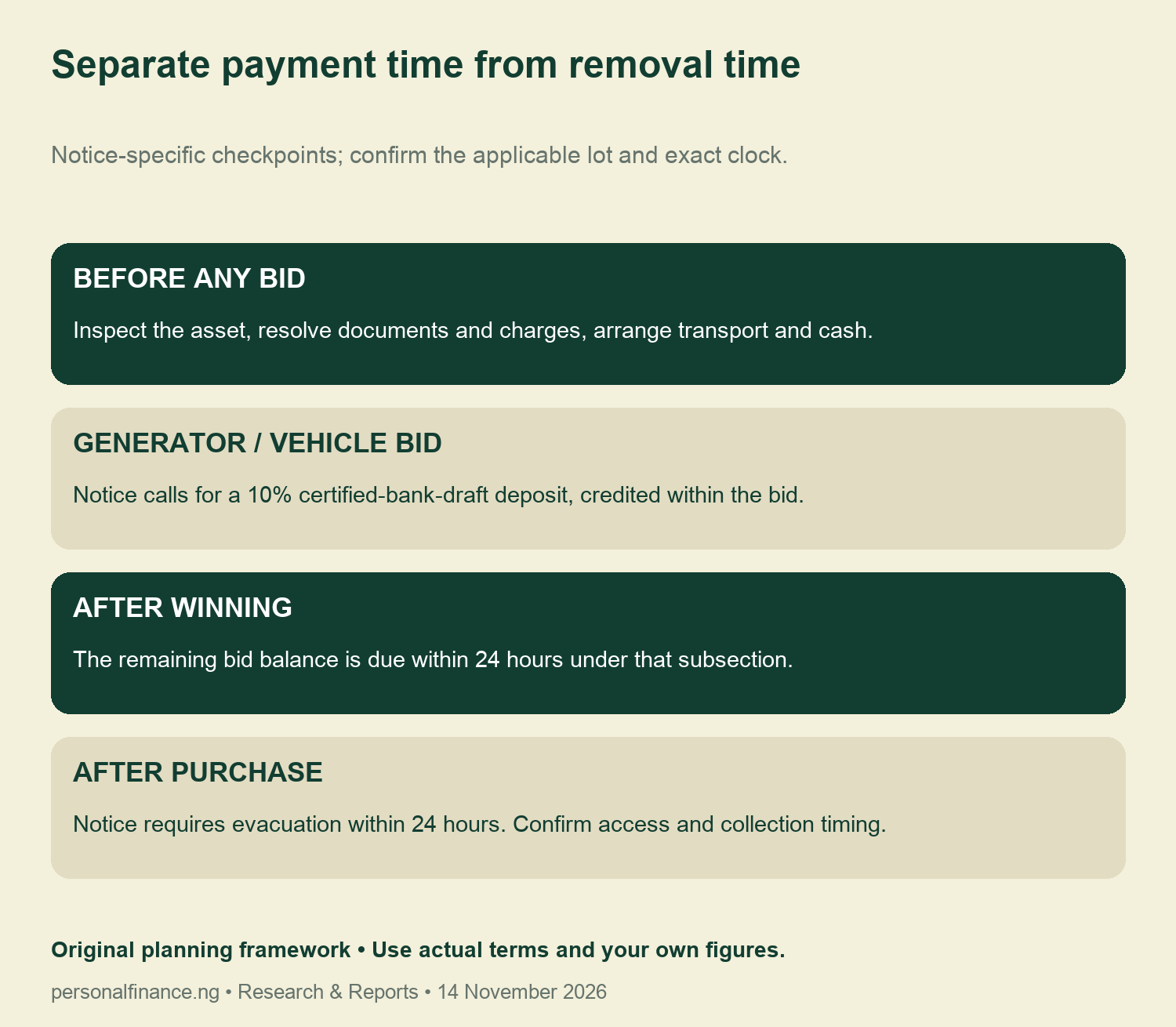
Ask how the balance deadline is measured and what proof of payment is accepted. Then separately confirm the removal deadline, collection hours, access restrictions and any lifting or loading requirements. Do not assume that booking transport later will satisfy the stated removal condition.
Inspect your own cash timing as carefully as the item. Funds that may arrive tomorrow are different from cleared funds available now. Avoid treating a short deadline as a reason to take urgent borrowing without understanding its total cost and repayment obligation.
Inspect what you can and record what you cannot verify
Use the inspection checklist for the exact item identifier. Record visible condition, whether operability was checked, documents seen and the identity of anyone providing a repair estimate. An inspection of a similar item does not establish the state of this one.
For an asset requiring specialist assessment, identify the relevant professional before bidding. Keep documentation or title questions separate from physical condition. A working machine can still have unresolved paperwork, while complete paperwork does not prove mechanical reliability.
Obtain moving and repair estimates from independent sources where practical. State the scope and any exclusions. A transport quote may omit lifting equipment, difficult access or a return journey; an estimate with those gaps is not a verified all-in figure.
Your Personalized Financial Plan
Get expert financial advice tailored exclusively to your goals. Receive a custom roadmap in just 1-3 business days.
Get StartedWhen declining is the useful outcome
A planning tool should make it easier to decline an unclear purchase. Missing inspection access, unresolved ownership questions, uncertain charges or an unworkable removal deadline can each justify stopping. None becomes harmless because the bid looks low.
Compare the proposed item with a realistic alternative serving the same need. Include the condition and costs you can actually establish for each. Do not claim auction purchases are cheaper without comparable evidence. Keep a record of why you declined so the next listing does not restart the same uncertainty.
Download the acquisition-cost planning tools
- Notice conditions and scope register (CSV)
- Fictional deposit and all-in cost arithmetic (CSV)
- Blank maximum-bid and unknown-cost worksheet (CSV)
- Blank inspection and deadline checklist (CSV)
Our mobile-data budget guide uses the same habit of adding related costs before comparing headline prices. Browse Research & Reports for other source-based household tools.
Methods, source limits and date check
We inspected the official public notice on 14 November 2026. The condition register preserves its distinct scopes. All purchase amounts and cost examples in this article are fictional; no reserve price, achieved discount, asset condition, ownership document or tax liability was independently verified.
Recheck the notice and lot details before any decision. After the scheduled sale period, this article remains a budgeting case study rather than an indication that a lot is available. Suggested citation: Personal Finance Nigeria, “NDIC Auction Purchases: Calculate the Full Cost Before Bidding”, original acquisition-cost framework and CSV tools. Cite NDIC for the dated sale conditions.