








Revolving credit limit repayment in Nigeria can reopen borrowing capacity, but it does not create income. Repayment uses cash to reduce a debt. If the lender restores access to the limit, that access remains an opportunity to borrow again, subject to the actual terms.
The useful household check is to follow three balances: cash in the account, debt outstanding and unused borrowing capacity. This guide provides a fictional ledger, a three-part infographic and four CSV tools. It does not assess an individual borrower or recommend a credit product.
What the new ExtraCash explanation establishes
Zedvance’s 12 November 2026 ExtraCash article describes a revolving facility with limits up to ₦1 million for eligible verified users. It mentions a 30-day cycle and restored limits after repayment, subject to eligibility. The same page says repayment cycles vary by customer segment, so the individual agreement matters.
That promotional article does not establish every fee, an individual repayment schedule or a complete borrowing cost. It is a primary source for what the provider says, not independent evidence of customer outcomes. The advertised maximum is neither universal approval nor proof that a particular payment is affordable.
A revolving credit limit is a ceiling, not earnings
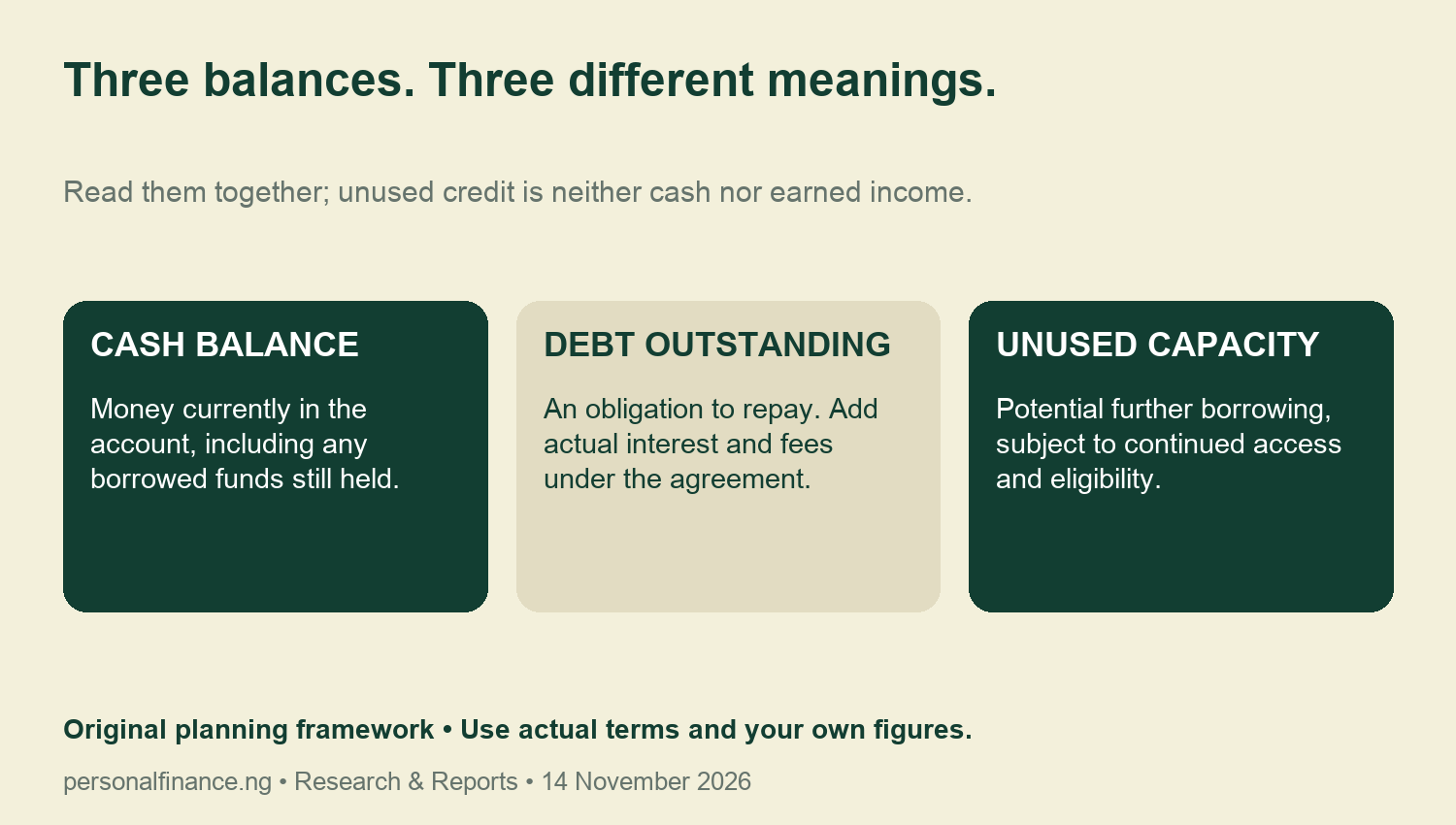
Cash in an account can come from earnings, existing savings, a sale or borrowing. The account balance alone does not reveal which source funded it. If borrowed funds remain in the account, keep the matching debt visible. Calling the whole cash balance money earned would hide the obligation.
Unused capacity answers a different question: how much additional borrowing might remain available under the facility? It is not cash already owned, and future access can change. Do not add it to savings or count it as the income that will fund the next repayment.
Follow a draw, purchase and repayment through the ledger
Start with fictional cash of ₦100,000, no debt on this facility and an unused ₦200,000 limit. A ₦60,000 draw raises the cash balance to ₦160,000, creates ₦60,000 of debt and leaves ₦140,000 unused. Cash minus this debt is still ₦100,000; borrowing itself has not increased that net position.
| Fictional stage | Cash | Debt | Unused limit | Cash minus this debt |
|---|---|---|---|---|
| Before draw | ₦100,000 | ₦0 | ₦200,000 | ₦100,000 |
| Draw 60000 | ₦160,000 | ₦60,000 | ₦140,000 | ₦100,000 |
| Spend 60000 | ₦100,000 | ₦60,000 | ₦140,000 | ₦40,000 |
| Repay 60000 | ₦40,000 | ₦0 | ₦200,000 | ₦40,000 |
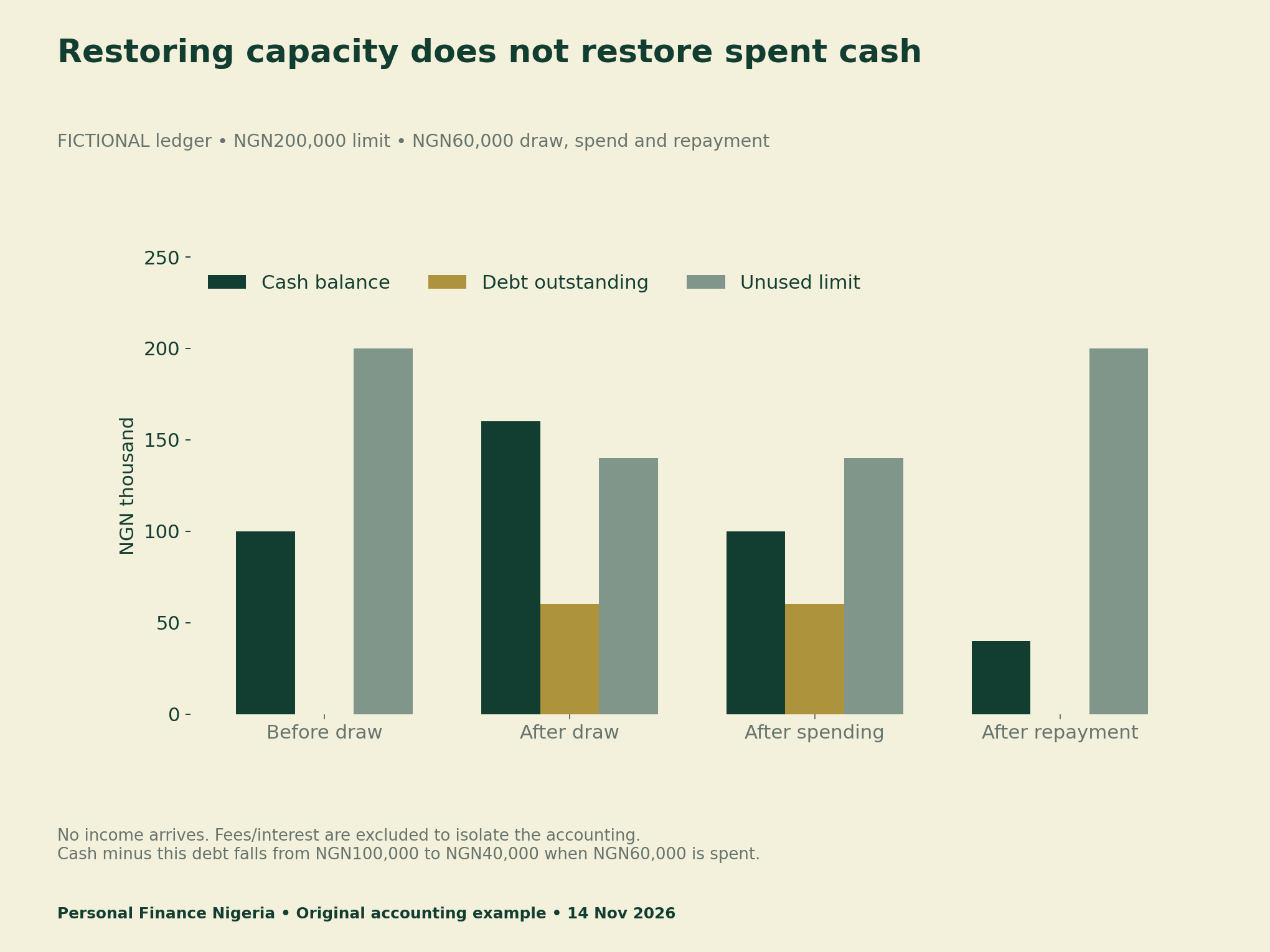
After spending the ₦60,000, cash falls to ₦100,000 while debt stays at ₦60,000. The net measure is now ₦40,000. Repaying the principal then leaves ₦40,000 cash and no facility debt. Capacity may return to ₦200,000 in this simplified example, but no extra ₦60,000 of income appeared.
The example excludes costs to isolate the accounting. Actual interest or fees can reduce the remaining cash further. Other assets and debts are outside the table, so its net column must not be described as a complete personal net-worth assessment.
Read the individual offer before calculating cost
Record the amount drawn and the amount actually received. If a charge is deducted before disbursement, those amounts may differ. Then list every scheduled payment and due date, including any final amount. Keep the offer version and checked date with the record.
Add all required payments to find the stated total payable, using the actual terms. Compare that with the net cash received when describing the cash cost. Do not invent an annual percentage rate from incomplete information or describe borrowing as interest-free because a public article omits the rate.
Check late-payment terms, automatic debit authority and any conditions for restoring the limit. Ask how settlement timing affects the displayed balance. A payment instruction, a settled repayment and a restored limit are separate events; a screen showing one does not prove all three occurred.
Test repayment without assuming another draw
Create a dated cash-flow check using expected receipts, essential expenses and the actual repayment due. Mark uncertain receipts as uncertain. Test what remains if the facility does not reopen, or if access returns later than expected. Borrowing capacity is not a substitute for a receipt in that calculation.
For example, a fictional ₦80,000 cash receipt minus ₦50,000 essential expenses leaves ₦30,000 before repayment. A ₦60,000 principal payment would create a ₦30,000 gap before any borrowing costs. A larger unused limit does not change that arithmetic; it only offers a possible new debt if access remains available.
If the plan requires another draw to cover normal expenses immediately after repayment, make that dependence explicit. Repeatedly restoring a limit can conceal an ongoing cash shortfall. The ledger is a way to see the pattern, not evidence that rolling a balance is a sustainable solution.
Your Personalized Financial Plan
Get expert financial advice tailored exclusively to your goals. Receive a custom roadmap in just 1-3 business days.
Get StartedUse four downloads to keep the balances clear
- Fictional cash, debt and unused-limit ledger (CSV)
- Provider claims and missing-information register (CSV)
- Blank offer-reading checklist (CSV)
- Blank repayment-without-redraw stress test (CSV)
Our mobile-data budget worksheet helps make one recurring cost visible. The auction-cost guide separates a purchase price from its other cash requirements. Use actual household figures rather than adding those articles’ fictional examples to your own budget.
Methods, limits and source record
We inspected the provider’s public article on 14 November 2026 and retained its eligibility and customer-segment qualifications. The accounting table is original fictional analysis. At each stage, unused capacity equals the assumed limit minus principal outstanding, while the net column equals cash minus the displayed debt. Actual account rules can differ.
No rate, complete agreement, affordability assessment or individual account was verified. The files require no credentials, statements or private financial records to be sent to this site. Suggested citation: Personal Finance Nigeria, “ExtraCash and Revolving Credit: A Restored Limit Is Not New Income”, original ledger and planning tools. Cite the provider separately for its product claims.


