





Bank transfer debited but not received Nigeria searches often begin with the same worry: your balance is lower, but the other person cannot confirm the money. Before paying again, separate the debit, the recipient’s credit check and the bank’s trace. They are three different pieces of evidence.
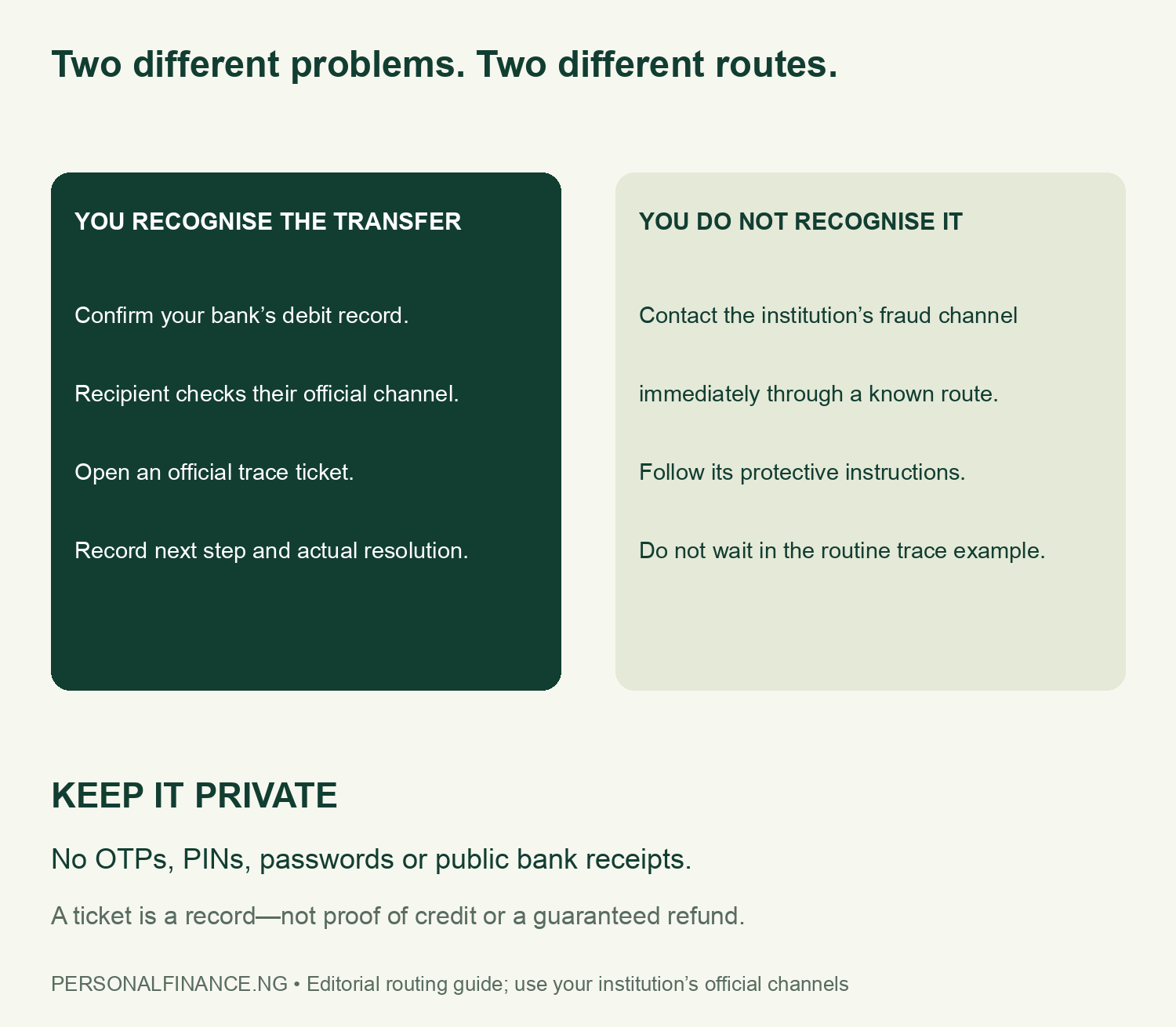
First, this guide covers a domestic transfer you recognise and authorised. An unfamiliar debit is different: contact the institution’s fraud channel immediately through a known official route. Do not put a potentially unauthorised transaction into a routine wait-and-trace example.
Bank transfer debited but not received Nigeria: start with both sides
UBA’s 20 November guidance on payment alerts warns that an alert or screenshot is not proof that money arrived. The recipient should verify credit using their own official banking application or authorised channel. This does not mean a genuine sender is dishonest; it means both parties need independent evidence.
First, on the sender’s side, open your own official account history. Record the amount, time, transaction reference and status shown. Then, on the recipient’s side, ask whether their independently checked account history shows the matching credit. Keep “not yet checked” separate from “checked and not visible”.
Do not ask the recipient for their login, OTP or PIN. You do not need access to another person’s account to ask whether they have checked through their own bank. A forwarded receipt may help identify a transaction privately, but it cannot replace the receiving institution’s actual account record.
What the new SIIPS reporting figure does—and does not—measure
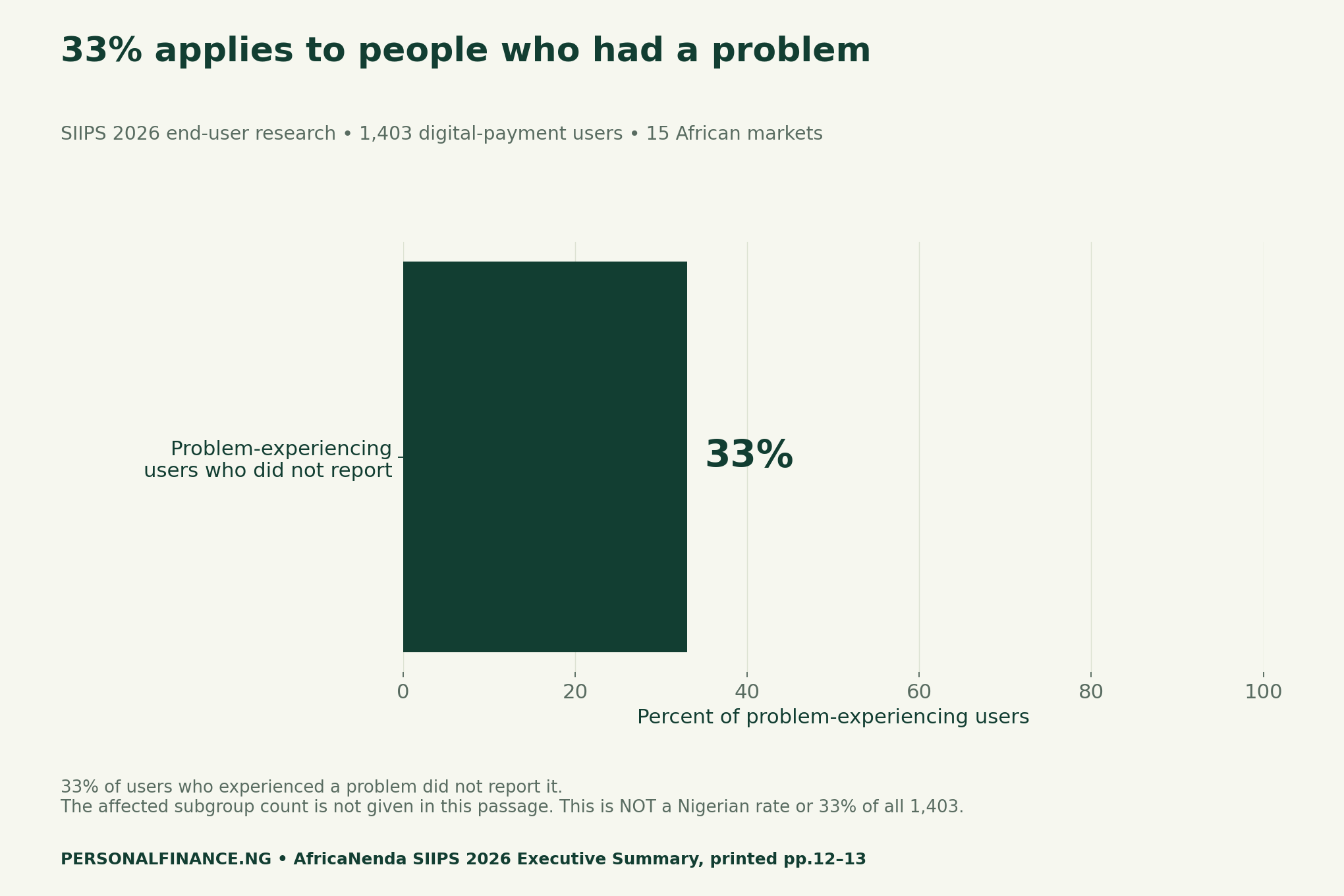
The SIIPS 2026 executive summary places complaint reporting in a wider African payment-trust discussion. Its 33% figure describes non-reporting among users who experienced a problem. It is not a Nigerian failed-transfer rate, a share of all transactions or the probability that your transfer will fail.
We have not multiplied 1,403 by 33% to invent a non-reporting headcount. That would use the whole sample where the statistic requires a smaller affected subgroup. The practical reason to retain a ticket is straightforward, but the research does not establish your individual outcome.
Why retrying before tracing can tie up more cash
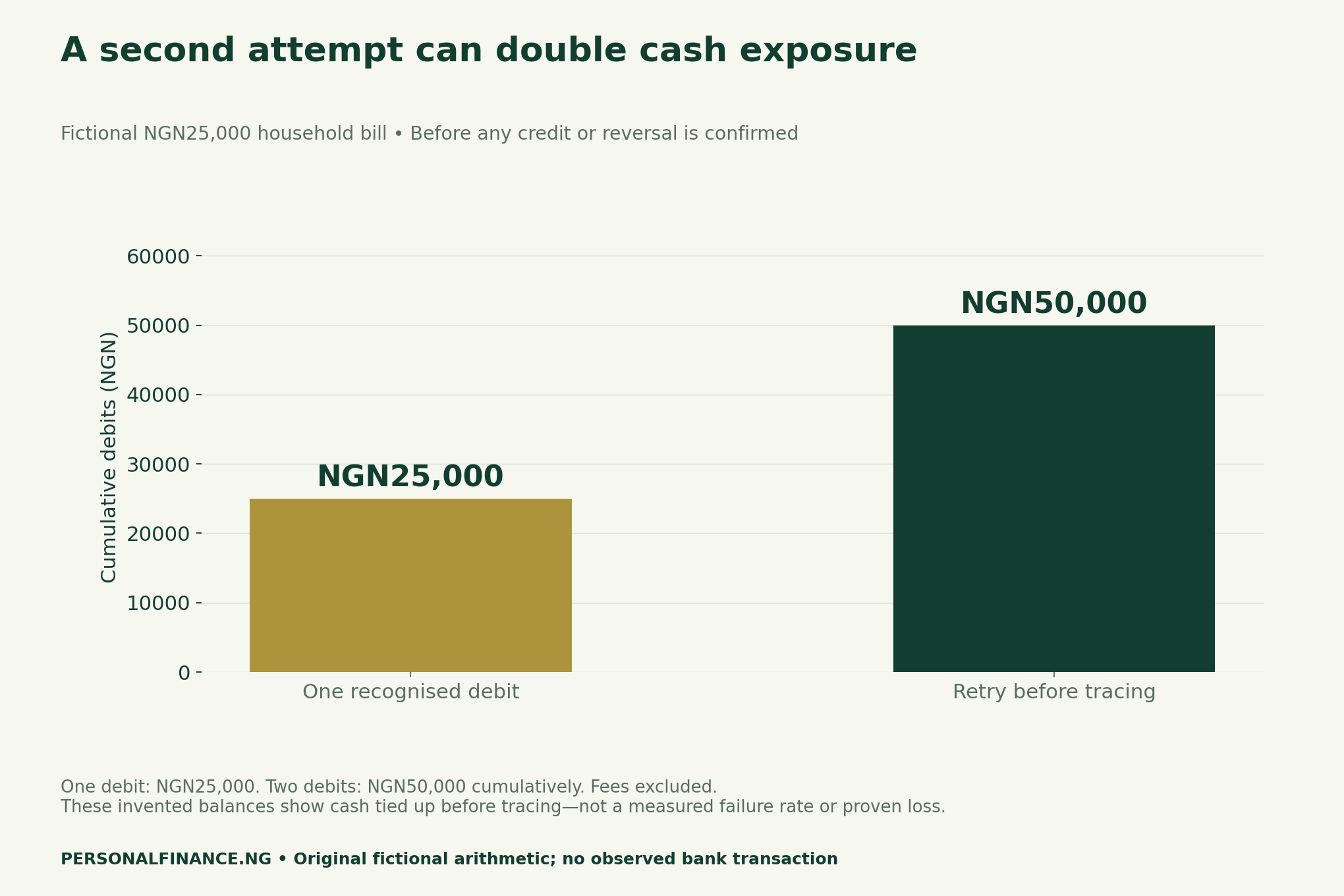
Suppose a shared household bill is ₦25,000. One recognised debit reduces available cash by that amount. If you send the same amount again while the first debit remains untraced, cumulative debits can reach ₦50,000 before either bank confirms credit or reversal. The bill itself is still ₦25,000.
As a result, that distinction matters when the same balance must cover food, transport or another bill. It does not prove the first transfer was lost or that both attempts will settle. If a payment is urgent, discuss the situation with the recipient and your bank rather than treating another attempt as a reliable diagnostic test.
Use a private trace card with separate timestamps
The blank CSV records the recognised debit time, amount, private reference, recipient-check time and status. It then separates the official ticket, the bank’s stated next step and the eventual resolution. Use a case label that makes sense to you; keep the file private and share only what the institution needs through its secure process.
Opening a ticket does not credit an account. Similarly, accepting a status enquiry does not reverse a debit. Mark the case resolved only after the relevant account evidence and the institution’s explanation support that conclusion. In addition, if two attempts have occurred, give each its own reference so the bank can distinguish them.
UBA Nigeria’s self-service page illustrates transaction-status and dispute functions. It is a bank-specific example, not a promise that every institution uses the same menu. Start from the app or website you already know, and use its official help route if the function is not clear.
Escalate through the applicable complaint route
The CBN’s complaints guidance starts with reporting to the financial institution. Its general escalation discussion refers to a two-week resolution period. That is not a universal transfer-reversal promise, and it does not justify delaying an urgent fraud report.
The CBN complaint portal separately instructs users to obtain an institution ticket and allow 24 hours for the complaint to be uploaded before accessing the portal. That upload step is not a guaranteed refund deadline. Follow the current instructions for your complaint type and retain the institution’s reference and response.
If you suspect account compromise, the CBN’s fraud-awareness guidance advises immediate contact with the bank. Use a known number or official app route, not a phone number supplied by a stranger offering recovery. We do not request credentials, receipts or account numbers from readers.
Your Personalized Financial Plan
Get expert financial advice tailored exclusively to your goals. Receive a custom roadmap in just 1-3 business days.
Get StartedMethod, limits and four free CSV files
We checked the SIIPS denominator, dated UBA alert guidance and official bank/CBN complaint pages on 22 November 2026. Our charts separate a published reporting percentage from fictional retry arithmetic. We did not access a bank account, test a live transfer or estimate a Nigerian failure rate.
Finally, the trace card supports record keeping, not a guaranteed recovery outcome. Exact bank processes and transaction classifications can differ. For the separate question of whether savings can be accessed in an emergency, see our digital savings access guide; deposit access and a disputed transfer require different evidence.
- Published evidence and denominator register (CSV)
- Fictional retry cash-exposure calculations (CSV)
- Blank private transfer trace card (CSV)
- Made-up trace-card example (CSV)
Sources: AfricaNenda SIIPS 2026 executive summary, printed pages 12–13 and sample description; UBA, 20 November 2026; UBA Nigeria self service; CBN complaints guidance and complaint portal. Suggested citation: Nigerian Personal Finance, “Bank Transfer Debited but Not Received: Check Before Paying Again”, 22 November 2026. Charts and tools are attributed original editorial analysis.


