





A mobile data budget in Nigeria should include everything you spend to keep a connection working. The main bundle is only the starting point. Backup purchases, emergency top-ups and outage-related travel can change which option costs less overall.
This guide combines a new survey with an original break-even calculation. It does not rank operators or claim a higher price buys better service. Use the four CSV downloads to compare your own costs and record whether a connection works for the tasks you actually need.
What the new Nigerian data survey can tell us
The NITDA–NBS Nigeria Tech Outlook report describes 2,147 usable adult household telephone interviews across the 36 states and FCT, conducted from 26 September to 9 October 2026. It reports 40.1% spending above ₦5,000 monthly on data and 43% willing to pay at least 25% more for reliability. Willingness is not a purchase or a saving.
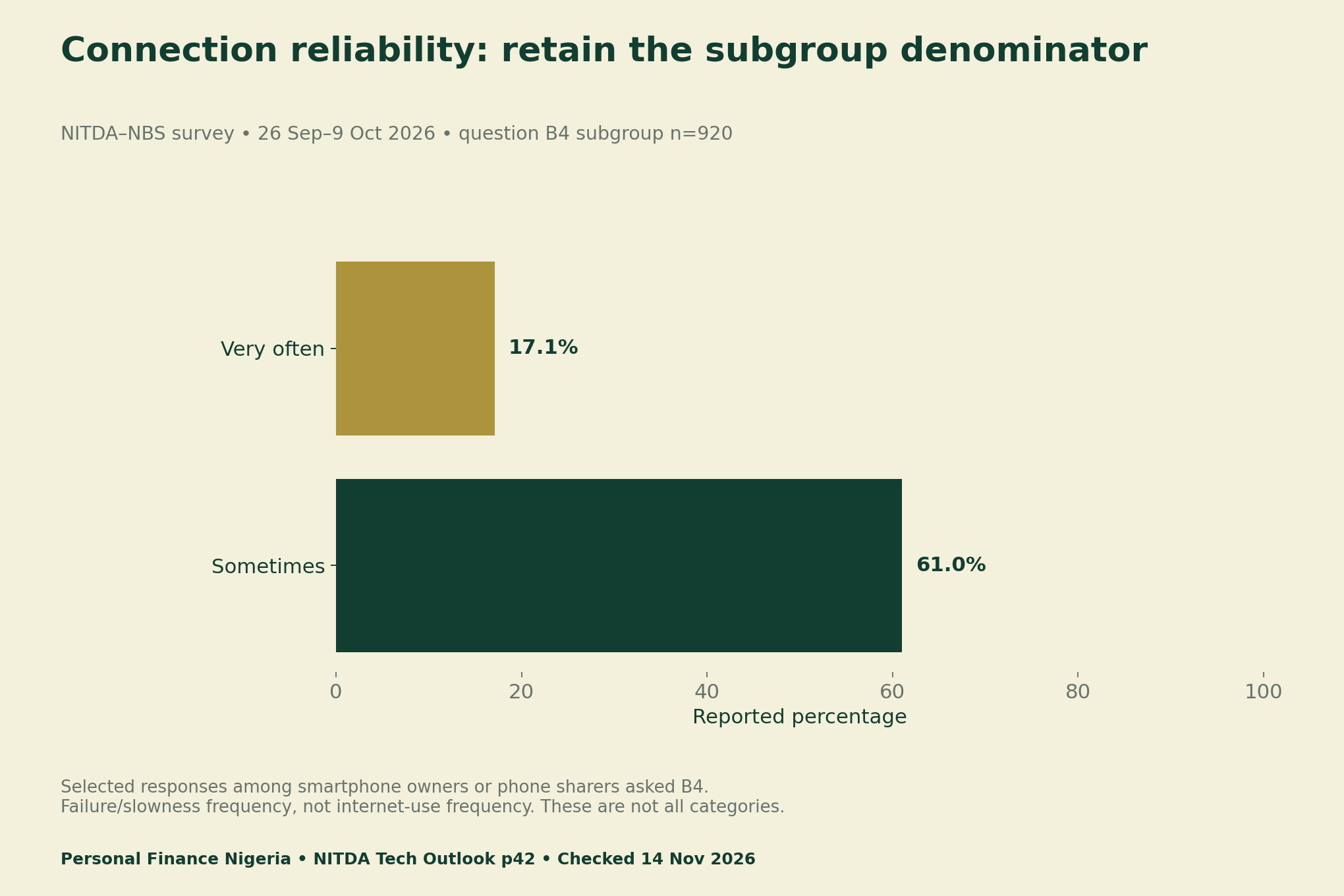
For reliability, the relevant base is the 920 respondents asked B4, rather than all household interviews. Their answers describe failure or slowness, not how often they went online. The results cannot identify the best operator for your home, commute or work location.
Build a mobile data budget Nigeria households can audit
Choose one comparison period before adding costs. Four consecutive weeks is useful for a diary; a calendar month can work if your records cover it consistently. Record the beginning and end dates. Do not compare a 30-day main plan with an unadjusted two-month backup bill.
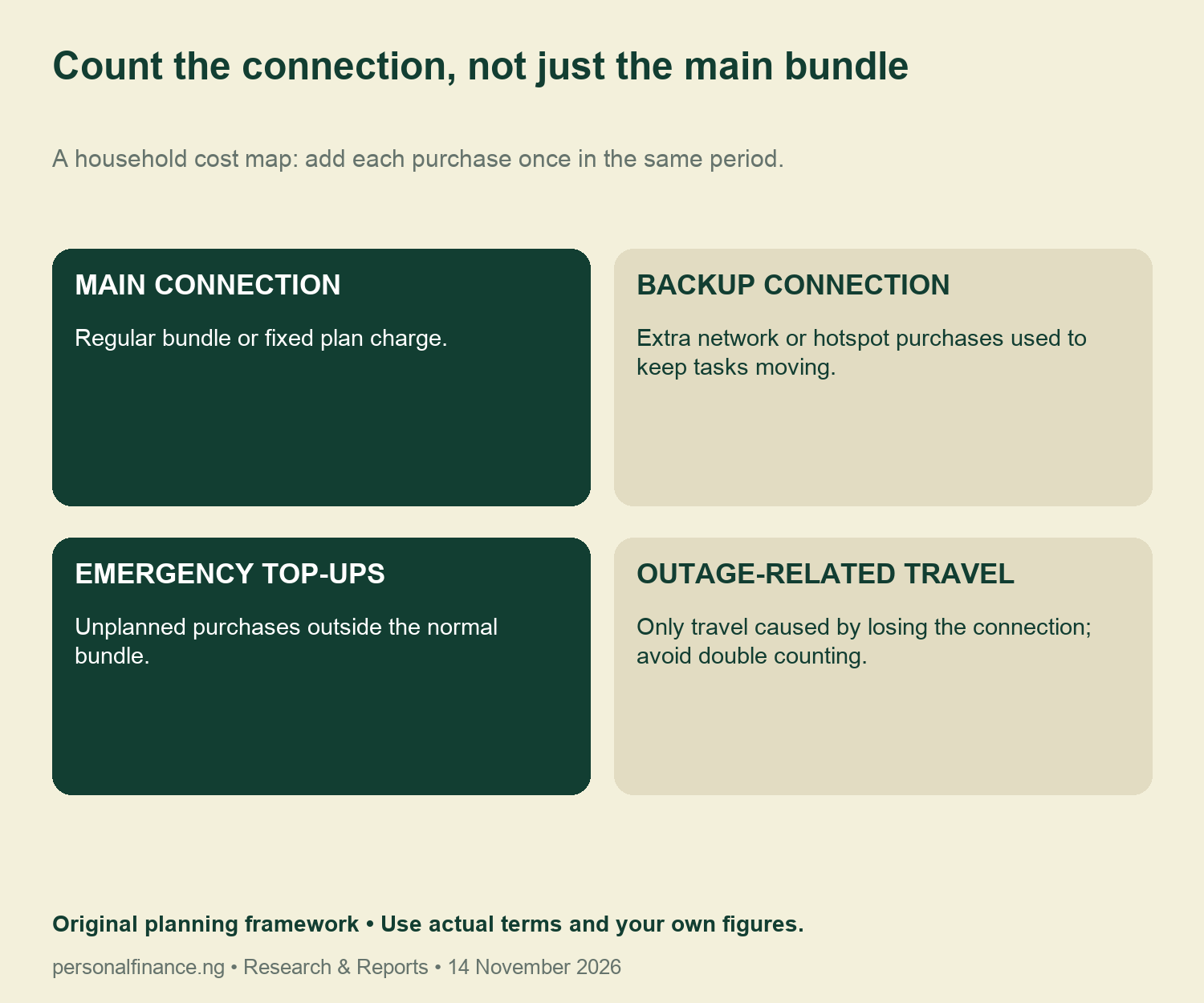
Allocate each payment to one category. If an emergency top-up is already included in your backup total, do not count it again. Note refunds and usable rollover separately so you can explain the final total. A payment record helps distinguish a bundle purchase from a vague recollection of what data usually costs.
Include shared household spending when it serves the same connection need. For example, one person may buy the main plan while another buys a hotspot bundle during an outage. Decide whose costs the comparison covers and keep that boundary unchanged between options.
Calculate the backup allowance before paying a premium
Consider a fictional household paying ₦5,000 for its main plan and ₦2,000 for backup data in the same period. Its current total is ₦7,000. An alternative main plan costing ₦6,250 leaves ₦750 before it reaches that current total. It is cheaper only when its remaining backup cost is below ₦750, assuming every other cost stays equal.
| Remaining backup with alternative | Alternative total | Difference from current ₦7,000 |
|---|---|---|
| ₦0 | ₦6,250 | ₦750 lower |
| ₦500 | ₦6,750 | ₦250 lower |
| ₦750 | ₦7,000 | Equal |
| ₦1,000 | ₦7,250 | ₦250 higher |
| ₦2,000 | ₦8,250 | ₦1,250 higher |
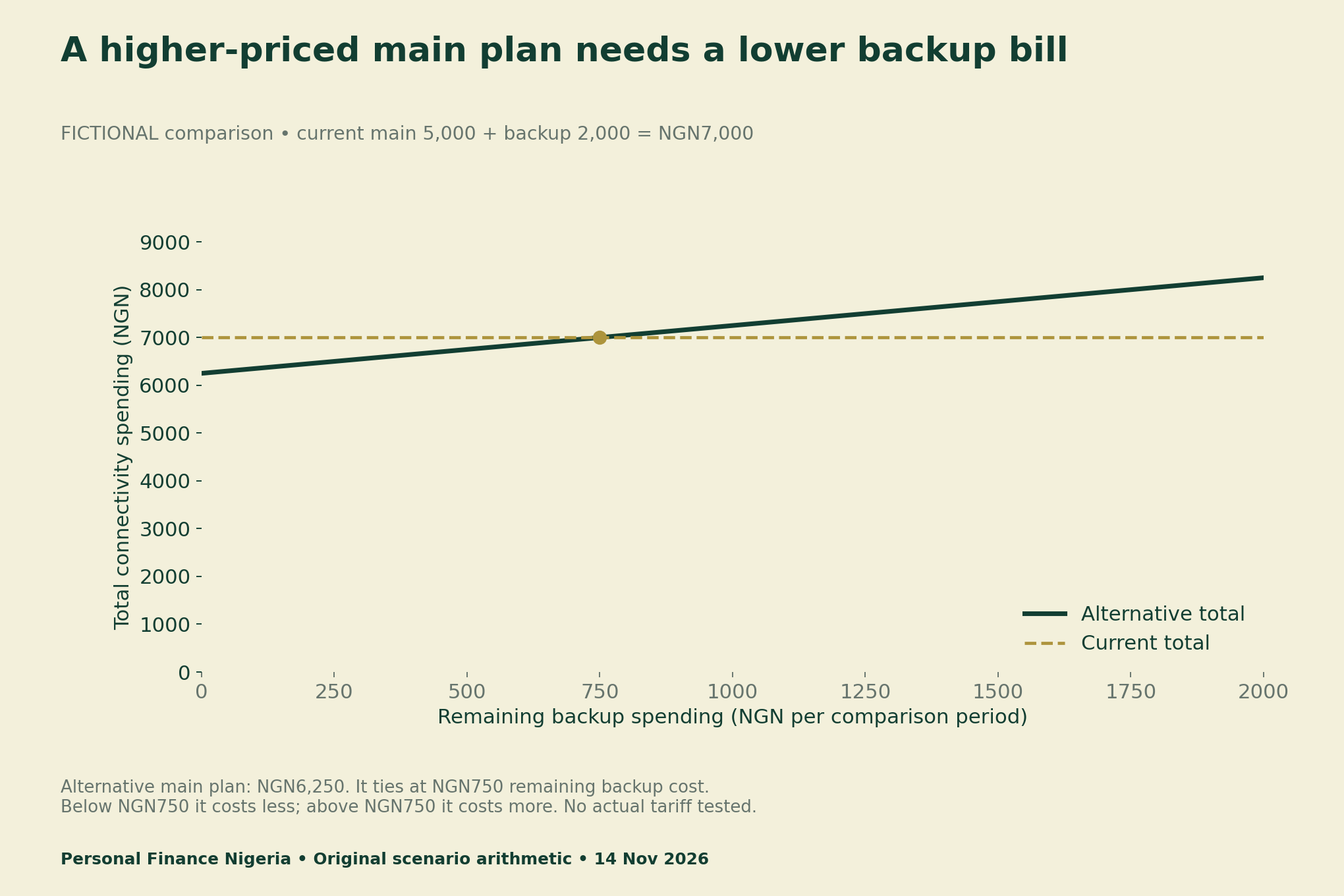
Extend the equation if another cost changes. A router charge, installation payment or connection-related journey belongs in the comparison when it applies. Keep one-off and recurring costs distinguishable. A lower first-period bill does not establish a lower cost over a longer commitment.
A higher price is a hypothesis to test
Write down what improvement would matter before switching. Perhaps a call needs to finish without interruption, or a file must upload during a particular evening window. Define that task in ordinary terms. A strong signal display alone does not tell you whether the task succeeds.
Use the reliability diary to record the time, interruption duration, affected task and whether a backup solved it. Do not record private message contents or account credentials. A short diary cannot predict every future outage, but it creates a more useful comparison than a single good speed test.
Where a short, affordable trial is available, check its current terms and your actual coverage before making a longer commitment. Record any change in usage or household size during the trial. Extra streaming or a new work task can raise spending even when the connection improves.
Keep the survey limits visible
Annex A reports empirical state weights, with no telephone-coverage or sex adjustment. The unweighted sample included 1,688 men, 448 women and 11 unstated responses. Completion was 2,147 of 2,800 targeted interviews, about 76.7%; the report explicitly distinguishes completion from a response rate. These limits matter for generalisation.
Treat the survey as context for a household question. It does not measure your own bill, prove a causal link between price and reliability or establish an operator recommendation. The original cost scenarios are deliberately separate from the survey percentages. No survey respondent is represented by the fictional household.
Download the mobile data budget and reliability tools
Start with your actual payment records in the cost ledger. Use the diary alongside it, then replace the fictional inputs in the scenario file. The measure register preserves the report pages and subgroup boundaries for anyone citing the selected figures.
Your Personalized Financial Plan
Get expert financial advice tailored exclusively to your goals. Receive a custom roadmap in just 1-3 business days.
Get Started- Survey measure and denominator register (CSV)
- Fictional backup-cost break-even scenarios (CSV)
- Blank four-week connectivity-cost ledger (CSV)
- Blank connection-reliability diary (CSV)
For more household research, browse Research & Reports and the Budgeting category.
Methods and update notes
We retrieved the complete NITDA report and checked the selected findings against pages 27 and 42 and the sampling account in Annex A, page 94. The charted cost comparison uses original fictional inputs. Calculations hold the alternative main charge constant and vary only its remaining backup expense; they exclude any unentered difference in fees or travel.
Research date: 14 November 2026. This is not a live-tariff comparison. Recheck plan prices, allowances, coverage and conditions before acting. Suggested citation: Personal Finance Nigeria, “Nigerian Mobile Data Spending: Is a More Reliable Plan Worth the Extra Cost?”, original break-even analysis and tools. Cite NITDA separately for its survey.