





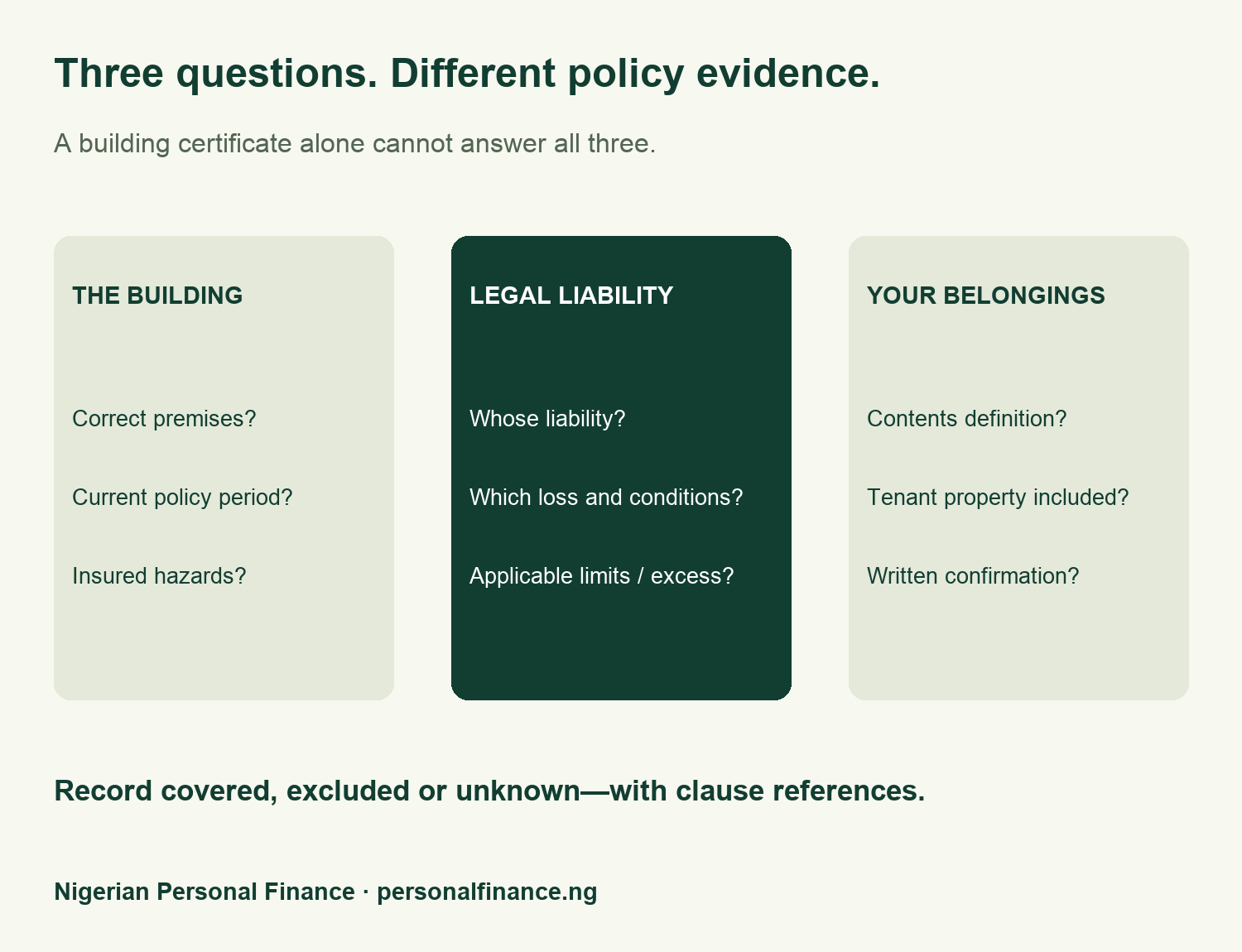
Landlord building insurance and tenant belongings in Nigeria raise different questions. A certificate for the premises does not by itself show that every item you own has replacement cover. Ask for the policy schedule and relevant wording, then separate building hazards, legal liability and movable contents.
This report includes two fictional inventory charts, a three-question infographic and four CSV tools. It helps occupants organise evidence before relying on a policy. It does not assess a real insurance contract, decide a claim or provide a valuation of anyone’s possessions.
Separate the November news from the insurance contract
Voice of Nigeria reported on 25 November 2026 that NAICOM and the Federal Fire Service strengthened their collaboration on compulsory building insurance. A technical committee has six weeks to recommend how to operationalise the Fire Services Maintenance Fund. That is an implementation-news hook, not a personal claim decision or an instruction to charge tenants a new percentage.
What section 76 says—and what you still need to check
The gazetted Nigerian Insurance Industry Reform Act 2025, section 76, addresses public-building hazards and the legal liabilities of owners and occupiers. Its definition includes tenant-occupied buildings and specified uses accessible to the public. Therefore, do not assume that “public building” means only a government-owned office. Ask the insurer or an appropriate adviser how the definition applies to the premises.
Section 76(3) places a quarterly remittance of 0.25% of relevant net premiums on direct insurers. Its base is not your rent or the value of your belongings. The provision does not establish a tenant surcharge or a claims-payment rate. Furthermore, the statutory duty does not replace the need to inspect the actual policy and circumstances of a loss.
Start by recording which premises the schedule names and the period of cover. Next, identify the insured party and the type of protection shown. Then request the clauses that answer your particular question. A certificate can be useful evidence, but a title on its own is an incomplete answer to a contents question.
Landlord building insurance and tenant belongings in Nigeria: build an inventory
For example, imagine an occupant lists a laptop at ₦150,000, a phone at ₦80,000, clothing at ₦50,000, furniture at ₦40,000 and kitchen items at ₦30,000. The total is ₦350,000. These are invented planning values, not current prices, replacement-cost advice or a real claim assessment.
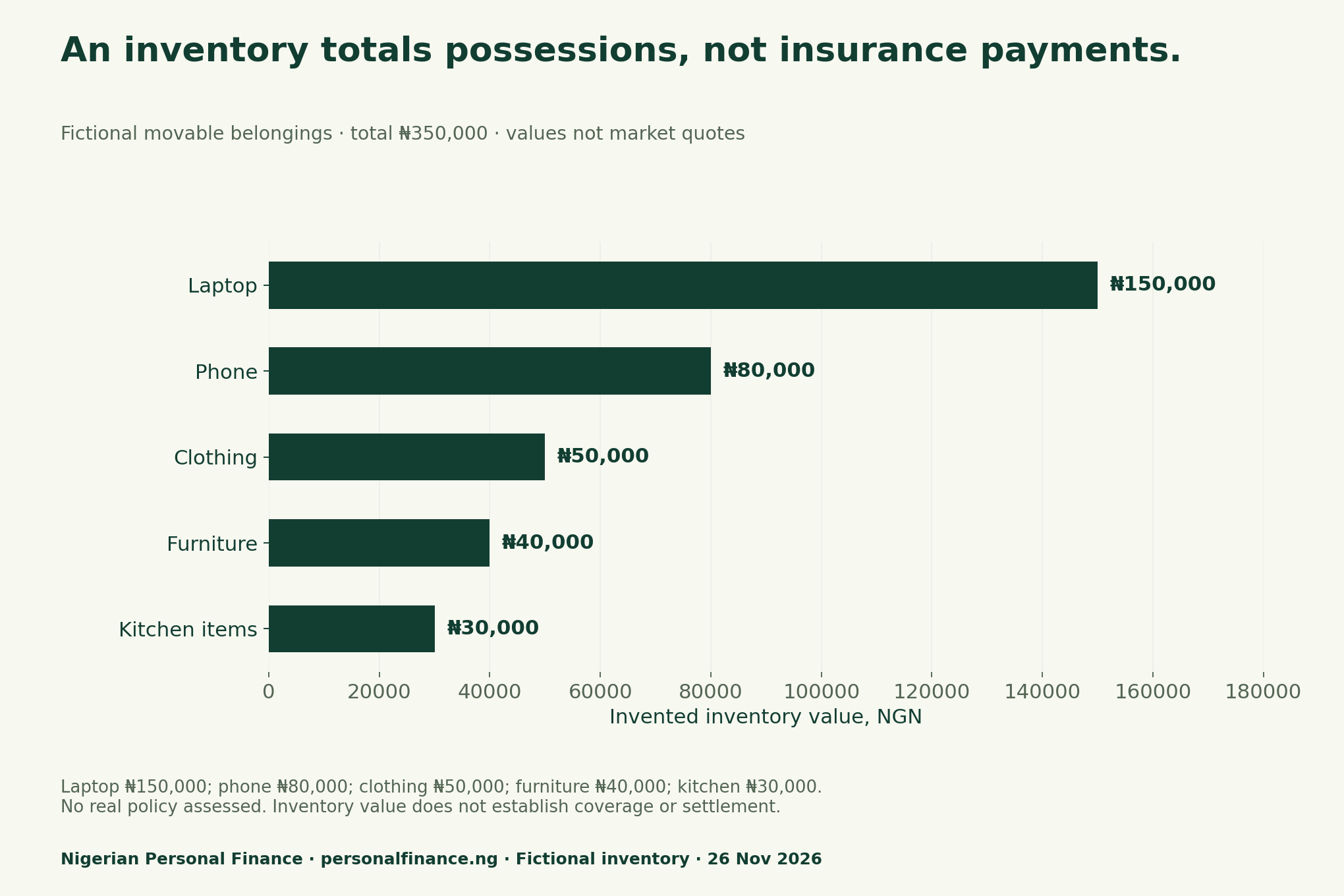
An inventory makes the question concrete. Instead of asking only “Am I covered?”, ask which definition includes a particular item, whose property the wording protects and what conditions apply. Keep photographs, receipts and other identifying evidence private. The public template asks only for document questions and local references.
Mark unknown explicitly instead of assuming cover
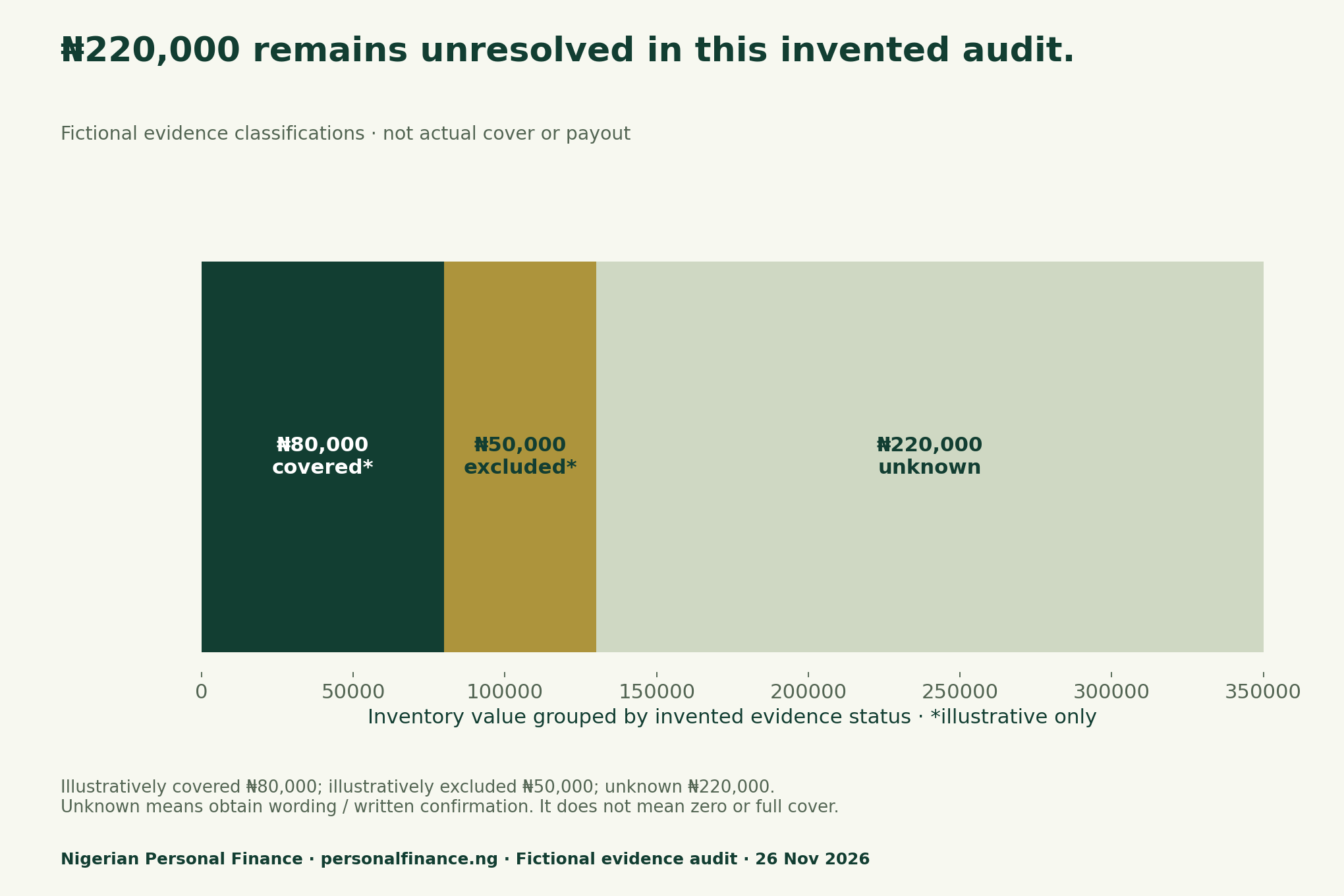
To demonstrate the audit method, invent three evidence labels. Suppose wording in this teaching exercise expressly includes the ₦80,000 phone and excludes the ₦50,000 clothing. The laptop, furniture and kitchen items remain unknown, totalling ₦220,000. These classifications are fictional; they are not standard terms or exclusions for Nigerian insurance.
| Invented evidence status | Inventory value | Next question |
|---|---|---|
| Illustratively included | ₦80,000 | Which limits, excesses and valuation terms apply? |
| Illustratively excluded | ₦50,000 | What does the actual exclusion say? |
| Unknown | ₦220,000 | Which wording or written confirmation is missing? |
The audit therefore preserves ₦220,000 as unresolved. Assigning zero would hide the need for evidence. Treating it as fully insured would make the opposite unsupported assumption. Similarly, the ₦80,000 illustrative included bucket still needs the applicable terms and evidence before anyone could assess a settlement.
Ask for the schedule, liability wording and contents definition
First, request the current schedule for the correct address. Ask who is insured, when cover starts and ends, and which sections apply. Next, request the liability wording and relevant conditions. Finally, ask whether any contents definition or endorsement covers property belonging to occupants in your position.
For example: “Please confirm whether this policy includes my movable belongings, identify the relevant clause and explain the applicable limits, excesses and claim procedure.” Ask for a written answer linked to the policy reference. Keep the reference in your private records rather than posting a document containing personal information online.
If the answer concerns liability, clarify what legal and factual conditions must be met. Do not read liability language as an unconditional promise to replace all possessions after any damage. Equally, do not assume a building policy can never respond to property damage. The wording, applicable law and circumstances determine the question.
If damage has already occurred
Prioritise personal safety and the relevant emergency response. Then use verified insurer or intermediary channels to ask about notification and documentation requirements. Keep dated evidence and receipts privately. Do not delay a time-sensitive notification while trying to finish our worksheet, and do not infer a universal claim deadline from this article.
Where coverage or responsibility is disputed, seek advice appropriate to the actual contract and loss. This report cannot determine whether a landlord, occupier or insurer owes a particular amount. It supplies an evidence-request method and transparent fictional arithmetic so readers can ask more precise questions.
Your Personalized Financial Plan
Get expert financial advice tailored exclusively to your goals. Receive a custom roadmap in just 1-3 business days.
Get StartedDownload the policy-evidence tools
The inventory file shows the five invented items. The totals file reproduces the three illustrative evidence buckets. The blank request template organises questions for the schedule, liability and contents sections. The source-boundary register separates enforcement news, statutory insurer remittance and personal policy evidence. Two charts suffice; extra figures would not reveal missing policy terms.
- Fictional movable-belongings inventory (CSV)
- Fictional covered, excluded and unknown totals (CSV)
- Blank policy-evidence request template (CSV)
- Law, news and policy-evidence boundaries (CSV)
Explore Insurance and Research & Reports. Suggested citation: Nigerian Personal Finance, “Landlord Building Insurance: Check Tenant Belongings”, 26 November 2026.