





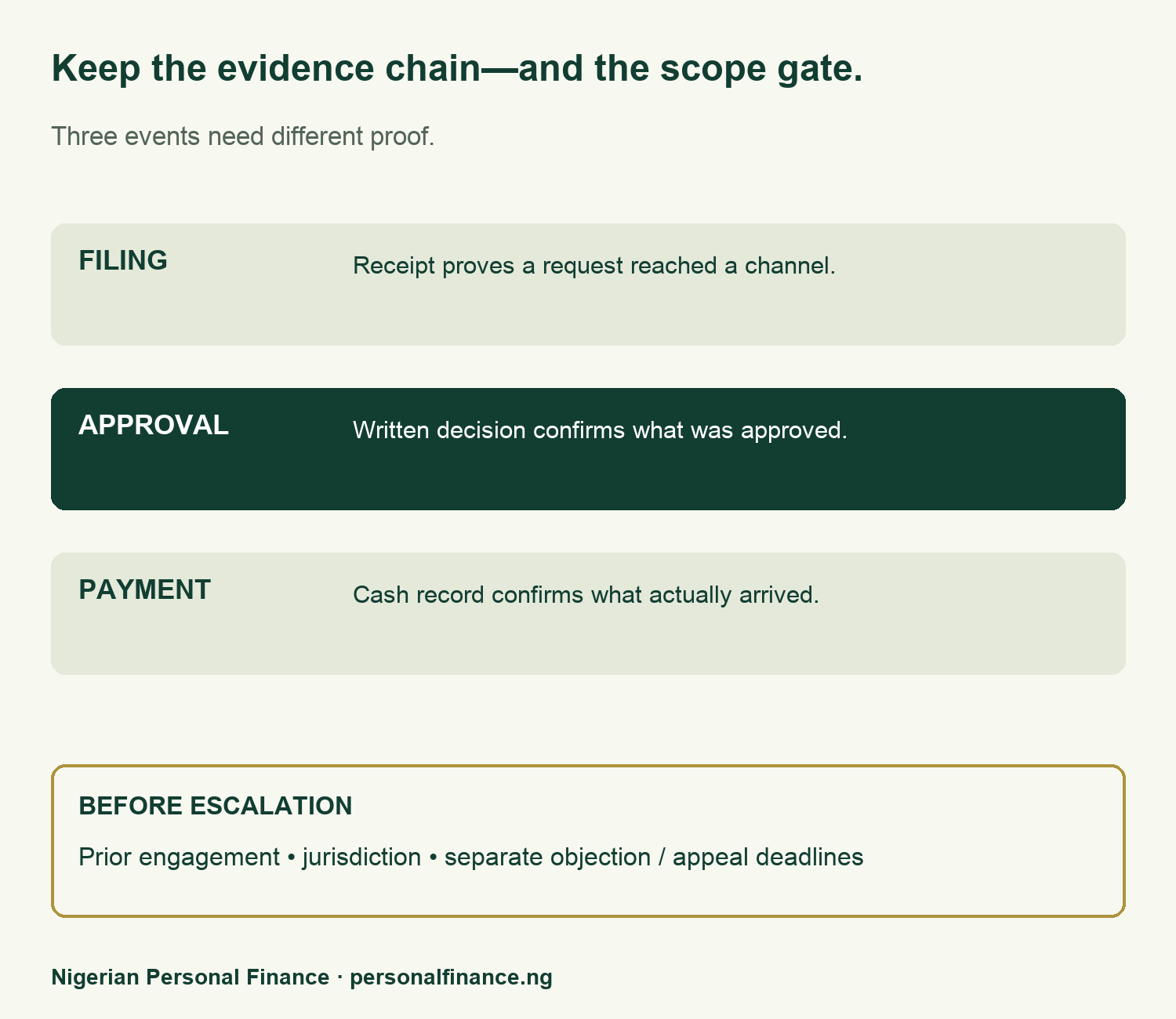
For a tax refund delay, Tax Ombud Nigeria guidance can help you identify an administrative complaint route. Before escalating, build a private chronology of the authority you contacted, when you contacted it, proof of receipt and the response. Keep proof of filing, a written approval and cash actually received as three separate records.
This report supplies a fictional contact-timeline chart, an evidence-chain infographic and four CSV tools. It explains how to organise an administrative complaint. It does not decide tax liability, establish that a refund is overdue or promise that the Ombud will accept a particular case.
Why the November Tax Ombud update matters
In its 20 November 2026 article on fair tax administration, the Office of the Tax Ombud describes its role in qualified operational, procedural and administrative grievances. The practical starting point is a clear account of what happened. A strong record distinguishes the requested administrative remedy from a dispute over the merits of a tax assessment.
Tax refund delay: check the Tax Ombud route in Nigeria
The official FAQ lists refund-processing delays and failure to respond among possible complaints. It says the Office’s complaint-resolution service is free and requires prior engagement with the relevant authority. Its explanation also makes clear that the Ombud does not overturn assessments. Therefore, frame a delay complaint around the administrative handling, not a demand that this route recalculate your tax.
Furthermore, the Office’s homepage says to exhaust the authority’s internal complaint mechanisms first. Keep evidence of those steps; do not assume that sending one email automatically satisfies them. The mandate page describes federal jurisdiction and arrangements envisaged with state and local bodies. Check the current scope for the actual authority before assuming a route applies.
For example, write down whether your issue is a missing acknowledgment, an unanswered request for status or a failure to explain a decision. Then identify the authority responsible for that specific step. A chronology that names the right office and document is more useful than a general statement that “tax has not replied.”
Build a four-field private chronology
Start with the date of each contact. Next, record the authority or office contacted. Add a local reference to your proof of receipt. Finally, note the response or next action in the authority’s own terms. If you have no reply as of a particular check, write that date rather than implying that you know what happened internally.
The blank CSV contains only those four fields. Keep actual correspondence, tax identifiers, bank details and identity documents in a secure private folder. Do not upload them to a public spreadsheet or send them to this publication. Use the official complaint process for any information the Office legitimately requires.
Read the fictional ₦75,000 example carefully
Imagine a taxpayer records a ₦75,000 refund request on 2 November, a written followup on 9 November and an internal complaint followup on 16 November. This is invented correspondence, not a real case or an official sequence of required waiting periods. It demonstrates how three rows can retain distinct evidence.
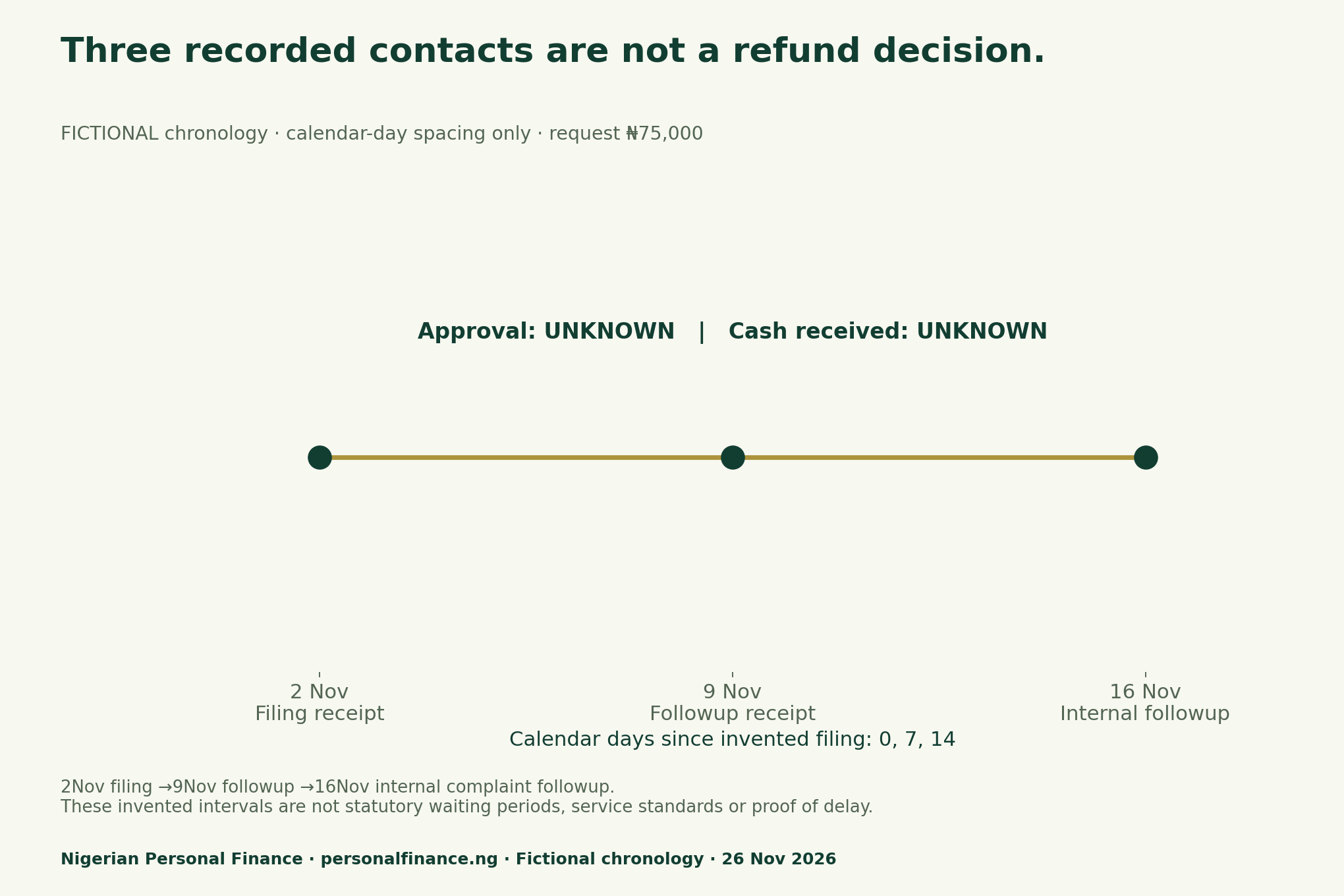
| Fictional date | Authority contacted | Proof retained privately | Response or next action |
|---|---|---|---|
| 2 November | Relevant tax authority | Filing receipt | ₦75,000 requested; no approval proved |
| 9 November | Same authority | Followup delivery receipt | Ask for status and missing requirements |
| 16 November | Internal complaints route | Copy and receipt | Record actual reply or no reply as of the check |
The first receipt shows filing in this example. However, it does not establish written approval of ₦75,000. A later approval would need its own dated evidence and terms. Similarly, an approval would not itself show that cash arrived. Therefore, the example leaves approved amount and received cash as unknown rather than treating the request as spendable money.
Describe an administrative remedy precisely
For example: “Please confirm the status of my refund request, identify any outstanding information and explain the next administrative step. I contacted the relevant authority on the dates shown and retained the listed receipts.” Adjust that wording to the facts you can substantiate. Do not present an invented sample as something that happened to you.
If you have received a decision, preserve its exact wording and date. Ask which part concerns the administration and which part concerns the assessment itself. An evidence pack can include both documents, but the route for challenging the amount may be different. Obtain appropriate professional advice if that distinction affects your rights.
Preserve other deadlines and check jurisdiction
The Joint Revenue Board (Establishment) Act 2025, Third Schedule provides for unresolved complaints and jurisdiction review. It also says an investigation does not affect action by the relevant agency. Do not assume that an Ombud complaint pauses an objection, appeal, payment or other applicable deadline. Identify and track each separately with advice suited to the case.
This report deliberately avoids a universal “wait this many days” rule. Refund types, authority decisions and applicable procedures can differ. The fictional timeline cannot establish when a legal clock began. A news publication date and the date you first checked your inbox are not substitutes for the relevant event in your own record.
Use the official complaint channel and retain its receipt
The official complaint guide describes submission, review and a recommendation or resolution process. Begin from the verified government website and use its complaint route. A general inquiry form is not necessarily the complaint form. Retain the tracking acknowledgment, further evidence requests and eventual communication as separate chronology entries.
Your Personalized Financial Plan
Get expert financial advice tailored exclusively to your goals. Receive a custom roadmap in just 1-3 business days.
Get StartedFinally, keep expectations tied to evidence. Submission is not acceptance of jurisdiction. Acceptance is not a promise to pay the requested sum. The Office’s own free service also does not mean that a private representative charges no fee. Verify any outside engagement separately rather than paying someone who claims a guaranteed refund result.
Download the chronology and scope tools
The fictional chronology exposes its invented dates and calendar-day spacing. The evidence-stages file preserves the ₦75,000 request while leaving approval and cash unknown. The blank chronology supports your own private record. The scope checklist points to official sources for prior engagement, jurisdiction, cost and separate deadlines. One timeline chart is enough; more charts would not establish missing decisions or a personal entitlement.
- Fictional three-contact chronology (CSV)
- Filing, approval and cash evidence distinctions (CSV)
- Blank four-field private chronology (CSV)
- Official scope and route checklist (CSV)
Explore Taxes and Research & Reports. Suggested citation: Nigerian Personal Finance, “Tax Refund Delay: Prepare Your Tax Ombud Evidence”, 26 November 2026.