




Research checked: 6 November 2026. An Abuja estimated electricity bill in November 2026 needs a match-first check. Find the correct business unit, feeder, service band and consumption period before comparing the billed energy with a NERC cap.
NERC published its resource notice on 2 November 2026. Its attached PDF is labelled November, but explicitly says energy consumed in October 2026. The schedule expresses each cap in kilowatt-hours, or kWh. It is not a naira tariff or a reading from your household’s meter.
This guide uses a small, clearly identified extract to show how to check a bill. It does not estimate an Abuja average, rank neighbourhoods or promise a credit adjustment.
Read the document period first
First, open the official November 2026 AEDC schedule (PDF) and keep a copy with your bill. Page 1 identifies the consumption month and the columns used to identify a row: state, business unit, feeder name, non-MD service band and cap.
However, a bill issue date alone may not identify the consumption period you need to compare. If the bill combines periods or does not show enough detail, request clarification before calculating a discrepancy. A November label should not be silently rewritten as November consumption.
The document concerns monthly caps for estimated billing of unmetered customers under the stated methodology. Confirm that the customer and charge being checked fall within the relevant scope. A cap comparison does not replace a meter reading or settle a metered-billing dispute.
The Abaji extract: specific rows, not a city average
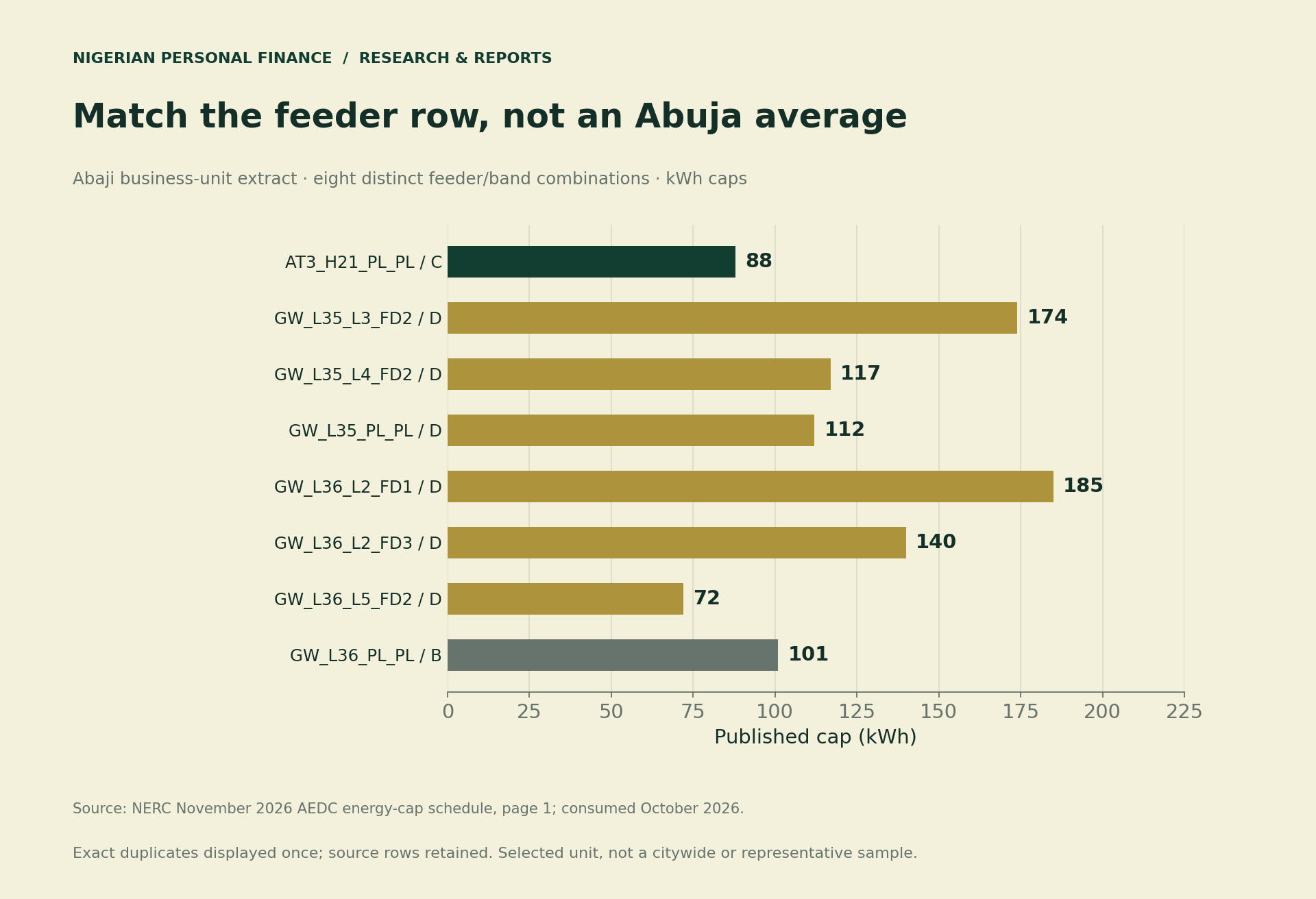
Page 1 includes these Abaji examples: feeder AT3_H21_PL_PL, Band C, 88 kWh; GW_L35_L3_FD2, Band D, 174 kWh; and GW_L36_L5_FD2, Band D, 72 kWh. Those values belong to those particular rows.
For context, Figure 1 shows all eight distinct Abaji row combinations on that page. The published extract contains ten Abaji rows because two identical combinations appear twice. Therefore, we remove only those exact duplicates for this display; the download preserves the source rows.
| State and business unit | Feeder | Band | Cap, kWh |
|---|---|---|---|
| FCT — Abaji | AT3_H21_PL_PL | C | 88 |
| FCT — Abaji | GW_L35_L3_FD2 | D | 174 |
| FCT — Abaji | GW_L36_L5_FD2 | D | 72 |
Do not choose the lowest cap in the table or borrow a neighbour’s row. Even within one business unit, the feeder and band remain necessary parts of the match.
A feeder label alone may not identify the right row
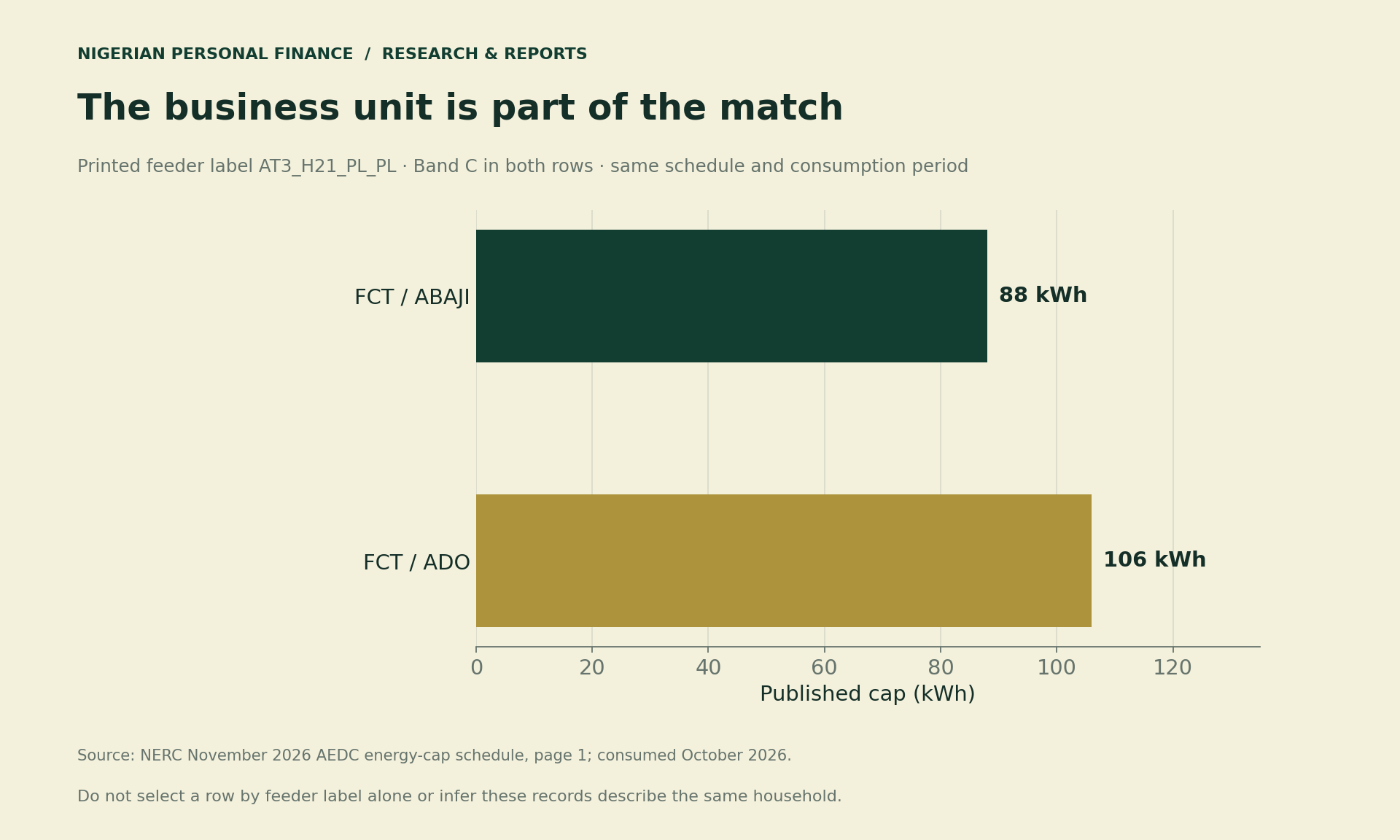
The same printed feeder label AT3_H21_PL_PL appears under both Abaji and Ado on page 1. Both rows show Band C, but the caps are 88 kWh and 106 kWh respectively. As a result, preserve the business-unit field. Do not select whichever number suits your calculation.
If your available details match multiple conflicting rows, treat the match as unresolved and ask for written confirmation. Do not average conflicting caps, infer a physical connection from a code alone or silently discard a difficult row.
Match an Abuja estimated electricity bill in November 2026
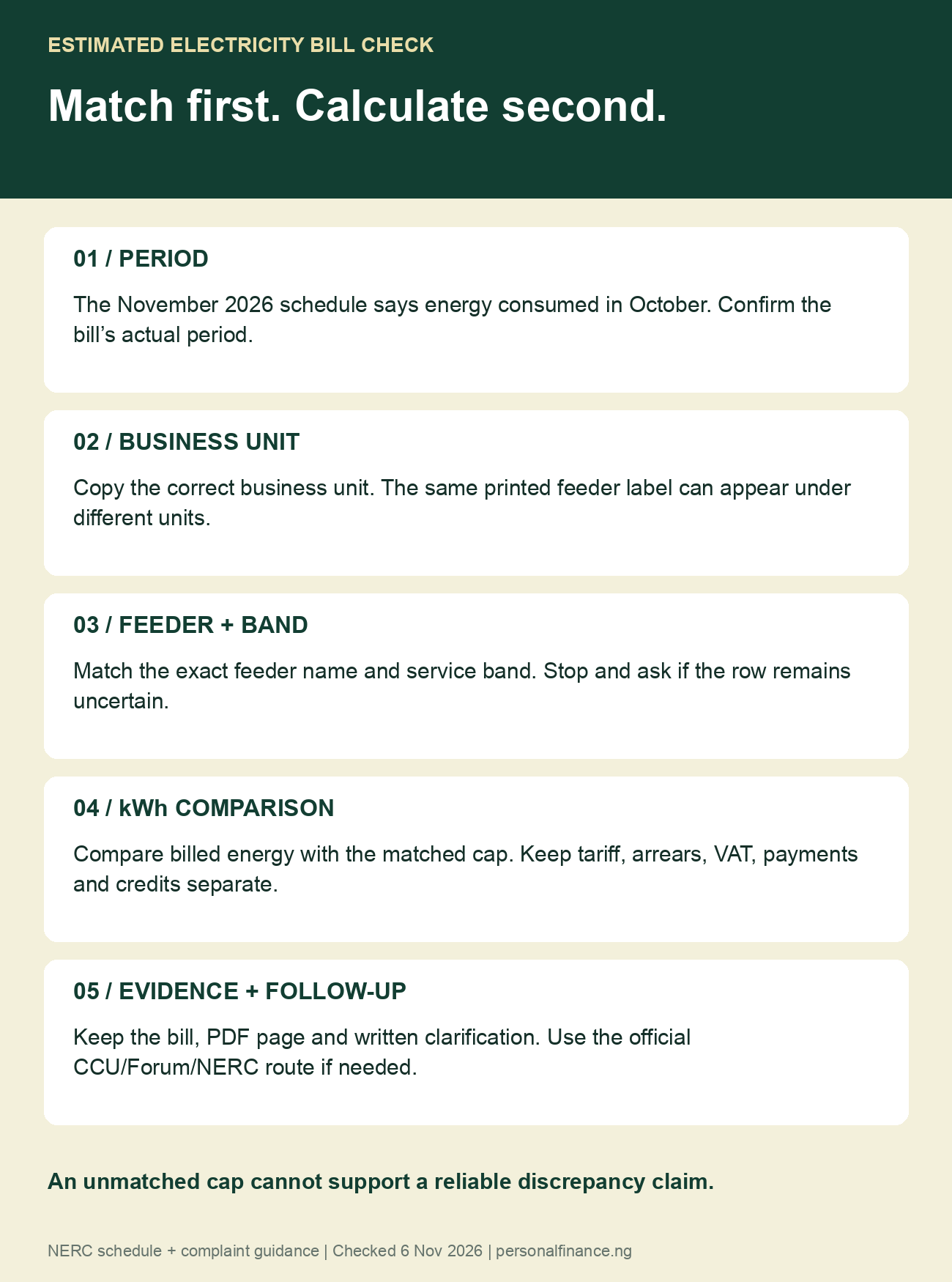
Next, build a short evidence record before doing arithmetic. Copy the bill’s period and billed kWh. Then identify the relevant schedule, business unit, exact feeder string and service band. Also, keep the PDF page number so someone else can reproduce your comparison.
A useful request is specific: “Please confirm the business unit, feeder, service band, consumption period and approved cap used for this bill.” That asks for an explanation without alleging wrongdoing or assuming a refund.
Fictional example: 200 kWh compared with 174 kWh
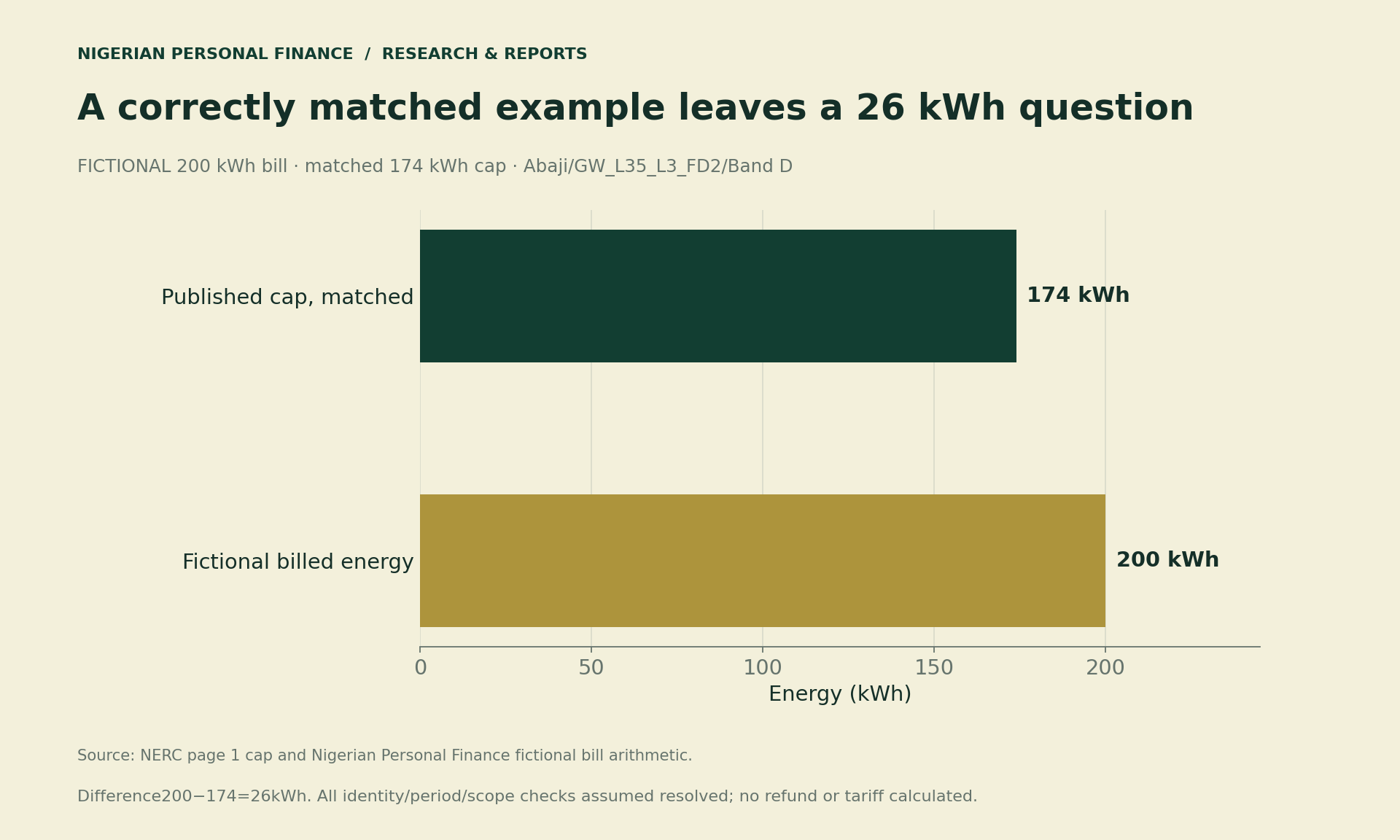
Suppose you correctly match a fictional 200 kWh estimated bill to the 174 kWh Abaji, GW_L35_L3_FD2, Band D row for the relevant period. The difference is 200 − 174 = 26 kWh. We do not assess an actual customer’s bill here.
The difference as a percentage of the cap is 26 ÷ 174 × 100 = 14.94% after rounding. State the denominator when sharing the result. Otherwise, two people can quote different percentages while using the same 26 kWh difference.
Your Personalized Financial Plan
Get expert financial advice tailored exclusively to your goals. Receive a custom roadmap in just 1-3 business days.
Get StartedWhy the denominator matters
Dividing 26 by the fictional billed 200 kWh instead gives 13%. That answers a different question: the difference as a share of billed energy. Do not describe that result as the percentage above the cap.
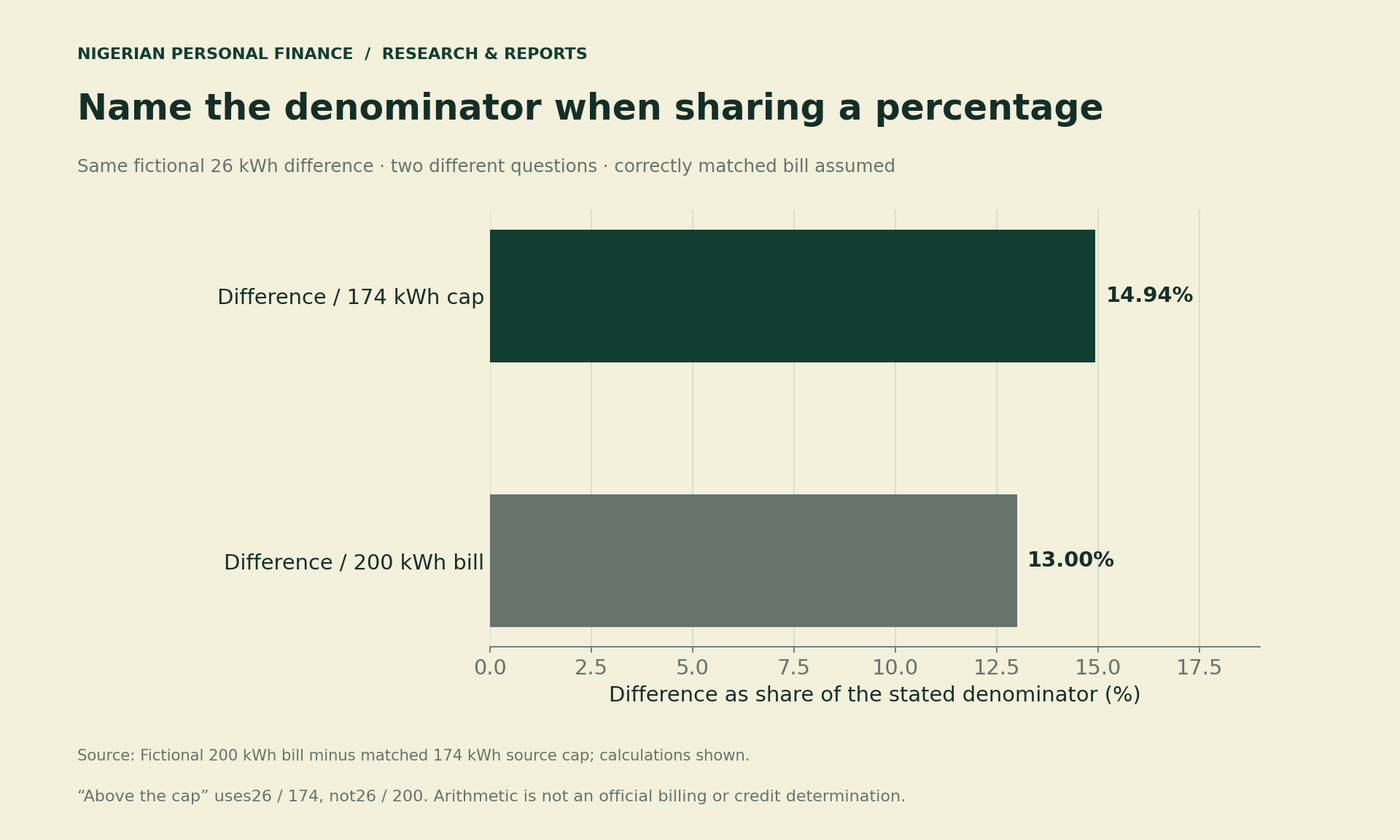
Neither percentage establishes the final naira adjustment. To understand an energy charge, also check the applicable tariff and other bill details. Arrears, VAT, credits, payments and other entries should remain separate from the kWh comparison.
Keep the whole bill reconciliation separate
A cap is an energy ceiling within its applicable scope, not the complete payable bill. Ask for an itemised explanation when you cannot reconcile the statement. In particular, distinguish current-period energy from an old balance. Also, check whether the company posted a payment after issuing the bill.
| Check | Record | Do not infer |
|---|---|---|
| Row identity | State, business unit, feeder and band | A citywide or neighbourhood-average cap |
| Period | Schedule label, consumption month and billed period | November label means November consumption |
| Energy | Billed kWh and correctly matched cap | The cap proves actual household usage |
| Money | Tariff, taxes, arrears, credits and payments separately | A kWh difference automatically equals a refund |
| Evidence | Bill, PDF page, correspondence and reference number | An unmatched comparison proves misconduct |
Use the original bill and payment records when contacting customer care. Keep full account details private and share them only through the appropriate verified service channel, not in a public post.
Follow the current official complaint route
NERC’s how-to-file-a-complaint guidance starts with the supplying distribution company’s Customer Complaints Unit. Keep your complaint reference, submission date, supporting documents and the response.
If the handling is delayed or you are dissatisfied, the guidance describes escalation to the NERC Consumer Forum. A further challenge to the Forum’s ruling can go to NERC through the published route. Check the current guidance and relevant office details rather than relying on an old phone number copied into a social post.
A mismatch is a reason to seek clarification through that process. This guide does not recommend withholding payment or making an accusation. Wait for written confirmation before treating a possible credit as approved.
Download the source extract and private check tools
Download the page-1 source extract (CSV) and the fictional calculation example (CSV). The extract retains repeated source rows and marks the exact duplicates omitted from Figure 1. It is a limited teaching extract, not the complete 15-page schedule.
Use the blank match-and-reconciliation worksheet (CSV) and the blank evidence and follow-up log (CSV). These files organise checks on your device and do not submit a complaint or collect account details for this website.
For the wider household plan, our Nigerian lifestyle budgeting guide can help separate essential bills from other spending. Our needs-and-wants guide addresses allocation choices; neither replaces an official billing determination.
Methodology and limitations
We downloaded NERC’s 15-page PDF from the notice dated 2 November and visually checked page 1 on 6 November 2026. The extract lists ten Abaji rows and two Ado rows for the shared-code example. We retain exact duplicate combinations in the CSV and display them once in the charts. We do not average rows across business units.
The four charts answer four distinct questions: the scoped feeder values, the need for a business-unit match, the absolute energy difference and the percentage denominator. A fifth chart would repeat the calculation rather than add evidence. The separate infographic explains the checking process.
All billed-energy figures in the worked example are fictional. Source caps are dated, feeder-specific values; they are not tariffs, meter readings, delivery measurements or estimates of household consumption. Recheck the correct official schedule when the bill period changes.