




The November 2026 FGN savings bond interest rates answer an annual-rate question. They do not tell a household that money will arrive every month. On a fictional ₦100,000 face-value holding, a simple gross quarterly calculation gives ₦3,312.50 for the two-year instrument and ₦3,562.50 for the three-year instrument. The difference is ₦250 per quarter, alongside a different maturity date.
This guide separates the coupon amount, payment calendar and access to principal. Our five charts and four CSV tools make the assumptions explicit. They do not recommend a purchase or establish what any investor will receive after deductions, adjustments or an early sale.
Closing-date warning, checked 6 November 2026: DMO’s 2 November public announcement and its attached offer artwork state 6 November. However, its subscription portal displays 10 November for both instruments. We have not reconciled those official displays. Confirm the applicable deadline and availability directly with DMO or an authorised distributor; this article does not say the offer remains open.
November 2026 FGN savings bond interest: the source terms
The DMO subscription portal lists the two-year instrument as FGS202826 and the three-year instrument as FGS202927. Its official announcement gives the same annual coupon rates. The offer artwork also lists settlement on 11 November 2026 and quarterly coupon dates of 11 February, 11 May, 11 August and 11 November.
| Term | Two-year instrument | Three-year instrument |
|---|---|---|
| Annual coupon rate | 13.250% | 14.250% |
| Stated maturity | 11 November 2028 | 11 November 2029 |
| Portal instrument code | FGS202826 | FGS202927 |
| Fictional holding used below | ₦100,000 face value | ₦100,000 face value |
Meanwhile, the DMO portal FAQ gives a ₦5,000 minimum and a ₦1,000 face value per unit. It says coupon payments occur every three months from the issue date. Those general terms help explain the model; the investor must still confirm the instrument’s final terms and actual allotment.
Why the closing date needs a separate check
| Official display checked | Date displayed | How to use it |
|---|---|---|
| DMO’s dated 2 November announcement and artwork | 6 November 2026 closing date | A specific issuer notice; confirm any subsequent amendment |
| DMO subscription portal instrument rows | 10 November 2026 end date | A conflicting portal display; do not treat it as a confirmed extension |
Consequently, a visible portal status alone cannot resolve this discrepancy. We retained the announcement and portal evidence. We also checked the document archive, but could not retrieve the November circular there during this check. Neither that retrieval problem nor this table creates a new deadline.
Calculate one quarter before planning one month
For a simple full-quarter illustration, multiply face value by the annual coupon rate, then divide by four. Therefore, ₦100,000 × 0.1325 ÷ 4 equals ₦3,312.50. Similarly, ₦100,000 × 0.1425 ÷ 4 equals ₦3,562.50.
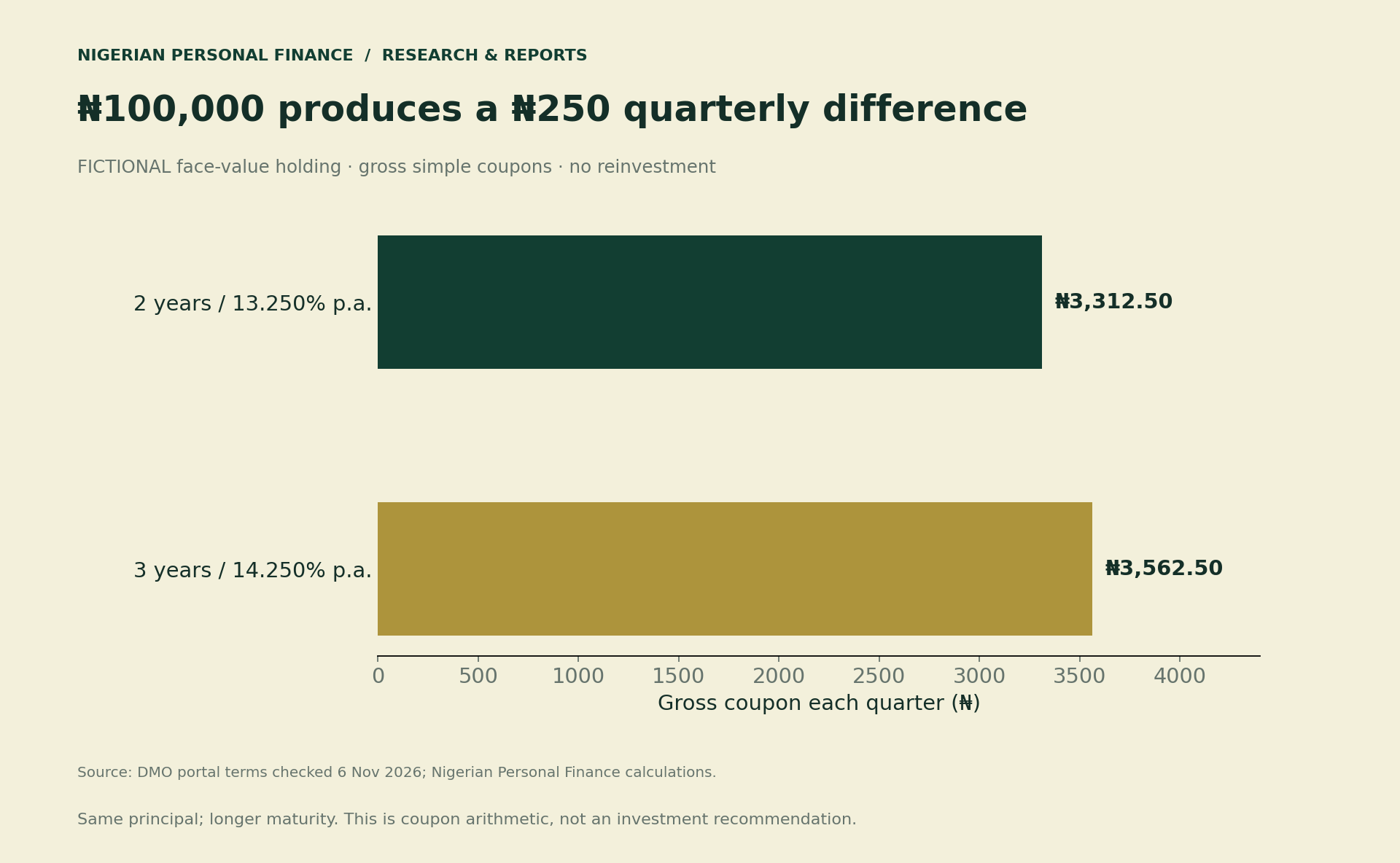
These calculations assume the full face-value holding earns a full scheduled quarter at the stated rate. They exclude reinvestment and any deductions or adjustments. Also, face value and cash paid are different concepts when an investor buys or sells at a secondary-market price.
The ₦250 difference becomes ₦1,000 across four full quarters. Nevertheless, choosing between maturities requires more than comparing that amount. A household may need access to the principal before the longer instrument matures. Write down the purpose of the money and the dates of likely needs before interpreting the rate difference.
Quarterly income does not fund every month on its own
DMO’s follow-up announcement identifies 11 February 2027 as the first interest-payment date. An annual total divided by twelve spreads the arithmetic evenly; the payment schedule does not do that.
For example, the three-year rate produces a simple annual coupon of ₦14,250 on our fictional holding. Dividing by twelve gives a ₦1,187.50 monthly budgeting average. However, that average is not a promise of twelve monthly credits.
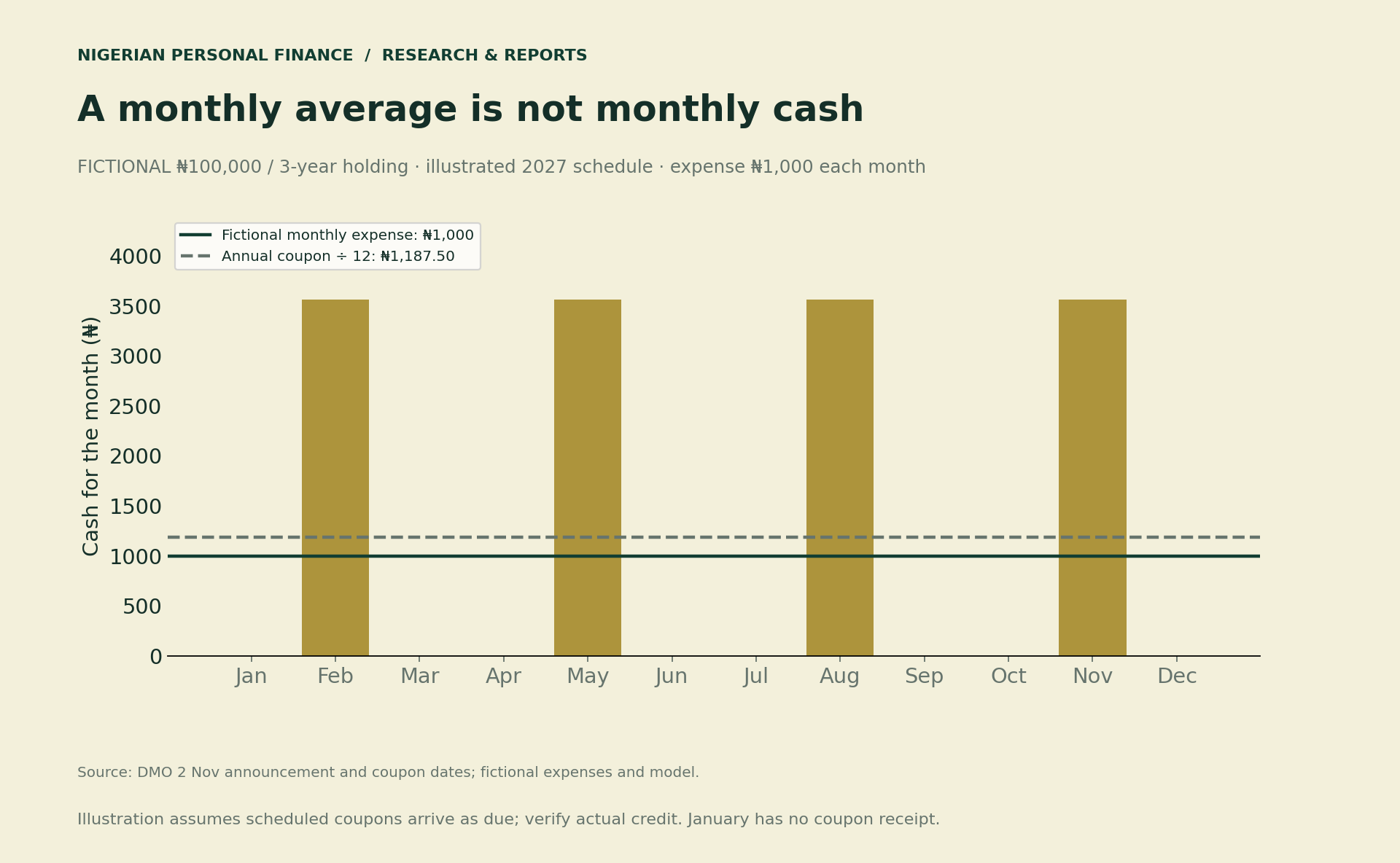
Suppose a household allocates a fictional ₦1,000 each month to a planned expense. January needs money from an existing cash balance or another confirmed source. If February’s coupon arrives as scheduled, the household can assign part of it to later months. It must avoid spending the same receipt twice.
Use a running balance rather than a reassuring average: opening available cash plus confirmed receipts minus planned payments equals closing available cash. Next, carry that closing balance into the following month. Our blank planner leaves inputs empty so the example cannot masquerade as a reader’s own budget. For broader context, see our guide to budgeting for a Nigerian lifestyle.
Compare the holding periods honestly
At the stated rates, eight full quarterly coupons sum to ₦26,500 over two years. Twelve sum to ₦42,750 over three years. These totals exclude the ₦100,000 principal, assume a full holding period and do not include reinvestment.
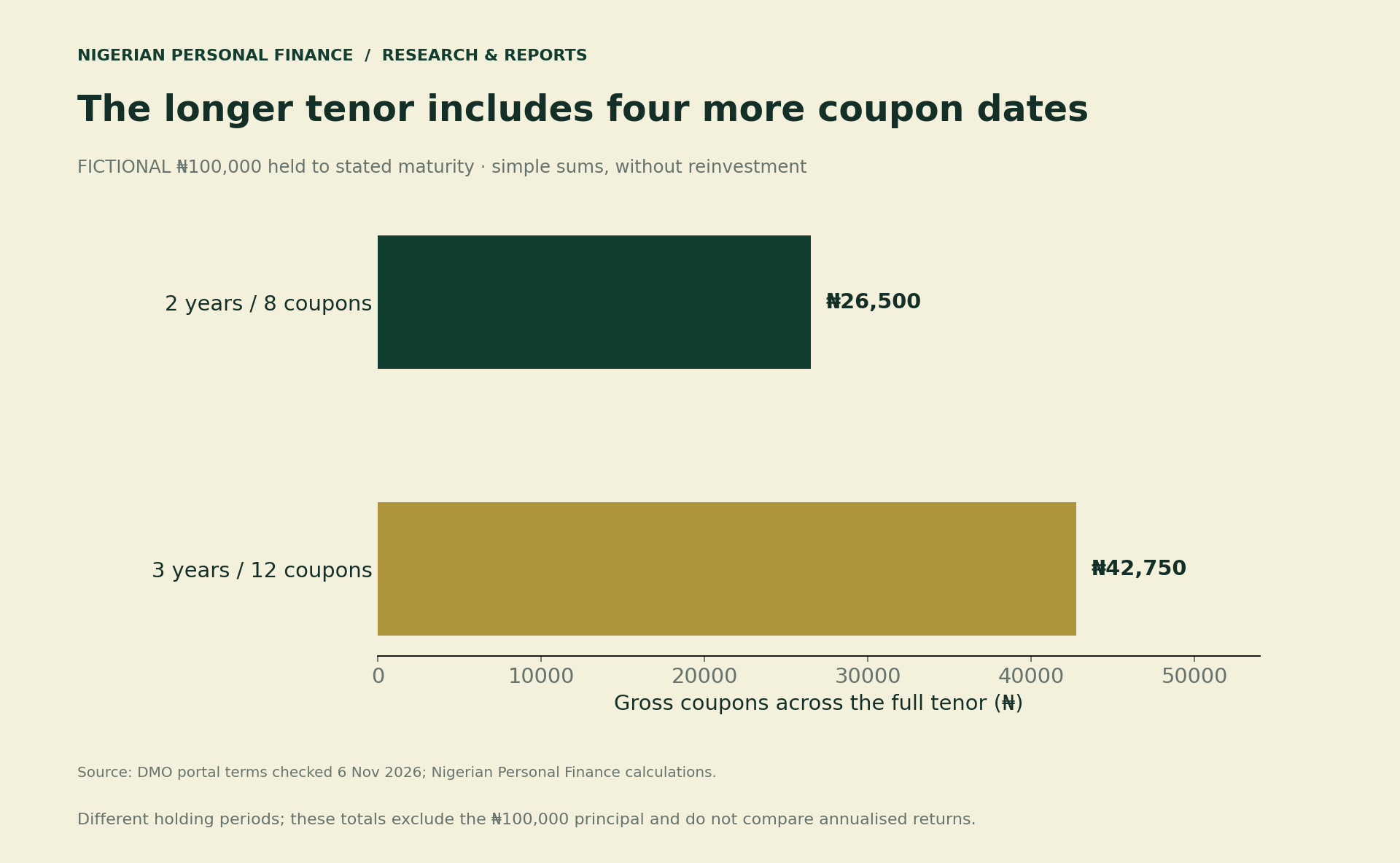
A fair decision record therefore keeps maturity alongside the coupon. It also separates nominal naira income from purchasing power. These charts contain no inflation forecast or estimate of a real return. A larger nominal coupon does not establish that future expenses will grow more slowly.
Your Personalized Financial Plan
Get expert financial advice tailored exclusively to your goals. Receive a custom roadmap in just 1-3 business days.
Get StartedThe minimum is a term, not an affordability test
The same formula scales to other face values. Our downloadable model includes ₦5,000, ₦25,000, ₦100,000 and ₦500,000 examples. These are selected teaching amounts, not allocation targets.
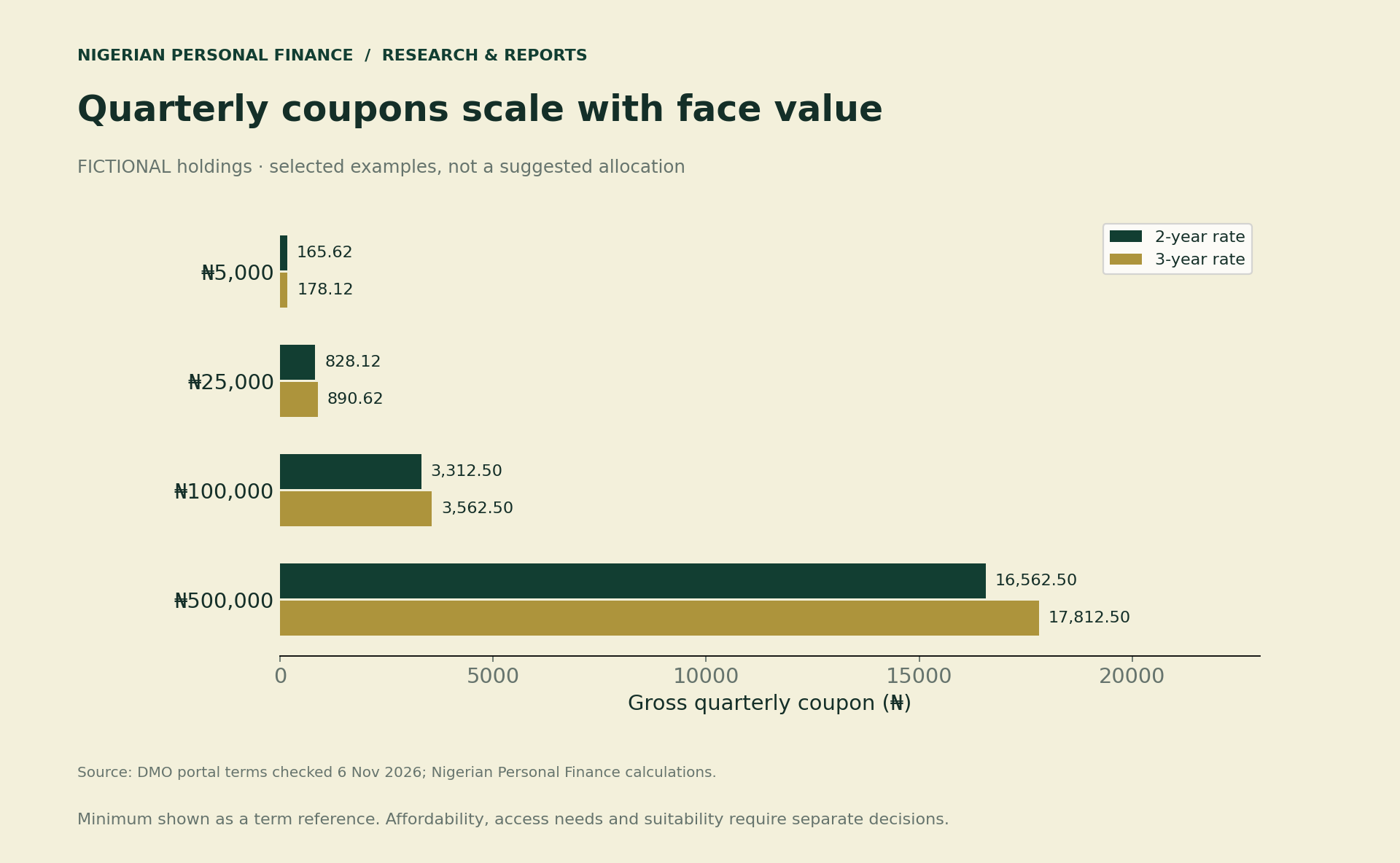
Before considering an amount, distinguish planned commitments from money needed immediately. Our emergency-fund discussion explains why access deserves its own question. Keep any personal balances and account identifiers private when using the worksheet.
Selling early asks a different question
The Nigerian Exchange’s savings-bond information describes secondary-market trading. Trading availability does not tell a reader what price, buyer or settlement time will be available for a particular holding.
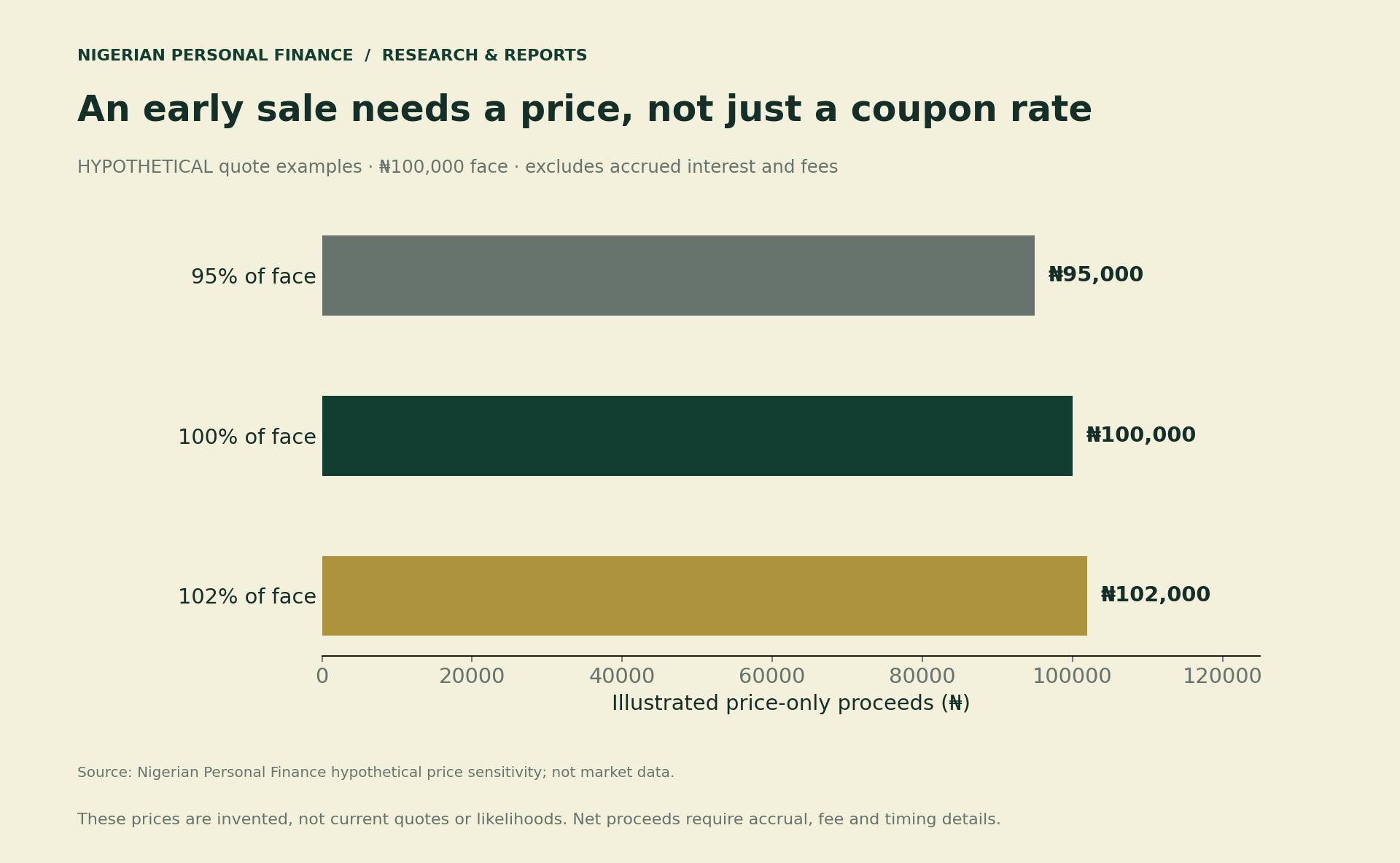
Ask for a dated written quote that states the price convention, accrued-interest treatment, fees, coupon entitlement and expected settlement. Then compare the resulting net cash with the amount originally paid. Do not simply subtract a chart’s price example from face value and call it a complete investment return.
Although the DMO FAQ says primary subscriptions attract no transaction fee, that statement does not establish that every secondary sale or related service is free. Request a written breakdown for the actual route. This article makes no individual tax assessment; confirm any applicable treatment rather than assuming the model is a net receipt.
Turn the calculation into a usable cash plan
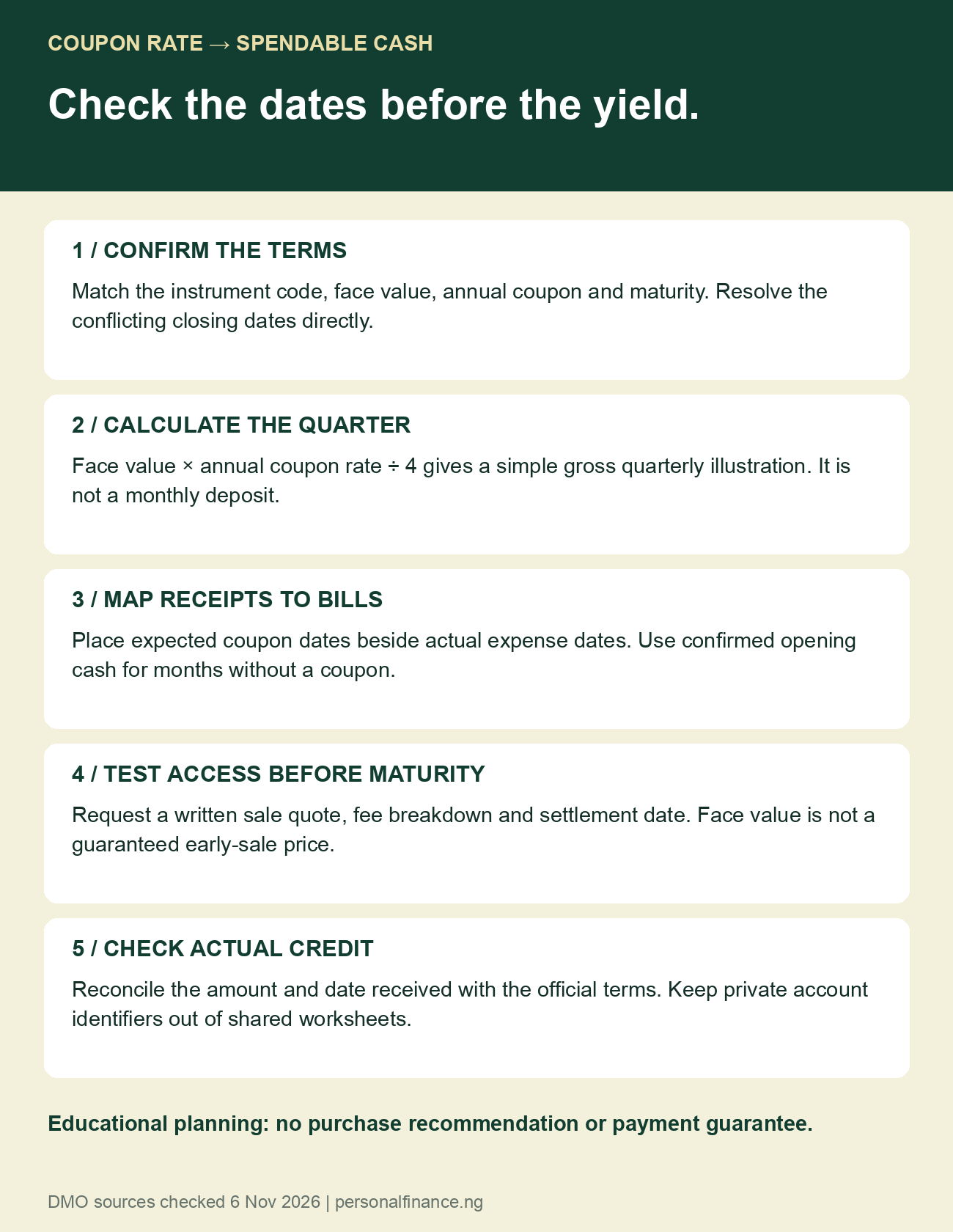
First, verify the instrument and resolve the date conflict. Next, calculate an illustrative coupon using the confirmed face value and rate. Place each expected payment beside the bills it might support. Finally, update the plan when the actual credit arrives; retain a clear distinction between an expectation and money already available.
Download the terms, model and blank tools
- Source-terms extract (CSV): two portal instrument rows, source link and the disputed displayed end date.
- Quarterly coupon model (CSV): eight fictional holding/rate combinations, annual totals, monthly averages and full-tenor sums.
- Blank monthly cash planner (CSV): twelve months with opening cash, confirmed receipts, expenses and closing balance fields.
- Early-sale question sheet (CSV): ten prompts for a dated quote and unresolved points, without private account identifiers.
Methodology and limits
Nigerian Personal Finance checked the DMO portal, its dated public announcement and attached offer artwork on 6 November 2026. We used the portal FAQ and exchange information for general product context. The closing-date displays disagree, so this report does not advertise an active subscription window.
Our editable scripts calculate simple coupons as face value × annual rate ÷ 4. Annual and full-tenor totals use multiplication without compounding. The monthly chart combines stated coupon dates with invented expenses; the sale-price chart uses invented prices. Neither chart forecasts an individual payment, market price, tax result or investment outcome. Verify the final terms and seek appropriately qualified advice for a personal decision.